

A reporter at one of Taiwan’s most widely read news outlets published a fabricated account over the weekend of a city council campaign confrontation, invented by an AI transcription tool she had used to process audio recordings from two campaign events. The story was filed without independent verification, and apparently without proper editorial oversight.
The incident underscores the clear and present risks posed by AI use in Taiwan’s highly commercialized and click-obsessed media space, where ethical breaches and poor professionalism are endemic, and where public trust in the media is sliding to historic lows.
The incident centered on a report by journalist Karen Tshuà (蔡愷恆), who ran a story on April 12 claiming that Yang Chih-yu (楊智伃), a potential candidate for Taipei city council running under the banner of Taiwan’s opposition Kuomintang party, had publicly confronted Hsu Fu (許甫), a city council candidate for the Taiwan People’s Party during a campaign event in the city’s Songshan District, ahead of local elections scheduled for November 2026. In fact, no such confrontation took place. The Liberty Times (自由時報), a major Taiwan daily newspaper with a news website and app, later revised the story and its headline in language that obscured rather than acknowledged the error, and initially stopped short of a public apology.
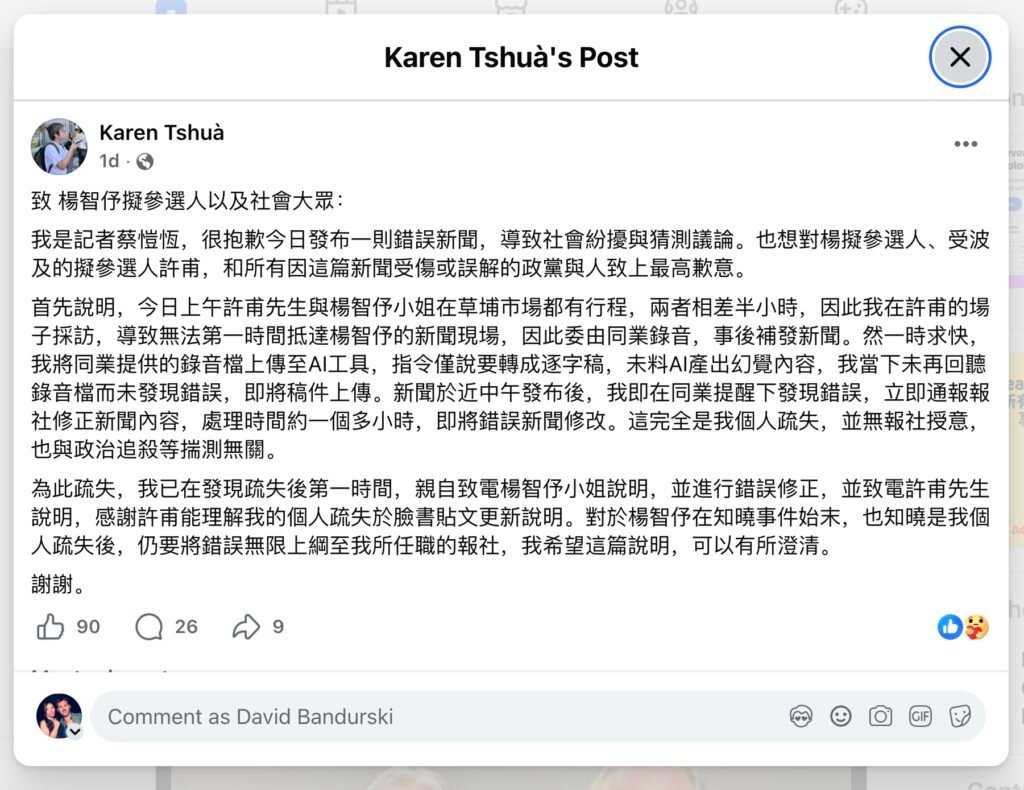
In a Facebook post the same day, Tshuà explained that she had been covering two campaign events simultaneously that morning, and had uploaded audio provided by a colleague to an AI tool with instructions only to transcribe it. She did not re-check the recording before filing. Tshuà was careful to note that her error was about process and carelessness, and not about political motivation — and she attempted to distance her employer from responsibility. “This was entirely my personal failing,” she wrote. “It was not directed by the newspaper, and has nothing to do with speculation [you might be hearing] about political targeting.”
In a brief statement posted to its website on Monday, The Liberty Times acknowledged the April 12 report as erroneous, corrected the story, and expressed regret to both candidates and readers. The post mirrored that of the reporter in putting the news outlet’s blame at arm’s length. “The reporter corrected the news content at the first opportunity and apologized to those involved,” it read. The statement made no mention of AI, offered no explanation of how the fabrication had occurred, and said nothing about the outlet’s policies — if they exist — governing the use of AI tools in reporting.
The outlet did not issue a formal correction notice, a practice typical among professional media in many places in the world, but rare in Taiwan. Among the only outlets to have such a policy is the government-funded Central News Agency (CNA), which issues “correction dispatches” (校正公電) to come clean about inaccuracies. CNA issued one such dispatch back in October, when it quoted in translation from an opinion piece in Time magazine without indicating that it was not news.
In his own response on Facebook to the spurious Liberty Times report, Hsu Fu, who is also known as “Osmar Hsu,” shared a video of his mobile screen as he scrolled through the story. In commentary below the video, the candidate suggested the reporter may have invited more extreme hallucination by feeding the AI audio recordings from two campaign events simultaneously, and may have also prompted the tool to generate conflict for dramatic effect.
But Hsu directed his sharpest criticism at the editors of the paper, which is generally regarded as sympathetic to the country’s ruling Democratic Progressive Party (DPP), saying they should have caught the error before publication. “The Liberty Times‘ internal control mechanisms must have completely broken down to produce such an absurd blunder,” he wrote.
Widely accepted standards of professional journalism generally hold that reporters and their supervisors bear responsibility for accuracy — and that errors must be promptly and transparently corrected. The recent decision at The Liberty Times appeared to be a case of editors hiding behind the reporter, forsaking their own professional obligations. As Hsu bluntly put it: “That takes no responsibility at all.”


