Activity Type: Media Cooperation Agreement

People’s Daily and Thailand’s PRD Sign News Exchange MOU

On July 20, 2026, the People’s Daily signed a memorandum of understanding on media cooperation with Thailand’s Public Relations Department (泰國民聯廳), or PRD, one of three separate media MOUs PRD concluded that day alongside Xinhua News Agency and China Media Group, as part of a package of 15 agreements marking the close of Thai Prime Minister Anutin Charnvirakul’s official visit to China, during which Taiwan was a key flashpoint. PRD Director-General Sudruetai Lertkasem signed the agreements at the Great Hall of the People, witnessed by Anutin and Chinese Premier Li Qiang. According to an Instagram post by NBT World, PRD’s own state-run English-language international television channel, the agreement with the People’s Daily covers “the exchange and reciprocal distribution of original news content and media personnel,” with the stated goal of increasing Chinese audiences’ access to information about Thailand and “fostering mutual understanding.” The China-Thailand joint communiqué issued the same day separately commits both governments to strengthening “media, publishing, and broadcast film cooperation” and to “jointly combat fake news and disinformation.”

Xinhua and National Media Group Sign News Exchange Deal

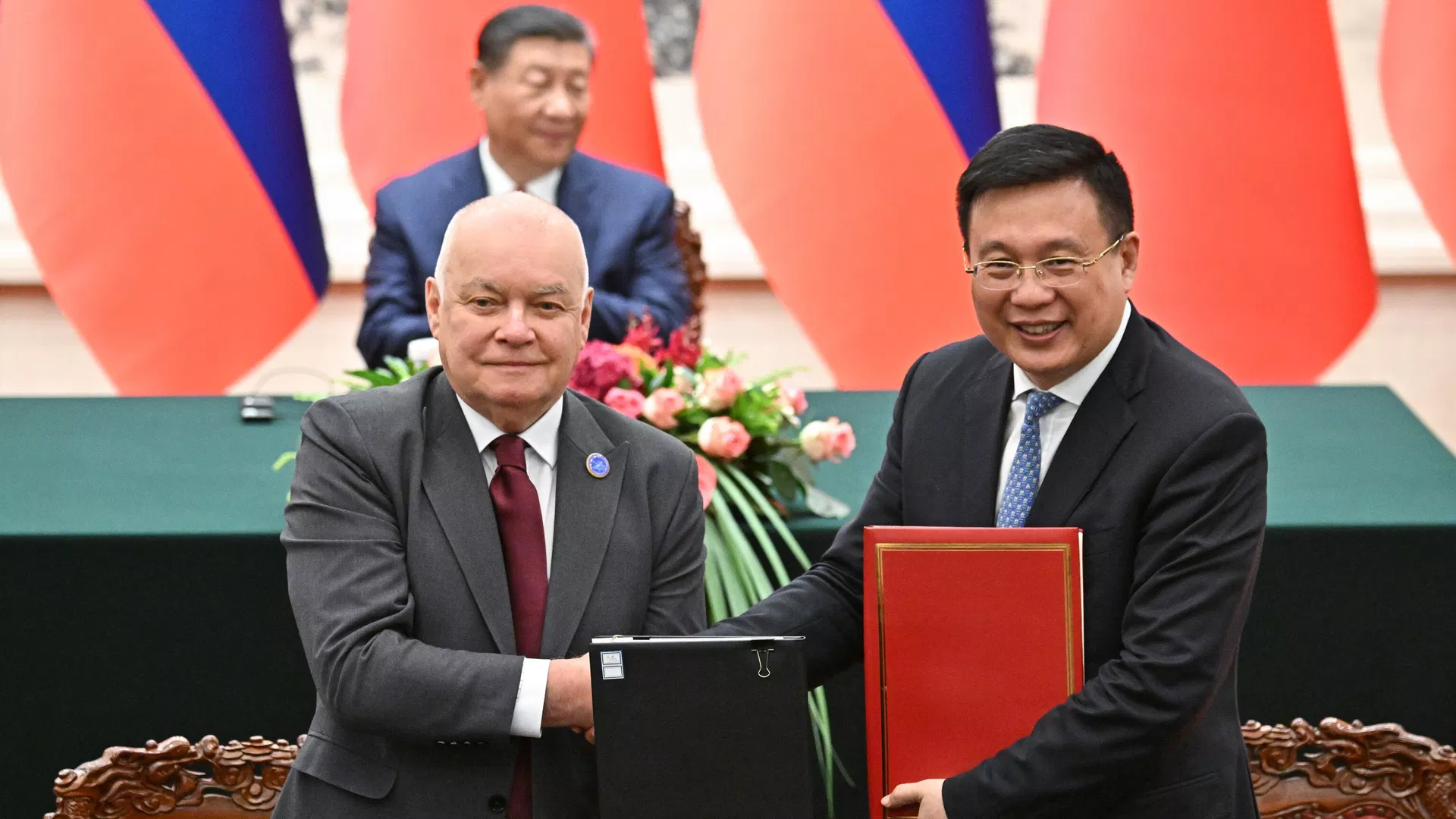
On May 20, 2026, during Russian President Vladimir Putin’s state visit to Beijing, Xinhua News Agency signed a news exchange and cooperation agreement with National Media Group (國家媒體集團), which Chinese state media described as owning multiple major Russian media outlets and handling external-facing information dissemination. According to Xinhua, the agreement covers the exchange of news and information products and mutual visits by personnel between the two sides, aimed at what it called “pragmatic cooperation.” Xinhua News Agency president Fu Hua (傅華) said the agency was ready to work with National Media Group “under the strategic leadership of the two heads of state” to deepen what he called the “comprehensive strategic partnership and coordination between China and Russia in a new era.” National Media Group controls 28 Russian media outlets, including Channel One, Izvestia, and REN TV, and has been under EU sanctions since 2024 for what the bloc described as actively spreading propaganda and disinformation related to Russia’s invasion of Ukraine. The holding is owned by Bank Rossiya and chaired by Alina Kabaeva, who has separately been sanctioned by the EU, UK, and US over her role at the outlet. The agreement was one of four documents Xinhua signed with Russian media that day.

National Media Group and CMG Sign Deal to Deepen SCO Coverage

On May 20, 2026, during Russian President Vladimir Putin’s state visit to Beijing, National Media Group (國家媒體集團) and China Media Group (中央廣播電視總台), or CMG, agreed to expand cooperation on coverage of events related to Russia, China and the Shanghai Cooperation Organization, a China- and Russia-led regional grouping. The two sides also agreed to establish a direct communication mechanism between their editors-in-chief to coordinate coverage of what National Media Group described as “extraordinary and particularly significant events.” National Media Group general director Svetlana Balanova, who is under EU and Swiss sanctions both for her role atop NMG and as head of the Public Council under Roskomnadzor, Russia’s media regulator, credited earlier cooperation with CMG for providing what she called “unprecedented information support” to the Chinese release of the Russian-Chinese co-produced film Red Silk (紅絲綢), formally credited as a Russia-China co-production. Set in 1927 aboard the Trans-Siberian Express amid Soviet-Chinese diplomatic tensions, the film follows a Chinese courier, Wang Lin, and a Soviet agent, Artyom, who are forced into an uneasy alliance to protect a piece of secret intelligence as assassins, defectors, and rival spies close in around them, according to the film’s Chinese distribution listing. The film premiered in Russian theaters on February 20, 2025, under the title Красный шёлк, and ranked second in Russian and CIS box office grosses for the week of February 27–March 2, 2025, trailing only The Poet, a musical biographical drama about Russian poet Alexander Pushkin. It opened in mainland Chinese theaters on September 6, 2025, roughly seven months after its Russian debut.

Xinhua and Gazprom-Media Sign Training Memorandum

On May 20, 2026, during Russian President Vladimir Putin’s state visit to Beijing, Xinhua News Agency and Gazprom-Media Holding (俄羅斯天然氣傳媒控股股份公司), one of Russia’s largest media conglomerates spanning television, radio, print and digital platforms, signed a memorandum on vocational and professional training for media personnel. The agreement provides for a systematic exchange of experience between journalists, editors and media specialists from the two countries, including joint educational programs, seminars, internships and mutual participation in conferences. Gazprom-Media chief executive Aleksandr Zharov said the partnership combined what he called Xinhua’s “unique global news gathering network” — an echo of how Xinhua describes itself on its own official site as operating a “global-coverage news information gathering network” (覆蓋全球的新聞信息採集網絡) — with the holding’s production and marketing expertise. The memorandum builds on an earlier content-sharing agreement between the two organizations signed in 2025, during Chinese President Xi Jinping’s visit to Russia.

Xinhua and TASS Mark 70 Years of Cooperation

On May 20, 2026, during Russian President Vladimir Putin’s state visit to Beijing, Xinhua News Agency signed a memorandum with Russia’s state news agency TASS (塔斯社) agreeing to hold a series of activities marking the 70th anniversary of their cooperative relationship. The agreement was one of four documents signed between Xinhua and Russian media that day, all included among the official list of outcome documents from the China-Russia heads-of-state meeting. Xinhua described the memorandum as intended to continue what it called “traditional friendship” (傳統友誼) between the two agencies and to support “professional exchange” (專業交流), according to its own account of the signing. TASS is Russia’s principal state news agency and one of the country’s oldest news organizations.

CMG and VGTRK Sign Documentary Cooperation Deal

On May 20, 2026, during Russian President Vladimir Putin’s state visit to Beijing, China Media Group (中央廣播電視總台) president Shen Haixiong (慎海雄) and All-Russia State Television and Radio Broadcasting Company (全俄國家電視廣播公司) director general Oleg Dobrodeyev signed an agreement to deepen cooperation on documentaries and feature reporting, witnessed by Chinese President Xi Jinping and Putin. According to Chinese state media, the agreement covers news coverage, program production, content exchange, joint events and personnel exchange between the two broadcasters, part of a wider package of Russia-China agreements signed that day spanning science, education, film, and youth exchange. The deal follows a similar memorandum VGTRK signed with CMG during Chinese President Xi Jinping’s state visit to Russia in May 2025, part of a broader pattern in which Russian and Chinese state and private media outlets have signed at least 14 partnership agreements since 2022, according to the Institute for the Study of War, a non-partisan US-based think tank. All-Russia State Television and Radio Broadcasting Company, known by its Russian acronym VGTRK, is Russia’s state-owned television and radio broadcaster.

Xinhua and Rossiya Segodnya Agree to Hold SCO Forum

On May 20, 2026, during Russian President Vladimir Putin’s state visit to Beijing, Xinhua News Agency signed a memorandum with Rossiya Segodnya (今日俄羅斯國際通訊社), Russia’s principal state multimedia news agency for foreign audiences, agreeing to jointly hold the 2026 Shanghai Cooperation Organization Expert Forum. According to Xinhua’s account of the agreement, the memorandum is meant to strengthen dialogue among think tank experts from Shanghai Cooperation Organization member states and advance cooperation in the information field. The agreement, which specifically mentions exchange of “professional experience” (专业经验交流) among the think tank experts, was one of four documents signed between Xinhua and Russian media that day, all included among the official outcome documents of the China-Russia heads-of-state meeting. According to Sputnik, Xinhua and Rossiya Segodnya had previously signed a memorandum to hold a BRICS Expert Forum during Putin’s May 2024 state visit to Beijing.

ON Media and CMG Sign Cooperation Agreement

On November 3, 2025, during Russian Prime Minister Mikhail Mishustin’s visit to China, MTS Media, the Russian entertainment holding that operates the KION streaming platform and later rebranded as ON Media, and China Media Group (中央廣播電視總台), or CMG, signed a cooperation agreement. The agreement provided for an exchange of expertise and best media practices between the two companies, and for the joint development of special projects dedicated to strengthening Russian-Chinese cooperation and “friendship,” a term the CCP frequently invokes to frame bilateral ties with select partner states. MTS Media general director Sofya Mitrofanova said the agreement with CMG opened “an entirely new level” of the holding’s presence in the international media market. Before leading MTS Media, Mitrofanova held senior roles at Gazprom-Media Holding, including as director of digital transformation, and at the streaming platforms Ivi, Okko, and Premier.

National Media Group and China Daily Sign Content Deal

On May 20, 2026, during Russian President Vladimir Putin’s state visit to Beijing, National Media Group (國家媒體集團) signed a cooperation agreement with China Daily (中國日報), the CCP’s English-language state newspaper. According to National Media Group, the agreement provides for the exchange of news content and exclusive materials, along with editorial coordination on promoting shared coverage topics. The two sides also agreed to jointly promote the English-language edition of Izvestia, a National Media Group-owned newspaper that the European Commission suspended from broadcasting in the EU in May 2024 over its role in supporting and justifying Russia’s war against Ukraine, to international audiences through China Daily‘s platforms. National Media Group general director Svetlana Balanova, who is personally sanctioned by the EU and Switzerland in her capacity as head of NMG and of the Public Council under Roskomnadzor, Russia’s media regulator, said the agreement would help the two organizations “create modern standards for working with information in a digital environment” for international audiences.