Fairfax Media was a major Australian media conglomerate that operated newspapers, magazines, radio stations, and digital properties across Australia and New Zealand from 1841 until its acquisition by Nine Entertainment Co. in December 2018. Founded when John Fairfax purchased The Sydney Morning Herald, the company expanded to control flagship publications including The Age and The Australian Financial Review. Despite its historical significance in Australian journalism, Fairfax faced mounting financial pressures in the digital era, implementing widespread staff cuts and transitioning to paywalls before ultimately losing its independence. The company’s willingness to engage in media partnerships with Chinese state entities, including signing cooperation agreements with China Daily and China Radio International in 2016, reflected broader industry trends of seeking revenue streams amid declining traditional media revenues.
Prothom Alo is Bangladesh’s largest-circulation Bengali-language daily newspaper, founded November 4, 1998, and published from Dhaka by Transcom Group’s Mediastar Ltd. The newspaper claims daily readership of 6.6 million for its print edition and 7.6 million across all platforms, with its online portal described on its X profile as “the most visited Bengali website in the world.” Prothom Alo has distinguished itself through investigative reporting on acid attacks, violence against women, and campaigns against drugs and religious terrorism. The publication has faced government pressure, including the 2021 detention of senior reporter Rozina Islam under the Official Secrets Act and a 2007 cartoon controversy that resulted in a supplement ban. Sister concerns include ABC Radio FM 89.2, Prothoma Prokashon publishing house, and several magazines covering science, politics, and youth topics. The newspaper organizes Bangladesh’s Mathematics Olympiad and won the 2025 “Best in South Asia” award from the International News Media Association.
The Daily Star is Bangladesh’s largest circulating English-language daily newspaper, founded by Syed Mohammad Ali on January 14, 1991, as the country transitioned to parliamentary democracy. As of 2025, Mahfuz Anam served as editor and publisher, with the newspaper owned by Mediaworld Limited, where Transcom Group holds major shares. The BBC described it as having a “reputation for journalistic integrity and liberal and progressive views – a kind of Bangladeshi New York Times.” The publication gained popularity for outspoken coverage of politics, corruption, and foreign policy. The newspaper has faced government pressure, including suspended advertisements in 2015 and website blocking in 2018 after reporting an extrajudicial killing. Controversies include Anam’s 2016 admission on ATN News of publishing military intelligence-fed stories during 2007-2008 and Executive Editor Syed Ashfaqul Haque’s February 2024 jailing on child abuse charges following domestic worker Preeti Urang’s death.
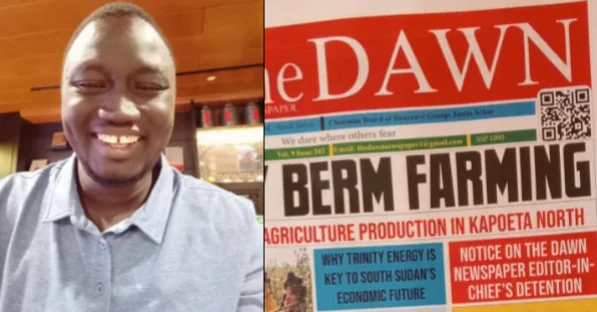
The Dawn, an English-language daily newspaper founded in 2016 and based in Juba, South Sudan’s capital, is described as “largely perceived as a pro-government newspaper” by media analysts. The publication, led by editor-in-chief Emmanuel Monychol Akop (艾曼努爾·蒙尼喬·阿科普), regularly features content from Chinese state media sources, particularly Xinhua News Agency (新華社). Recent examples include Xinhua’s December 15, 2024 commentary titled “China’s pro-growth policies deliver comfort in turbulent world,” which reported China’s transition to “moderately loose” monetary policy. Another featured piece, “CEWC a blueprint for China’s sustainable and inclusive growth in 2025,” described the Central Economic Work Conference as setting “the economic tone for 2025 amidst global uncertainties.” Sports columnist Akuot Goor contributes regularly to the newspaper. In December 2024, the newspaper’s Editor-in-Chief Emmanuel Monychol Akop was detained by suspected National Security Service officers, raising concerns about press freedom in the country.
Berliner Zeitung is a daily German newspaper first published on May 21, 1945, as the first post-World War II daily in Berlin. Initially established under Soviet control in East Berlin, it became the largest newspaper in the German Democratic Republic during the Cold War era. After German reunification, ownership changed multiple times through Gruner+Jahr and Robert Maxwell (1990), Holtzbrinck (2002), Mecom Group (2005), DuMont (2009), and finally to entrepreneurs Silke and Holger Friedrich in September 2019. The paper faced controversy when Holger Friedrich acknowledged working as an informant for the Stasi under the codename “Peter Bernstein” from December 1987 to February 1989. In 2023, Friedrich further violated journalistic source protection by informing Springer CEO Mathias Döpfner about leaked information from Julian Reichelt. In October 2024, the newspaper entered into a cooperation agreement with China Media Group (中央廣播電視總台), launching “The Chinese Perspective” column featuring content from Chinese state media correspondents.
Chongqing Jiazuo Film and Culture Media (重慶佳左影視文化傳媒有限公司) is a privately held Chongqing company that specializes in film and television production and distribution and that distributes Chinese programming in Latin America under state guidance. Founded in June 2017 with a registered capital of 5 million yuan, it is 80 percent owned by its founder and general manager, Zuo Yue (左越), and 20 percent by Yin Boyu (尹博宇). Although privately held, the company has worked closely with state bodies since its founding. It set up a Latin American subsidiary in Peru in 2018 under the guidance of Chongqing’s culture commission. In December 2022, it joined that commission, Sichuan International Studies University (四川外國語大學) and the AI company iFlytek (科大訊飛) in co-founding a film translation center. A state media report said the center was meant to “promote the construction” of the Western China International Communication Organization (西部國際傳播中心), which formally launched in August 2023. Jiazuo was thus a founding partner in infrastructure built for Chongqing’s external propaganda apparatus, which suggests close cooperation with both the city’s international communication center and Chongqing’s leadership. The company has participated in “China Time Slot” (中國時段) initiatives in Peru, Colombia and Mexico, which were carried out “under the auspices of the National Radio and Television Administration and the Chongqing Municipal People’s Government.” The project was selected in 2023 among the first demonstration projects of the “TV China Theater” (電視中國劇場) program run by the National Radio and Television Administration, or NRTA, which places Chinese series in fixed time slots on foreign broadcasters. The NRTA, a ministry-level agency controlled by the Central Propaganda Department of the Chinese Communist Party, has promoted international cooperation in radio, television and online audiovisual content. In November 2024, Jiazuo signed a trilateral cooperation agreement with Peru’s Willax TV and Classic Media China Internacional SAC(經典傳媒中國國際有限公司). The company claims to have opened such slots in more than ten Latin American countries. Zuo was named to the NRTA’s 2023 leading talent program for international communication. In October 2025, she presented the company’s Latin American work at the launch of a research workstation in Chongqing. The event was guided by the propaganda office of the Chongqing CCP Committee and co-organized by the Western China International Communication Organization, whose chairman, Zhao Wujun (趙武君), spoke on the international communication of the Party’s “innovative theory.”