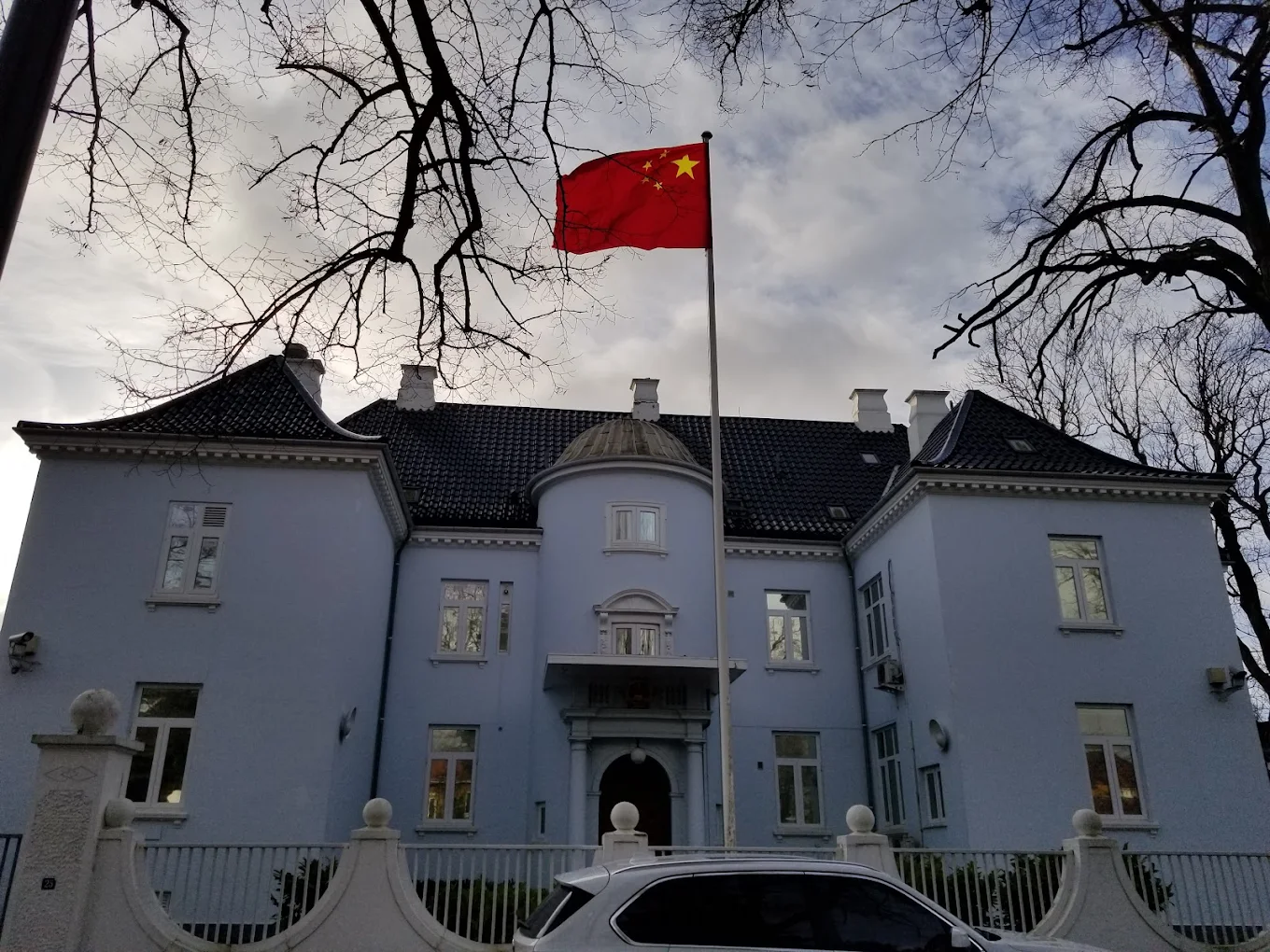
The Embassy of the People’s Republic of China in Romania is China’s chief diplomatic mission to Romania, located in Bucharest. The office opened in 1949, after the two countries officially established diplomatic relations. The embassy handles visas and casual services, trade promotion, government outreach, and public diplomacy. In June 2026, the embassy accused right-wing Liberal Party (PNL) deputy Alexandru Muraru of interference in China’s internal affairs after he came back from a visit to Taiwan and in an article, praised the democratic system in the country, which China claims as its own territory.
The Chinese Embassy in Kyrgyzstan (中華人民共和國駐吉爾吉斯共和國大使館) is China’s diplomatic mission in Bishkek, representing the Ministry of Foreign Affairs. China and Kyrgyzstan established diplomatic relations on January 5, 1992, shortly after Kyrgyzstan’s independence from the Soviet Union, and China’s first ambassador presented his credentials that August. The embassy has taken part in bilateral education and media cooperation events in Kyrgyzstan, including through public remarks by its counselors at ceremonies such as the November 2024 unveiling of the Ban-Mo Institute at Kyrgyz State Technical University and the 2026 China-Kyrgyzstan Media Cooperation Forum. Kyrgyzstan also maintains a consulate-general presence for China in Osh, though that post has been temporarily closed since February 2019, with its functions transferred to the Bishkek embassy.
The Embassy of the People’s Republic of China in Slovakia (中華人民共和國駐斯洛伐克共和國大使館) is China’s chief diplomatic mission to the Slovak Republic, located in Bratislava. China first established diplomatic relations with the former Czechoslovakia on October 6, 1949. When Slovakia became an independent state on January 1, 1993, China immediately recognized the Slovak Republic and established relations at the ambassadorial level. In November 2024, the two countries elevated ties to a strategic partnership. Slovakia has become China’s fourth-largest trading partner and largest source of imports in Central and Eastern Europe. Chinese ambassadors have regularly published op-eds in outlets described as fringe or alternative Slovak media, including Nové Slovo and Slovenské Národné Noviny. In 2025, for example, Ambassador Cai Ge published an opinion piece in Nové Slovo arguing that Taiwan is part of China and that reunification is “unstoppable.”
The Embassy of the People’s Republic of China in Georgia (中華人民共和國駐格魯吉亞大使館) is China’s chief diplomatic mission to Georgia, located in Tbilisi. The embassy handles visas and consular services and promotes trade, investment, and cultural exchange between the two countries. China was among the first countries to establish formal diplomatic relations with Georgia following its independence from the Soviet Union, on June 9, 1992. In June 2026, the two countries upgraded ties to a “comprehensive strategic partnership,” building on a strategic partnership established in 2023. In May 2024, Georgia’s parliament passed a “foreign agents” law requiring NGOs and media outlets that receive more than 20 percent of their funding from abroad to register as serving foreign interests. The law triggered mass protests in Tbilisi and was condemned by the EU as a threat to Georgia’s democratic path. The Chinese ambassador said the law was “a matter of domestic politics” and that China’s non-interference reflected respect for Georgian sovereignty. The Digital Forensic Research Lab later found that these comments were amplified across pro-government Facebook and Telegram pages as part of a broader campaign framing China as more respectful of Georgian sovereignty than the US and EU.
The Embassy of the People’s Republic of China in Denmark is China’s chief diplomatic mission to the Kingdom of Denmark, located in Copenhagen. China and Denmark established diplomatic relations on January 9, 1950, making Denmark the second country to establish diplomatic relations with the People’s Republic of China following its establishment on October 1, 1949. China is Denmark’s largest Asian trading partner, with around 500 Danish companies operating business in China. In late 2025, the embassy exerted its diplomatic power to pressure the Danish newspaper Berlingske after reporting that the Chinese military modernization may be a way to reunify Taiwan during the 80th anniversary military parade.
The Chinese Embassy in Cyprus is the diplomatic mission of the People’s Republic of China in Nicosia, Cyprus, established following diplomatic relations on December 14, 1971. In 2021, the two countries upgraded their relationship to a strategic partnership. The year before, in 2020, the Chinese embassy became the focus of diplomatic rivalry as China accused the United States of intimidating Cyprus and other allies by pressing them to join the “Clean Network” initiative, which targeted Chinese 5G technology firms over data privacy and security concerns. In August 2022, the embassy raised eyebrows by issuing a statement comparing China’s claim over Taiwan to Cyprus’ claim over its northern region, declaring that “neither China nor Cyprus is entirely reunified” and that national unity is a shared concern between the two countries. This resurfacing of the so-called “One China, One Cyprus” principle sparked dissatisfaction among Turkish Cypriots, as it rejected the sovereignty of the Turkish Republic of Northern Cyprus (TRNC). Investigation by Lingua Sinica suggests that the Chinese Embassy in Cyprus operates the Chinese and Cypriots Friendship Promotion Association (CCFPA) and several other entities in the country as front organizations. The CCFPA’s affiliated social media accounts almost exclusively retweet content from China’s Ambassador to Cyprus — suggesting the purportedly nongovernmental organization fostering China-Cyprus business collaboration is actually an embassy-controlled entity.
The Embassy of the People’s Republic of China in the Republic of Ghana (中華人民共和國駐加納共和國大使館) is the primary diplomatic mission representing Beijing’s interests in Accra. Following the establishment of diplomatic relations in 1960 and their restoration in 1972, the embassy has overseen the elevation of bilateral ties to a “Strategic Partnership” as of 2024. The mission actively coordinates with local groups like the Ghana–China Friendship Association (加納—中國友好協會) to promote “friendship” (友好)—a term in CCP official discourse that generally entails the accommodating of China’s interests in relationships. The embassy’s economic and commercial office manages significant infrastructure and energy projects—such as the Bui Hydroelectric Power Station and the $2 billion Sinohydro bauxite-for-infrastructure deal—ensuring that local development aligns with Beijing’s broader strategic objectives in West Africa.
The Embassy of the People’s Republic of China in Senegal is China’s chief diplomatic mission to the Republic of Senegal and the Republic of The Gambia, located in Dakar. The mission’s origins trace to the establishment of diplomatic relations between the People’s Republic of China and Senegal on December 7, 1971, when Senegal recognized the People’s Republic of China, positioning it among the early West African nations to establish diplomatic ties with the People’s Republic of China during the Cold War era. The embassy is currently located at Rue 18 Prolongée, Fann Residence in Dakar, Senegal. The embassy’s consular operations extend to The Gambia, where consular services, including visa processing, are administered through the Senegal office. The diplomatic team includes counsellors responsible for Political Affairs and Economic and Commercial Affairs, operating under China’s Ministry of Foreign Affairs (外交部). For visa applications, the embassy operates a dedicated China Visa Application Center in Dakar that processes documentation for both countries. The embassy maintains official communication channels through its website and emergency consular hotline services for Chinese nationals in both countries, while actively engaging in public diplomacy and media diplomacy through networking with local media groups and hosting training programs and official visits.
The Chinese Embassy in Bangladesh serves as China’s official diplomatic mission to the People’s Republic of Bangladesh under the Ministry of Foreign Affairs (外交部). The embassy claims to be dedicated to promoting bilateral cooperation and providing services to Chinese nationals in Bangladesh. Since establishing diplomatic relations in 1975, the embassy emphasizes that China has become Bangladesh’s “largest trading partner” and highlights growing cooperation under the Belt and Road Initiative (一帶一路 ). The embassy maintains active engagement with Bangladeshi media and government officials.