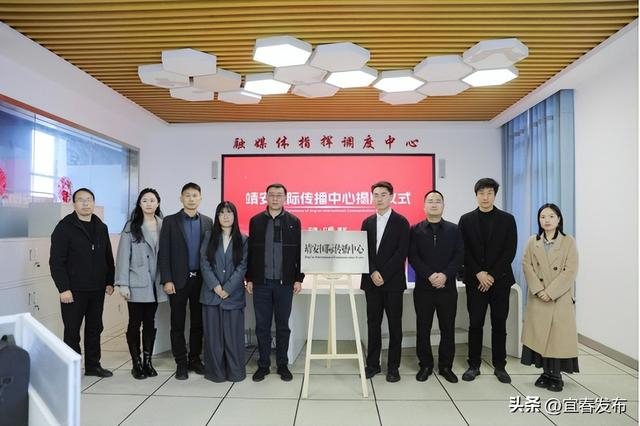
This week, the city of Yichun in China’s southern Jiangxi province announced the opening of its third international communication center — a special office dedicated to promoting the local image to the world and responding to Xi Jinping’s call to “tell China’s story well.” The office, which promises to showcase “Yichun’s charm,” is the latest manifestation of a far-reaching nationwide effort to build China’s “discourse power.” But it might also be a symptom that begs a serious question: Has Xi Jinping’s sprawling domestic campaign for global influence spread itself too thin?
International communication centers, or ICCs, are sprouting across China like mushrooms after the rain. According to some estimates, more than 200 such centers now operate nationwide, including 29 at the provincial level and, increasingly, at the city and county levels. Jing’an County’s new center — Yichun’s third — boasts somewhat unaccountably that its overseas social media platforms have attracted followers from over 70 countries and regions, with a reach exceeding 30 million people. This sounds more like bluster for the sake of political point-taking close to home than a realistic assessment of impact.
The center says it will “deepen local characteristics, shape communication brands,” and push content bearing “Chinese temperament, Jiangxi style, Yichun charm, and Jing’an characteristics” to the world. But is anyone in Yichun thinking about, well, the audience?
Whatever the case, this push locally to amplify China’s voice internationally has intensified dramatically during the past five years. Since the Chinese Communist Party first conceived a soft power push nearly two decades ago under Hu Jintao, China’s leadership has obsessed over achieving greater global influence. Central to this effort has been developing “discourse power” — huayuquan (话语权) — commensurate with China’s comprehensive national power.
Under Xi, external propaganda has since August 2013 been combined with the softer-sounding notion of “telling China’s story well,” while framed toward Party officials in language redolent of the Cultural Revolution as a global “public opinion struggle.” By May 2021, speaking at a Politburo study session, Xi stated clearly that international discourse power was essential to creating “a favorable external public opinion environment for our country’s reform, development, and stability.”
Xi frames this as addressing what he calls the “third affliction” — the “suffering of criticism” from Western discourse hegemony, following Mao’s defeat of foreign aggression and Deng’s victory over poverty. In this worldview, the CCP’s legitimacy cannot be secured at home without dominance in the global information space.
Since 2018 Xi’s approach to this goal of greater “discourse power” has been a strategy that we have called at CMP “Centralization+” — essentially the idea that central-level propaganda resources like China Media Group, China Daily and Xinhua must be augmented by leveraging the strength of local and regional media groups and other actors. The strategy employs centralized messaging control while distributing operational capacity across provincial, city, and county-level actors — the most prominent of these being so-called international communication centers (国际传播中心). These local centers launch branded online platforms as well as social media accounts on Facebook, YouTube, Instagram, and X, generally with zero visibility about their state-run identity, flooding information spaces with content tailored to specific regions and languages.
In some cases, these centers can be well-resourced and effective. Clear examples can be found particularly along China’s southern border, where a handful of provincial-level ICCs are focusing their energy on Southeast Asia. These include the Guangxi International Communication Center, which aims to “tell the story of China and Guangxi to the outside world, and serve to build a closer China-ASEAN community with a shared future,” and the Yunnan South Asia and Southeast Asia ICC, which held at least eight international events between July and November this year (one drawing more than 500 participants from 110 countries).
But Yichun’s third ICC demonstrates how, when centralized ambition meets local implementation, the results can seem comically out of proportion. The Jing’an International Communication Center (靖安国际传播中心), which according to the official release will be “led by the Jing’an County Propaganda Office and operated by the Jing’an County Convergence Media Center,” promises to amplify “Jing’an’s positive energy.” But the tiny office, with its shiny new signboard, seems a caricature of the grandiose goals set out by Xi Jinping during a Politburo study session in late 2013, when he spoke of “strengthening the capacity for international communication and carefully constructing an external discourse system.”
When hundreds upon hundreds of counties across China each have their own international communication center taking to Facebook and Instagram and boasting millions of global fans from “England, France, Italy, Hong Kong, Macau and Taiwan,” who are they really communicating to? And who are they kidding?