Telling China’s Story, One Bottle at a Time
Meeting in Beijing last week, China’s annual political gathering, the “Two Sessions,” introduced plans for the country’s economy and society over the coming year. Technologies like AI were a clear focus in the premier’s government work report. But not all of the gadgets taking center stage in media coverage were so high-tech. Enter the vintage hot water bottle.
On March 12, as the annual plenary meetings of the country’s top legislative and advisory bodies concluded, the Ningbo Daily published a story in which reporter Cheng Liangtian (成良田) described becoming curious about the apparently long-used hot water bottles passed out at the conference. A staff member explained, according to the report, that the National People’s Congress “has always emphasized thriftiness.” The reporter then discovered that the model, now discontinued, had been manufactured three decades ago.
Cheng concluded by drawing a not-so-journalistic link between the humble vessel and the mystique of Chinese Communist Party power: “Through an old hot water bottle, one glimpses the spirit of diligence and frugality that defines a great party,” he wrote.
What can explain such a strange fuss over water bottles? And why is the Ningbo Daily reporter getting so warmed up about this oddball topic?
With this month’s political meetings touching on issues with the potential to unsettle — unemployment, sluggish consumer spending, a flagging economy — focusing on the minutiae of thrifty housekeeping can serve as an effective distraction. Or so the authorities hope. China’s economic outlook is far from optimistic. The GDP growth target set at this year’s Two Sessions was 4.5 to 5 percent — the lowest in 35 years. And as early as January, Cai Qi (蔡奇), one of the country’s top leaders, instructed propaganda officials to “place economic publicity in a position of importance” and tighten “guidance over public sentiment.”
Small diversions have long served larger propaganda goals in China. In his 2018 book China’s Digital Nationalism, Florian Schneider, a professor at Leiden University who studies political communication in the PRC, describes how the authorities treat China’s media networks as an “info-web” — using their central position within it to inject officially approved “symbols and statements into discourses about the nation, its leaders, and their sovereignty.” Journalists for state media in China learn too that one of their most critical roles is to help create this symbolic world, at the expense of reporting facts. In this system of meaning creation, the battered hot water bottle can be a perfectly serviceable tool.
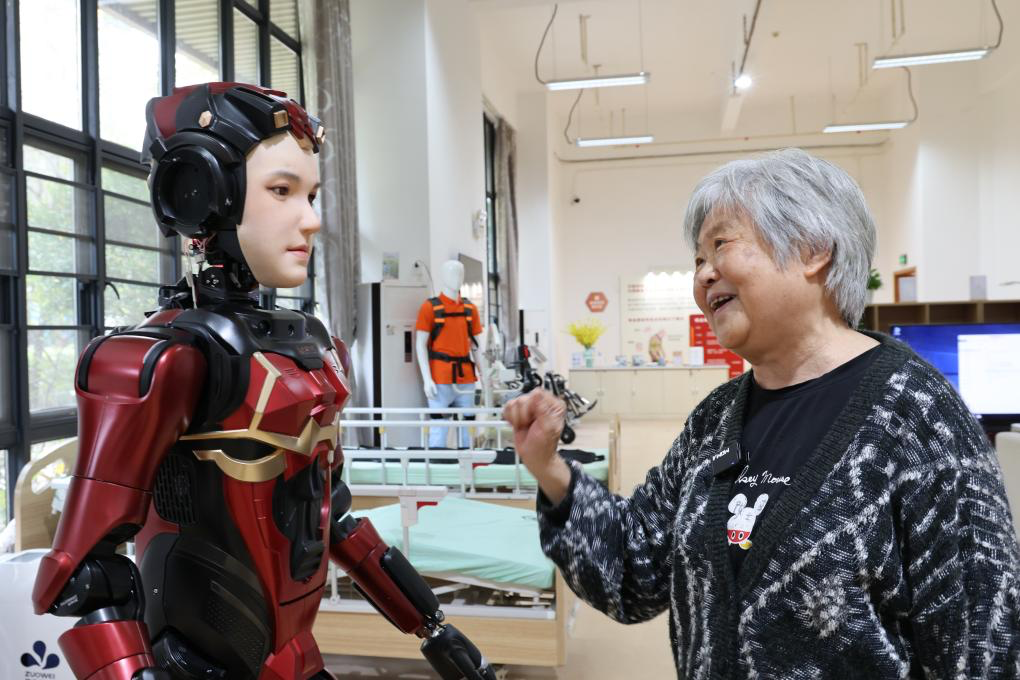
Hot water bottles at the NPC are a minor but telling case in point, one of many such non-news diversions communicated during the course of the meetings — including the ubiquitous AI robot, a symbol of the country’s tech dominance and ambition. The props invite the public to celebrate frugality as an imagined virtue of the CCP leadership, while turning their gaze away from real social and economic challenges.
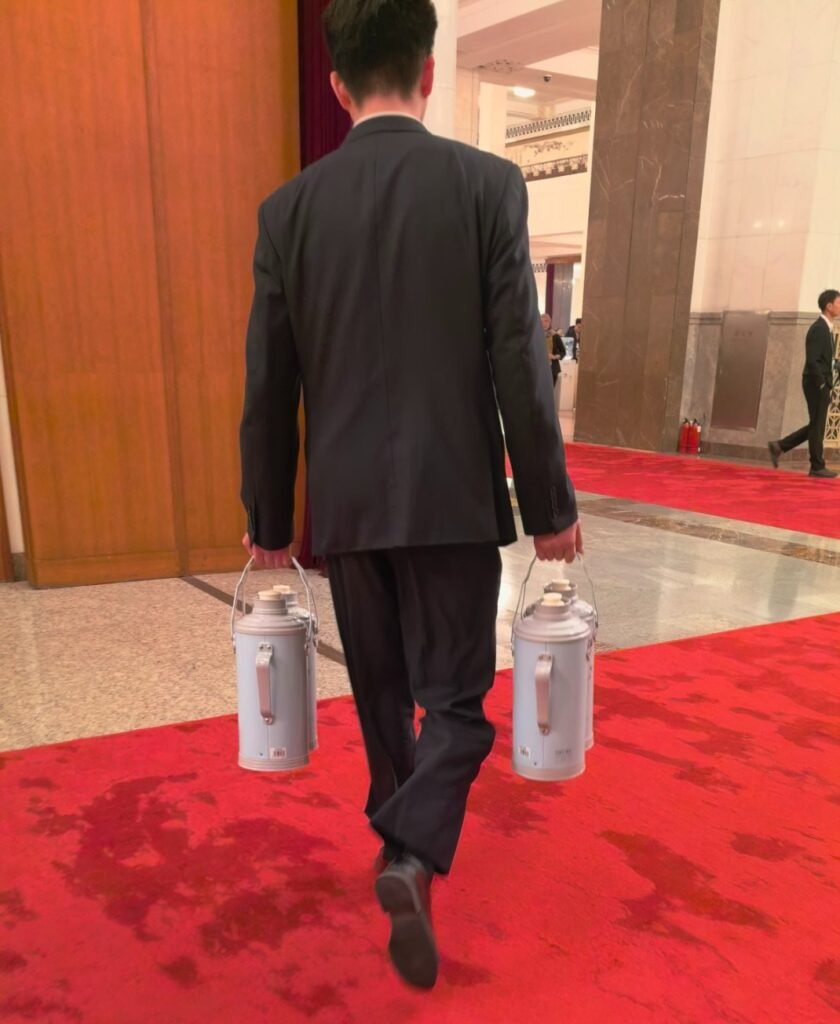
The story quickly went viral. The hashtag “The Great Hall of the People’s Hot Water Bottle Has Been Used for 30 Years” (#人民大会堂的热水瓶用了30年#) trended on Weibo, where it was picked up and amplified by state and commercial media outlets.
Even the manufacturer — a company in Jiaxing, Zhejiang province — weighed in, telling reporters that it had been sending staff to the Great Hall every year for 16 years to carry out maintenance, and that “no matter how material life changes, frugality is always the foundation.”
Not all readers, however, were warmed by the nostalgic glow of the water bottle story. On Weibo, alongside supportive comments, some users pointed out the irony that keeping the old bottles going had likely cost more than simply replacing them. Another declared that “the most hilarious and farcical video of the year has arrived.”
On Reddit, where Chinese-language communities often include diaspora users and those accessing the platform via VPN, the verdict was blunter still: “What is the government doing with this kind of stunt other than performing and spreading a sense of panic? They keep telling residents to spend more, while the government itself puts on this pointless show.”
As inconsequential as the news story was, it did not go unexamined. Wuyue Sanren (五岳散人), a former Chinese media insider turned independent commentator now based in Kyoto, took to his YouTube channel to raise questions about several of the story’s key claims. Drawing on his experience working within China’s state media system, he noted that bottles and other such objects — far from being frugally preserved — are routinely cycled out of use every three-four years as necessary. He also questioned why the timeline in subsequent reports had quietly shifted from “30 years” to “16 years” of use. One likely reason, he said, was that the media indeed calculated, as social media users had snidely remarked, that ongoing maintenance costs would have exceeded simple replacement costs, undermining the core narrative of frugality.
So why keep them? Wuyue Sanren set aside the rational explanations — frugality, tradition, and so on — and pointed to something else more basic: superstition. For all the Party’s public denunciations of superstitious thinking, he said, a quiet fear in the leadership runs just beneath the surface. Changing out objects associated with political continuity, even worn-out hot water bottles in a ceremonial hall, could portend unwanted power shifts. “On the one hand, they are always emphasizing that superstition is bad,” said Wuyue Sanren. “On the other hand, they have a constant sense of dread.”
But perhaps the most succinct response to the water bottle ballyhoo came again on Reddit, from a user who ridiculed the state media fixation on nostalgia and emotion: “Classic propaganda apparatus,” they wrote. “Moved by its own storytelling.”