Last week, a delegation from one of Europe’s oldest universities toured a center in northeast China dedicated to the preservation of the Siberian tiger and Amur leopard. The tour concluded with a strategic cooperation agreement between the university and a local state-run media group to “jointly promote the development of Sino-Spanish humanities and international communication” between the two countries.
The deal, and the odd circumstances of its conclusion, are a classic example of how China has in recent years sought to advance state narratives abroad and tip the scales of what it calls “discourse power.” The strategy, meant to raise positive perceptions of China in the world, relies on encouraging provinces and cities to reach out globally, a phenomenon that at CMP we have called “Centralization+.”
But seeing how this connects to tigers and leopards, which are regarded in China’s northeastern Jilin province as both a natural treasure and a cultural brand — and how a European university became caught up in what is essentially a ruse over cultural exchange — will require a bit of context.
As for the basics of the deal, on April 23, Jishi Media (吉视传媒), Jilin Province’s only state-owned listed cultural enterprise, signed a strategic cooperation agreement with the University of Salamanca pledging to jointly produce a documentary on ecological themes, build “international communication capacity” — which in a Chinese official context refers concretely to China’s external communication — and deepen exchanges in journalism, culture, and AI. You Zhiqiang (由志强), Jishi Media’s Party secretary and chairman, signed for the Chinese side, while Salamanca rector Juan Corchado signed for the Spanish. The ceremony was witnessed by the propaganda office of the Jilin Provincial Committee of the Chinese Communist Party and the China Public Relations Association (中国公共关系协会), or CPRA.
Select PRC Media Engagements in Spain
Scroll
Tracking Beijing’s expanding media presence in Spain — through broadcaster deals, journalist training, and ambassador-penned opinion pieces.
Jan 2009
CCTV and RTVE Sign Agreement
During Premier Wen Jiabao’s (溫家寶) official visit to Spain, China Central Television (CCTV) and Spain’s public broadcaster RTVE signed a cooperation agreement covering news exchange, documentary co-productions, cultural programming, and professional training.
Aug 2014
Xinhua Partners with Policy Observatory
Xinhua News Agency (新華社) and Spain’s Observatorio de la Política China signed a cooperation agreement in Madrid to exchange information, organize joint seminars, and circulate publications on Chinese politics. China’s ambassador to Spain presided over the ceremony.
May 2016
Xinhua Chief Meets Agencia EFE
Xinhua editor-in-chief He Ping (何平) met Agencia EFE (埃菲通訊社) president José Antonio Vera in Madrid, calling for Xinhua to serve as a “bridge” between the two countries — language characteristic of the CCP’s framing of state media as instruments of public diplomacy.
Oct 2019
Xinhua and Europa Press Collaborate
Xinhua and Spain’s largest private news agency, Europa Press, announced a partnership described as “a privileged broadcast channel” for Spain in China. The agreement aimed to increase Chinese state news coverage in Europa Press’s International Service.
Mar 2023
China-Spain Anniversary Series Launched
China Media Group and Spain’s Ministry of Culture launched “China-Spain Cultural Journey” (中西文化之旅), a documentary series marking 50 years of diplomatic relations, broadcast via CGTN and Spanish partners including TVE, Telemadrid, Canal Sur, and Britel Media Group.
Nov 2023
Ambassador Pens Economy Op-Ed
Chinese Ambassador Yao Jing (姚敬) published a signed article in Barcelona’s El Periódico promoting China’s economic record. Despite targeting a Spanish readership, the piece was laden with CCP terminology, including a reference to “the central CCP leadership with Xi Jinping as the core” (習近平同志為核心的黨中央).
Jul 2024
CMG Signs Deal with Mediapro
China Media Group (中央廣播電視總台) and Barcelona-based Mediapro Group (梅迪播集團) signed a memorandum covering media resource sharing, audiovisual production, and technology applications. CMG director Shen Haixiong (慎海雄), who also serves as a deputy head of the CCP Publicity Department, signed for the Chinese side.
Jul 2024
CMG Signs Deal with UN Tourism Body
China Media Group signed a cooperation memorandum with the United Nations Tourism Organization (UNWTO) in Madrid, covering tourism news reporting and brand promotion. Shen Haixiong cited the CCP’s Third Plenum reforms, claiming “unlimited potential” in media-tourism integration.
Jul 2024
CMG Hosts Cultural Exchange Event
CMG hosted a cultural exchange event in Madrid titled “China’s Deepening Reform in the New Era,” bringing together the president of the Communist Party of Spain and Ambassador Yao Jing. CMG announced plans to bring Spanish journalists to China and invited Spanish museums to join CCTV’s National Treasure (國家寶藏) program.
Sep 2024
CMG and Culture Ministry Sign MOU
China Media Group and Spain’s Ministry of Culture signed a memorandum for strategic cooperation on broadcasting and film production, witnessed by Premier Li Qiang (李強) and Prime Minister Pedro Sánchez during Sánchez’s second official visit to China.
Sep 2024
CMG Secures La Liga Rights
China Media Group and La Liga signed a media cooperation agreement in Beijing, granting CMG broadcasting rights for the 2024–25 La Liga season across television and digital platforms. The signing coincided with Prime Minister Sánchez’s visit to China.
Sep 2024
Xinhua President Meets Agencia EFE Again
Xinhua president Fu Hua (傅華) met Agencia EFE president Miguel Ángel Oliver in Beijing, expressing interest in expanded news and personnel exchanges. Fu also promoted the World Media Summit, a Xinhua-organized forum that serves as a channel for Chinese state framing of global media responsibilities.
Feb 2025
Ambassador Pushes One China Line
Ambassador Yao Jing published an article in El Periódico de España arguing that UN General Assembly Resolution 2758 settled Taiwan’s status as part of China — a claim that mirrors CCP official policy but goes beyond the resolution’s actual text, which makes no mention of Taiwan.
May 2025
Consul Writes Op-Ed in Catalan Magazine
Meng Yuhong (孟宇宏), China’s consul general in Barcelona, published an op-ed in El Triangle warning that any attempt to separate Taiwan would be “harshly responded to by 1.4 billion Chinese.” The piece also claimed Prime Minister Sánchez had “reiterated” support for Beijing’s One China Principle — a characterization not reflected in Spanish government readouts of his April 2025 Beijing visit.
Aug 2025
26 Spanish Journalists Sent to Beijing
China International Communications Group (中國國際傳播集團), a body directly under the CCP’s Central Propaganda Department, organized a ten-day training course in Beijing for 26 Spanish journalists and analysts. Participants included reporters from El País. A CIDCA official described the program as “a concrete action to implement initiatives proposed by President Xi.”
Sep 2025
Ningbo Photography Exhibition Opens in Madrid
The “Ningbo Through the Lens” (光影裡的寧波) exhibition opened at the China Cultural Center in Madrid, organized by Ningbo’s city-level propaganda office and China International Publishing Group (中國外文局), which reports directly to the Central Propaganda Department. The event was framed as implementing the China-Spain Comprehensive Strategic Partnership Action Plan (2025–2028).
The CPRA, an ostensible non-profit association, is a prime example of how the cloaking of Party-state ties is a key strategic aspect of China’s international outreach. In fact, the association is directly run by the Central Propaganda Department, the body under the CCP in charge of ideology, media control, and international messaging. One of its key objectives is to “strengthen international exchanges and continuously expand the international influence of China’s public relations work.”
The upshot is that while the University of Salamanca and its officials may have believed they were completing a media and cultural exchange deal with credible Chinese partners, they were in fact sitting across the table from several different arms of China’s Party-state propaganda structure, all sharing the singular agenda of promoting Chinese narratives back in Spain and across Europe.
That China’s chief interest in this deal is more positive communication about the country globally is clear not just from last week’s signing, but from previous agreements between Spanish entities and Jishi Media. In April 2025, the state-run company signed a memorandum of understanding with the Fundación Conocer China (西班牙知华讲堂基金会), a Madrid-based foundation dedicated to deepening Spanish understanding of China, pledging to develop materials “helpful for Spain to understand 21st century Chinese reality.” This is a subtle reference to China’s state position on external communication, which holds that the country is treated unfairly in global public opinion — owing largely to Western media dominance — and needs to counter-balance this state of affairs with a robust approach, including media partnerships of the kind tracked at CMP’s Lingua Sinica.
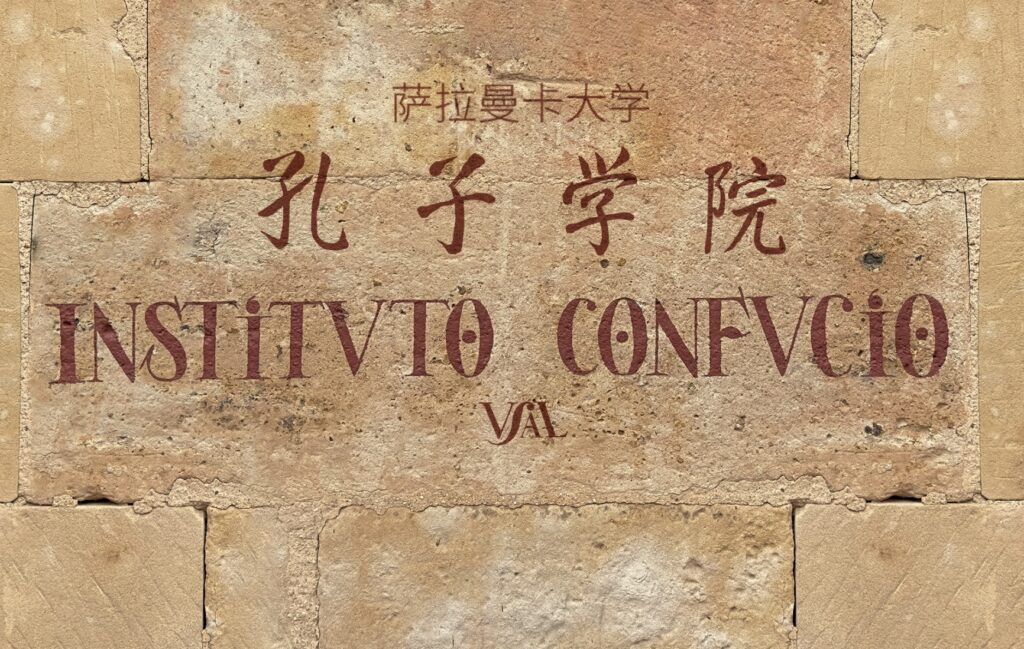
An image from the official web page at the University of Salamanca website for the Confucius Institute, established in May 2025.
Another key aspect of the Salamanca-Jilin story is the involvement of the Northeast Tiger Leopard Cultural International Communication Center (东北虎豹文化国际传播中心). Founded in January 2025 by Jishi Media and the Northeast Tiger Leopard National Park Administration, the center is Jilin Province’s fourth provincial-level international communication center — and a textbook example of the strategy documented in CMP’s Centralization+ report, which describes how China has since 2018 built a nationwide network of such centers under provincial propaganda department oversight to advance Party messaging goals abroad.
The deal last week illustrates the ways that potential partners around the world, including in Europe, can be vulnerable to outreach from media groups and other actors that are simply shifting faces of the Chinese Party-state with a single agenda — to advance China’s official narrative.
The university’s own announcement described the agreement as establishing “a roadmap for the development of joint projects in the field of media communication, especially in areas linked to digital innovation, content production and specialized training.” That language, entirely about the supposed intellectual value of the exchange, gives no hint whatsoever of the Party-state apparatus that lies behind the deal, or its own agenda.
The idea of China’s Central Propaganda Department and the Jilin propaganda office offering substantive exchange on “media communication” to a leading European university is absurd on its face. The whole deal sits uneasily with the core purpose of educational institutions, whose interest is in openness and the free exchange of ideas.
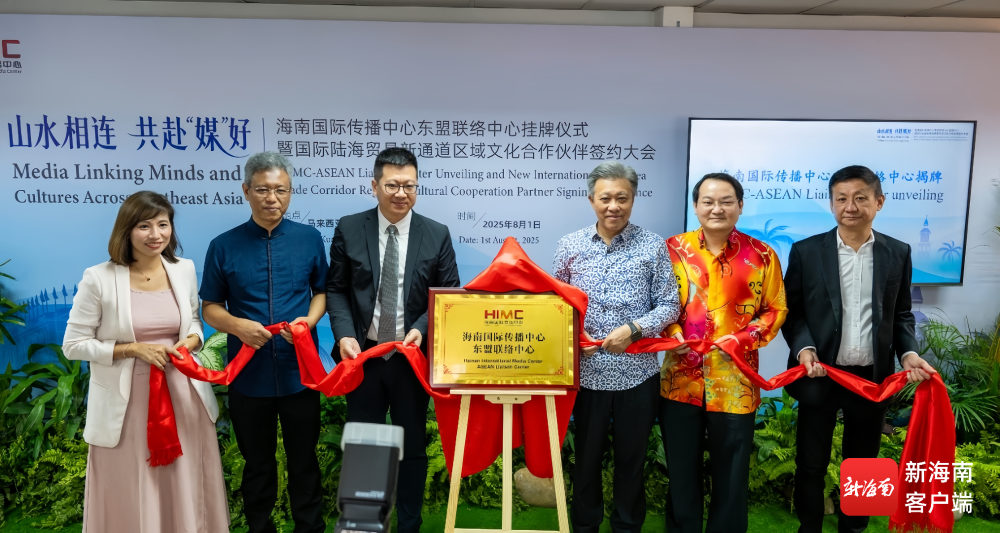
Hainan province, long China’s testing ground for economic and policy innovation, has emerged as a key experimental front in Beijing’s latest campaign — leveraging local and regional media to boost the country’s global “discourse power.” Earlier this summer, the Hainan International Media Center (HIMC), an office directly under the province’s propaganda office, unveiled a liaison center in Dubai, planting its flag in the Middle East. In Kuala Lumpur on Friday, it opened a new ASEAN Liaison Center (東盟聯絡中心), staking out Southeast Asia as a priority region for outreach.
Established in 2019, the HIMC was among China’s earliest provincial-level international communication centers (ICCs), following on the heels of the municipality of Chongqing, which launched its ICC in June 2018. The province’s unique position as a trade port experiment along what the CCP leadership has in recent years dubbed the “Maritime Silk Road” makes it a natural laboratory for President Xi Jinping’s “centralization+” approach to international messaging. It is also a key military region in the South China Sea from which China presses its territorial claims, a constant agitation for many ASEAN member states.
The launch ceremony for the HIMC liaison hub was attended by more than 60 guests under the theme “Media Linking Minds and Cultures Across Southeast Asia,” including Datuk Seri Wong Chun Wai (拿督斯里黃振威), chairman of the Malaysian National News Agency, Teh Hao Ran (鄭豪然), executive editor of Kwong Wah Yit Poh (光華日報), and Niu Xiaomin (牛曉民), deputy editor-in-chief of Hainan Daily Media Group (海南日報報業集團). The formation comes as Hainan prepares for the December 18 start of its free trade port’s closed-loop operation (封關運作), a development that officials say will dramatically increase connections with ASEAN countries. ASEAN has been Hainan’s largest trading partner since 2021.
The center, guided by Hainan’s provincial propaganda department and led by Hainan Daily Media Group, aims to serve as what officials described as a “comprehensive cooperation bridge” linking Hainan with ASEAN countries through international communication, economic cooperation, cultural exchange, and think tank collaboration.
The overseas expansion reflects Xi’s 2021 directive to “tell China’s story well” (講好中國故事) — terminology that has been core to the party’s international communication objectives since August 2013 — and make China “credible, lovable and respected” (可信、可愛、可敬), as Xi urged in a May 2021 speech to a collective study session of the CCP Politburo on “external propaganda” (外宣). Officials at the Kuala Lumpur ceremony invoked the same language, emphasizing the center’s mission to “tell good stories of China and Hainan” (講好中國故事、海南故事) to ASEAN audiences.
So the first Ministerial Meeting of China’s Global Civilization Initiative (GCI) didn’t top your news agenda? Despite the grandiose terms in which leaders have previously described this third initiative to signal the country’s global leadership in key areas — including also security (GSI) and development (GDI) — state media apparently made little effort to externally publicize what was meant to be its opening party of sorts. Just a smattering of English reports touted the gathering, which took place in Beijing on July 10 and 11. Serbia seemed the only nation to formally announce its participation as a diplomatic matter.
First introduced in March 2023, this initiative is built around a broader concept of “civilization” that Xi has trumpeted since the 20th National Congress of the CCP in October 2022 as a new grandiose concept to shore up his own domestic legitimacy [READ “China’s ‘Xivilizing’ Mission”]. So far, however, the GCI has been relatively understated as a foreign relations strategy. China’s leaders might have hoped to move it centerstage, but they seem not to have even preannounced the ministerial meeting.
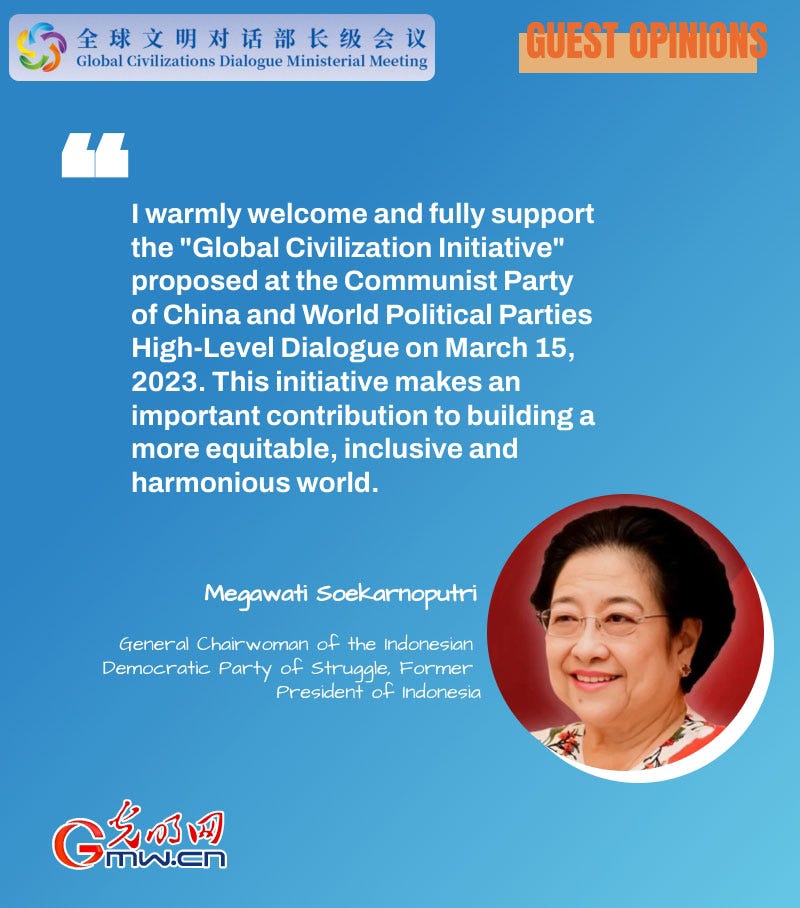
Remarks shared by the Central Propaganda Department-run Guangming Daily on the GCI meeting from former Indonesian president Megawati Saekarnoputri.
Naturally, there was a bit of fuss about the meeting in the pages of the People’s Daily, where a congratulatory letter from Xi Jinping made the front page on July 11. In his message, Xi stressed that at this critical juncture in international affairs, civilizational dialogue must transcend isolation and conflict. According to state media, the event attracted more than 600 political, cultural and educational leaders from approximately 140 countries and regions. Among the participants, featured in a CCTV+ video that received a paltry 247 views, was “American Tai Chi practitioner Jake Pinnick,” who called for dialogue and cooperation.
Also emerging from the event was a global“action plan” (行动计划) for civilization. The plan shows a strong focus on developing nations in the Global South. More on that in due course.
“She criticizes Taiwan, and this actually resonates with many young media friends in Taiwan.” So, with mendacity, began a June 11 profile of Taiwanese writer Guo Xueyun (郭雪筠) in Shanghai-based outlet The Paper (澎湃), coming two days after she published an essay in Guancha (觀察網), another of the city’s online outlets.
The coverage exemplifies China’s cultivation of sympathetic Taiwanese voices to support unification messaging. Writing under the byline “Taipei Girl Looks at Mainland China” (台北女孩看大陆), Guo has become a recurring fixture in China’s state-run and tightly controlled media, where only one narrative on Taiwan is accepted — that “unification” with China is inevitable, and the deepest desire of the population.
Born around 1990, Guo graduated from the advertising department at Taiwan’s Fu Jen University before moving to Beijing in 2012 for graduate studies at Peking University. Her generational perspective — contrasting Taiwan’s current struggles with China’s (much-mythologized) current prosperity — reinforces the state narrative that Taiwan would benefit from closer ties leading eventually to what China views as “unification,” and many Taiwanese view as annexation. In a 2018 interview with Beijing Youth Daily, she reflected on feeling both amazed and ashamed during her initial Beijing experience to discover that while Chinese typically saw the positive aspects of Taiwan, the reverse was not true.
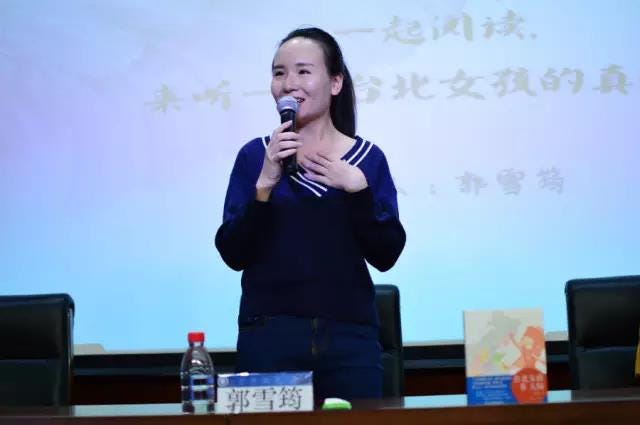
Guo Xueyun, China’s not-so-secret weapon on Taiwan issues, on the lecture circuit. SOURCE: Tianjin University.
Guo’s transformation from struggling student to prominent author is of course also a story of concerted institutional backing. Her debut book, Taipei Girl Looks at Mainland China (台北女孩看大陸), was published in 2016 by People’s Literature Publishing House (人民文學出版社), controlled by China Publishing Group (中國出版集團有限公司) — a government company under the State Council. Her 2022 novel, I Am in Beijing (我在北京), was released through Jiuzhou Publishing House (九州出版社), a publisher directly controlled by the Taiwan Affairs Office (中共中央台灣工作辦公室), the CCP body that coordinates propaganda and messaging toward Taiwan.
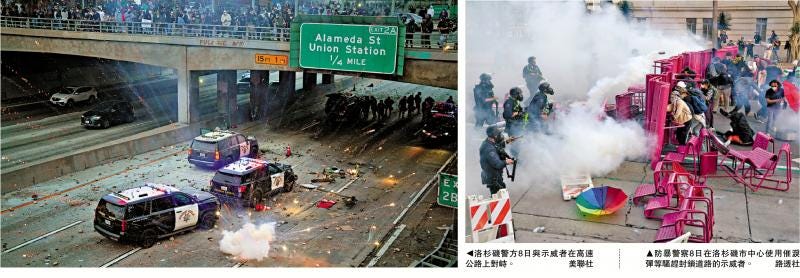
Donald Trump’s use of the National Guard and US Marines to quell protests in Los Angeles against his immigration policies became a major story across Chinese media last week. Op-eds filled with images of turbulence interpreted the news as pointing toward imminent “civil war,” words used in several reports. Pursuing their long-term goal of discrediting the US political system, Chinese state media are now pushing at a door the Trump administration has opened wide.
Scenes of aggressive police action in LA are reported by Hong Kong’s government-run Ta Kung Pao.
China’s state-run Xinhua News Agency reported that its journalists had been injured while covering the protests. The article purported to deliver the will of the protesters, quoting them as saying they were “hard-working local community residents who wanted to express their opinions peacefully.” The report reached second-place on the Baidu search engine’s list of hottest news topics on June 9. The same day, another trending post from a prominent self-media account predicted that the events in California were a “prelude” to deeper conflict. “America’s ‘civil war’ has begun” (美国”内战”开始了), the author declared, calling the unrest “the first large-scale street conflict of the Trump 2.0 era” and comparing downtown Los Angeles to “a Middle Eastern war zone.” The post received close to 1.6 million reads.
In Hong Kong, media similarly mirrored these narratives of American decline. The online news outlet HK01 and state-backed newspaper Ta Kung Pao (大公报) both framed the conflict as a consequence of long-term social divides within the US, with HK01 warning that without resolution, America would “eventually fall into the abyss.”
For more on Chinese media portrayals of protests in the United States, and our perspective at CMP on how Trump administration actions have been a huge assist for China’s external propaganda efforts, read “A Trump Card for China’s Media.”