

Independent Chinese journalist Chai Jing (柴静), formerly a celebrity anchor for state-run China Central Television (中国中央电视台) and now based in Europe, has released an interview on her YouTube channel with Taiwanese journalist Hsu Tsung-mao (徐宗懋), who on June 4, 1989 suffered a head wound near Tiananmen Square while covering the student movement and the military crackdown that crushed it.
The interview, cut with footage of the 1989 protests and official news coverage from the time, is a rare instance of in-depth eyewitness reporting within Chinese-language media outside China on the June 4 crackdown — a topic that remains actively suppressed within China.
Hsu was present in the Chinese capital from May 27 to June 10, 1989, and shared firsthand impressions of the student movement with Chai, describing the difficulty students had organizing themselves. “In mainland parlance, their democracy, the form their democracy took, was a kind of ‘native-method steel smelting,'” said Hsu, referencing the crude methods of backyard steel furnaces during China’s disastrous Great Leap Forward. “But that was quite natural. It was not their fault. It was simply the historical conditions of the time.”
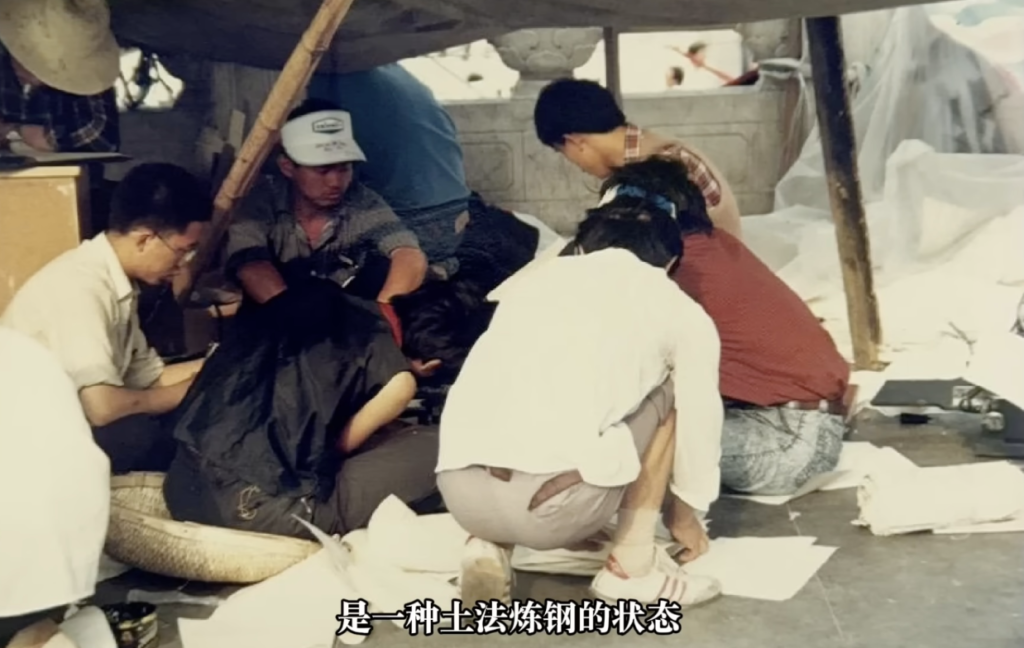
After being shot, Hsu was carried to a nearby hospital for medical care by an unidentified carpenter. He recalled the episode with some feeling during the interview. “I owe him my life,” he said. According to Hsu, a nurse at the hospital also donated her own blood to him when there was an insufficient supply, and after his surgery, she pressed the recovered bullet into his palm.
Hsu told Chai during the interview that the pain of what he experienced on June 4, 1989, has accompanied him “every minute, every second” over the intervening decades. “But I absolutely don’t need anyone to feel sorry for me,” he said.
Chai’s interview also features a diary left behind by a female student from the square, and recollections from Taiwanese writer Yang Du (楊渡), who covered the crackdown alongside Hsu and accompanied him to the hospital. Yang has since published The Unburned Book (未燒書), a memoir revisiting his Tiananmen experience.
Hsu Tsung-mao remains a controversial figure in Taiwan, known for his pro-unification views, which diverge sharply from the majority public opinion in the country. According to survey results released in January by National Chengchi University’s Election Study Center, nearly 60 percent of Taiwanese favored maintaining the status quo as of December 2025, while those supporting any form of unification remained a small minority at roughly seven percent combined.
Hsu played a central role in recovering the remains of Zhu Feng (朱楓), a CCP intelligence operative executed in Taiwan in 1950, and facilitating their return to mainland China. He has since described this work as laying “an important spiritual foundation” for cross-strait reconciliation. This month, Hsu published an article in China Times (中國時報), a Taiwan newspaper generally regarded as having a pro-China editorial stance, arguing that peaceful unification represents Taiwan’s path to self-preservation.
Hsu’s writing also appears in ThinkChina, an English-language publication run by Singapore’s SPH Media under Lianhe Zaobao (联合早报).


