

“The times always call to us — the media belonging to the new era may yet arrive in ways we do not yet know.” Whether a message of hope or of resignation, these words marked the end last week of Undergrad (學苑), a student magazine that had published for 74 years at the University of Hong Kong (HKU), the territory’s top-ranking tertiary institution. The editors said they were ceasing operations immediately after twice failing to recruit new members. It was the latest sign of shrinking space for independent political expression at Hong Kong’s universities.
Founded in 1952 as an English-language student newsletter, Undergrad adopted its Chinese name and switched to Chinese-language publication in 1959. Over the decades, it became a fixture of Hong Kong student activism. Its situation became more precarious in 2015, in the wake of the Occupy Central pro-democracy protests, when then-Chief Executive Leung Chun-ying (梁振英) took the unusual step of naming Undergrad directly in his annual Policy Address, criticizing a magazine feature and companion book on Hong Kong self-determination as “mistaken propositions.” Undergrad‘s editors accused Leung of suppressing free expression.
In 2021, the magazine’s operations narrowed sharply after HKU withdrew recognition of the Hong Kong University Students’ Union (香港大學學生會), the student union under which it was published. This followed an expression of sympathy by student leaders for a man who fatally stabbed a police officer and then killed himself. Cut off from campus facilities and funding, the union, and Undergrad with it, has struggled to function over the past five years.
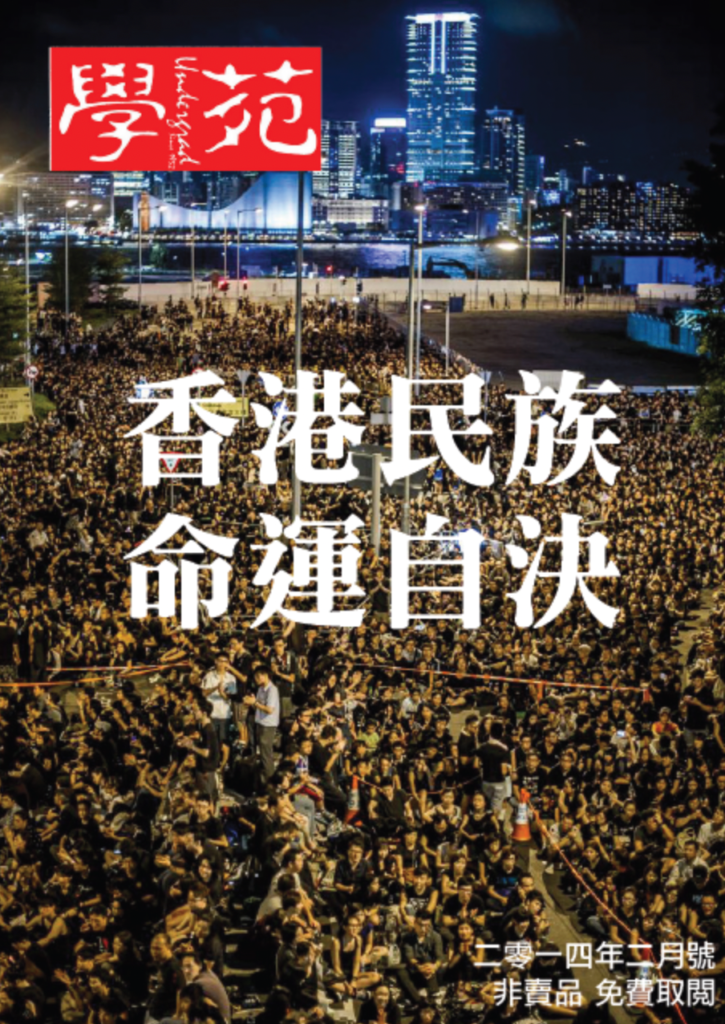
Over its 74 years, Undergrad counted alumni across Hong Kong’s political spectrum, including the late former Chief Secretary Rafael Hui (許仕仁), veteran journalist Ching Cheong (程翔), who was imprisoned in China for nearly three years on espionage charges for his journalistic work, and lyricist James Wong (黃霑), a foundational figure in Cantonese pop music sometimes called one of Hong Kong’s “Four Great Talents.”
Responding to the news, Tou Yiu-ming (杜耀明), a former Undergrad editor and retired journalism professor, told France’s RFI that HKU had lost an essential platform for training young minds, warning the university now risked becoming what he called “an education factory.” The story was reported by Mak Yin-ting (麥燕庭), herself a former head of the Hong Kong Journalists Association, who was detained by police in 2023 while covering a banned vigil for the 1989 Tiananmen Square crackdown.
In its closing statement, Undergrad‘s outgoing editorial committee seemed to preempt any suggestion that the closure was a forced measure. The statement’s only oblique nod to politics was its use of the phrase “new era” (新時代), a term closely associated with Chinese leader Xi Jinping (習近平), which may have been a wry aside. They chose instead to describe the closure in almost lyrical terms. “This is not something to lament with sorrow,” they wrote, “but simply the natural ebb and flow of history.”


