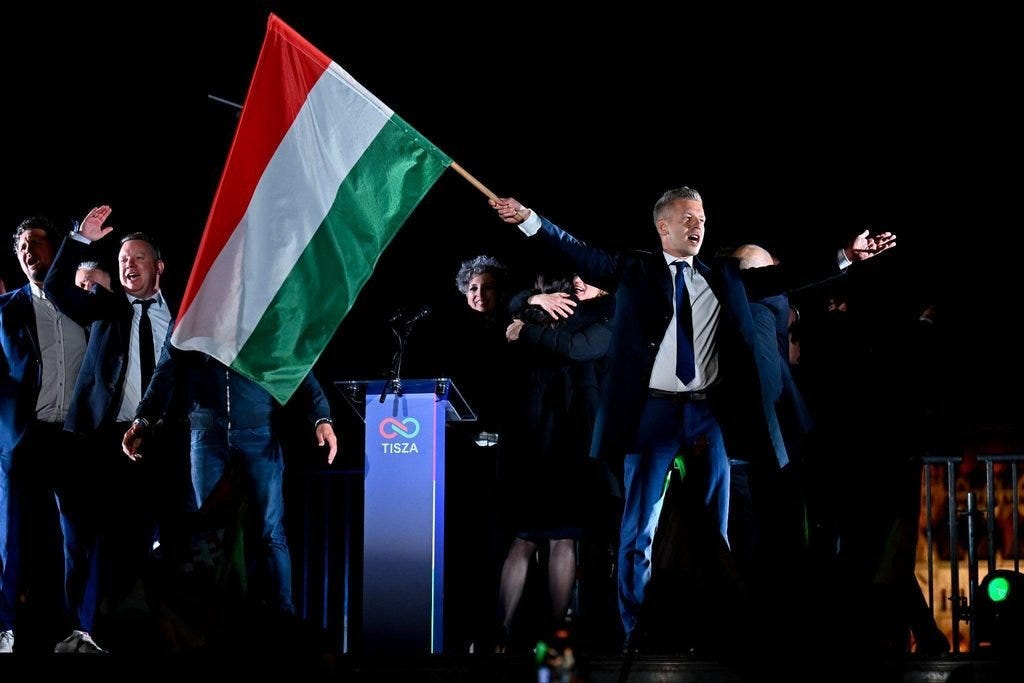
In April 2026, Péter Magyar’s centrist Tisza Party won the Hungarian parliamentary elections, ending Viktor Orbán’s sixteen-year hold on power. The shift set off a reshuffling of the media system that Orbán left behind, with public broadcasters enforcing leadership changes, and outlets that depend on state money cutting staff or closing their doors.
That tightly-controlled system took over a decade to build. It began in 2010 with the passing of a media law that set up a new regulatory body run by government loyalists. The culmination of this process was the establishment of a pro-government media conglomerate that came to control the majority of the media in the country. Journalists faced pressure through financial and legal burdens and smear campaigns.
As Orbán tightened his grip at home, his media opened up to a new partner: China. Hungarian state outlets signed cooperation agreements with Chinese state media such as the official Xinhua News Agency. In 2024, journalists from pro-government Hungarian outlets participated in organized press trips to Xinjiang after which they published positive reports on the region’s development. The cooperation between the two countries has been primarily diplomatic when it comes to media, built through content-sharing agreements, joint coverage, and state visits.
Lingua Sinica spoke with András János Teleki, a researcher at Taiwan’s National Chengchi University, to understand the collapse of Orbán-era media control and the relationship between Chinese media and Hungarian media.
Dalia Parete: For people unfamiliar with it, can you introduce us to the general media landscape in Hungary?
András János Teleki: Right now the Hungarian media landscape is going through a very big change. In April we had the parliamentary elections, where we witnessed a change of government. After sixteen years in power, Viktor Orbán and his [right-wing nationalist] Fidesz Party lost. The more centrist-leaning Péter Magyar and his Tisza Party won and formed a new government.
Under the old administration, [under] the rule of Viktor Orbán (2010-2026), Hungary’s media market slowly shifted from a diverse one to a captured one, where the government controlled most of the media system. That transition did not happen overnight. It was the product of Orbán’s administration rebuilding the whole media system over the course of his sixteen-year rule.
Reporters Without Borders also noted these significant changes; according to its World Press Freedom Index, Hungary fell from 23rd place in 2010 to 74th place in 2026. That was a big jump, reflecting the deteriorating situation of the media.
But now, since the Hungarian elections, we have a very new situation, and we don’t know what will happen. But what we see is that the tone of Hungarian public media has changed a lot and become a little bit more objective. So I think under the new government there will be a much better situation.
DP: You mentioned that there was a whole new system built over the sixteen years of Orbán’s rule. Can you walk me through how that actually happened?
AJT: Yes. The transition started with a 2010 media law, which set up a new media authority run by government loyalists. Over the years, public broadcasters became the government’s mouthpiece and the government bought or shut down many independent outlets. That is the case of Népszabadság, a daily independent and opposition newspaper, founded in 1956, that was abruptly closed down in October 2016 by its publisher. The paper had been purchased by an Austrian businessman, whose company, Mediaworks, owned it along with other newspapers. The company shut the paper down shortly after it published stories that made the government look bad, and the remaining Mediaworks portfolio was later sold to a businessman close to Orbán.
After the 2010 media law, the government also set up the Media Council, a regulatory body overseeing media in the country. It had the power to decide, for example, what got published and who got fined for their reporting for being “immoral” or “unbalanced” or “having hateful content.” It was led by people who were very close to the government.
The next step was to capture the private media market. Government-friendly businessmen began buying up independent or private outlets one by one, gradually reshaping their editorial line to align more closely with the government. Over time, most of these outlets became part of one big pro-government conglomerate called Central European Press and Media Foundation, or KESMA (Közép-Európai Sajtó és Média Alapítvány). This big group made up about 77.8 percent of the Hungarian news industry under the last Orbán government. The interesting thing is also that Hungary’s competition authority (GVH) never scrutinized the KESMA merger, even though a merger of that size should have led to close antitrust scrutiny. At the beginning, the GVH actually opened an investigation but closed it after the government declared the merger was an act of “national strategic” import.
State advertising was also used as a weapon. The Hungarian state had a lot of money coming from EU funding and state companies and ministries directed advertising spending mostly toward pro-government outlets.
Government-friendly businessmen began buying up independent or private outlets one by one, gradually reshaping their editorial line to align more closely with the government.
DP: What are the real pressure points or dangers for media personnel in the country?
AJT: Hungarian journalists rarely face real physical threats. The government methods were more sophisticated. Legal and financial burdens were the most common methods used against journalists. There was also a lot of surveillance. We had a very big scandal in 2018 when it came out that the government had bought the Pegasus spyware from Israel, and some investigative journalists, like Szabolcs Panyi, found traces of it in their phones.
Another pressure point was smear campaigns. We had a very particular state authority called the Sovereignty Protection Office, created in 2023 to scrutinize alleged foreign interference. What it basically did was to make independent and oppositional journalists worry about what they were reporting. It created a climate of fear. The office labeled many journalists and independent media institutions as agents of hostile foreign countries. The goal was to run this kind of smear campaign against oppositional media workers.
There was also a blockade on access to public data. Under Hungarian law, Act CXII of 2011 (known as the obligation to disclose data of public interest) and the European Convention on Human Rights, the government was supposed to hand over public records to journalists, including ministry spending. So journalists had to go to court to obtain the information they needed. Government agencies could also demand huge sums under the guise of “reimbursement of costs,” a fee introduced in 2015 over the workload of these requests. This was another step that made the reporting difficult.
DP: With Magyar’s Tisza Party now in power after a victory that ended Orbán’s 16-year rule, how do you expect the media landscape to change?
AJT: I do expect Hungary’s media landscape to change, and I think that shift has already begun. The new government has already taken several steps to dismantle Orbán’s propaganda machine. They have started reshaping the Hungarian public media and changing its leadership — new people are already coming in. I think this is a very positive change.
What is more important is that the media empire that was running things is slowly collapsing on its own. They do not have the money anymore to pay their outlets and journalists. They are closing outlets and cutting the staff. For example, the state-owned newspaper Mandiner suspended its print edition at the end of July after losing its state-linked funds.
DP: China and Hungary have close ties in terms of diplomacy, economy, education, etc. Is this closeness also reflected in the media space?
AJT: Very much. I think the close Hungary-China relationship is reflected in the media space. It was mainly an Orbán-era phenomenon, and it runs through state media.
Over the years some Hungarian outlets close to the Orbán party, such as Mandiner and Demokrata, participated in Chinese state-organized journalists’ trips to Xinjiang in 2024, publishing material about the trip.
There also are many formal agreements. In 2023 and 2024 alone, Hungarian public media signed deals with Chinese state media giants like Xinhua, People’s Daily, and China Media Group. One Hungarian independent outlet, Átlátszó, got hold of the contract signed, the majority of which is about news exchange, joint coverage of high-level state visits, staff exchange, and joint research on artificial intelligence.
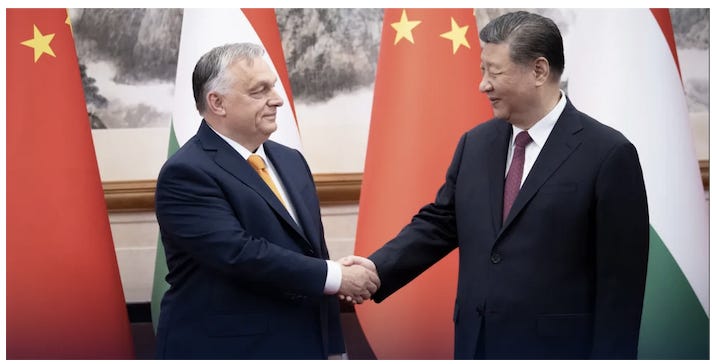
The highest level of the relationship between the two countries was when Xi Jinping visited Hungary two years ago. They signed eighteen agreements, including media ones, and Xi even published a signed article in Magyar Nemzet, the ultra-conservative newspaper linked to the Fidesz Party. It was ironic, because the Hungarian newspaper had originally a right-wing stance, so it was strange to see the leader of the Chinese Communist Party publishing an article there.
The future of all of these partnerships is now uncertain, because the Hungarian media system is changing, and the new government values its relationship with the United States and the European Union much more than its relationship with China. So the future of these cooperations is very much an open question.
DP: How do you understand the nature of the relationship between Chinese and Hungarian media?
AJT: This kind of media cooperation is political, not commercial. It does not relate to the media market. It has a political reason and a political goal. It is a tool for diplomacy. The Chinese side itself stresses that this cooperation runs under the “personal care and guidance” of the leaders from both countries, which tells you how political this is. These deals are part of bilateral diplomacy — but it also means that they are not run professionally, because a European state broadcaster having to cooperate with Chinese state media is not really a normal, professional agreement.
There is also the asymmetry of content flow. For example, the deal signed between the now-closed state-owned media fund company Médiaszolgáltatás-támogató és Vagyonkezelő Alap (MTVA) and People’s Daily allowed the Hungarian newspaper to republish People’s Daily content, and high-level visits generate content for both sides. But the important thing is the direction: much more Chinese narrative content goes into Hungarian media than Hungarian narrative content goes into Chinese media.
Media cooperation between Hungary and China is political, not commercial.
DP: In 2021, investigative outlet Direkt36 reported that China Radio International pressured Klasszik Radio to air Chinese state content ahead of a premier’s visit. Is this kind of leverage through financial dependence still common today?
AJT: Airing Chinese state propaganda does not get you anywhere in Hungary. Hungary is a country that had its own socialist dictatorship that ended in 1989, and the Hungarian public did not care about that content. This kind of financial pressure is quite rare today.
The question one might ask is why Klasszik Radio aired content from China Radio International (CRI). A few months before the incident happened, Klasszik Radio sold part of its airtime to GBTimes Oy, a Finland-registered company that was initially paid by China Radio International to produce Chinese content across a network of European stations. So Klasszik Radio had financial ties to a CRI partner and did not want to jeopardize the relationship.
DP: Given the large Chinese diaspora population, what’s the state of Chinese-language diaspora media in Hungary?
AJT: The Chinese diaspora in the country was the biggest in Eastern Europe in the 1990s. After 1989, thanks to the new visa-free agreement between the two countries, many Chinese people migrated to Hungary. Most of them relocated to the capital, Budapest, where they still live today. We do not know much about the exact size of the Chinese diaspora. In contrast, official estimates suggest a lower figure; unofficial estimates suggest a higher one. According to census data collected by the Hungarian Central Statistical Office (HCSO) in 2022, Hungary had 18,154 Chinese residents at that time. However, researchers know that during the Orbán administration, from 2013 to 2017, more than 18,000 Chinese citizens received residence permits under the Hungarian “golden visa” scheme. Perhaps this explains why, while the HCSO reported 8,852 Chinese citizens living in Hungary in 2011, that number had risen to 18,154 by 2022. Academic studies have examined the formation, functioning, and religious life of the Chinese community in Hungary; however, much remains to be researched, and many questions remain unanswered. Research is complicated by the community’s ongoing transformation and change.
There are a handful of Chinese-language newspapers operating in Hungary, mostly based around the Kőbánya district, which is the center of the Chinese diaspora. They cover news, culture, and business, but mainly for the diaspora itself.
An article by investigative outlet Direkt36 found that some of these diaspora media have a direct relationship with China. For example, in 2023, the editors of eight Chinese-language media based in Hungary attended the eleventh edition of the World Chinese Language Media Forum (第十一屆世界華文傳媒論壇), hosted by China News Service, where they are encouraged to publish pro-China articles. Among them was Teng Weijie (滕維傑), the editor of the Chinese-language newspaper New Herald (新導報).
That said, the scale is important here. The Chinese diaspora does very little to shape broader Hungarian public opinion, and China does not really need this channel in Hungary. This is because the Hungarian government itself was already pro-China.
Andras Janos Teleki is a researcher at Taiwan’s National Chengchi University,