As the democratic race for mayor picks up pace in Taipei ahead of November 28 local elections in Taiwan, state-run media and online accounts in China are pouncing on every opportunity to apply leverage. The latest target is television host Kevin Tsai (蔡康永), best known for Kangsi Coming (康熙來了), the hit variety-comedy show he co-hosted for 12 years with celebrity Taiwan actress Dee Hsu (小S).
Tsai is under fire from Chinese state commentators for attending an October 4 campaign launch for Puma Shen (沈伯洋), a candidate for the ruling Democratic Progressive Party (DPP) who was sanctioned two years ago by China’s Taiwan Affairs Office (國台辦) as a “Taiwan independence diehard.” One year later, the official Xinhua News Agency reported that the municipality of Chongqing had opened an investigation into Shen for his “separatist criminal activities” in co-founding Kuma Academy (黑熊學院), a civil defense group in Taiwan.
Pressed by Taiwan media after his appearance at the October 4 event, Tsai stressed that he was interested in hearing from all sides. “I’m just here to check it out,” he said. The host’s defense of his legitimate democratic right to election curiosity drew a firestorm on Chinese social media, with both Tsai’s name and the phrase “Kevin Tsai appears at separatist’s campaign venue” (蔡康永現身台獨分子競選會場) trending on Weibo. According to the New York-based World Journal (世界日報), a Chinese-language news outlet linked to Taiwan’s United Daily News, many users posted under Tsai’s video account on Douyin, China’s domestic version of TikTok, to voice their unhappiness.
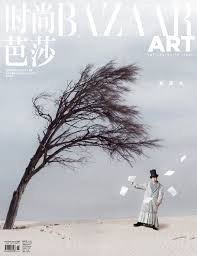
The commercial consequences followed immediately on the heels of Tsai’s attendance at the October 4 event. The same night, Leapmotor, a Hangzhou-based car manufacturer that had previously engaged Tsai for marketing events, clarified on social media that the host “is not a spokesperson for Leapmotor.” In the first line of the statement, the company affirmed China’s sovereignty claims over Taiwan. Bazaar Art (時尚芭莎), the Chinese art-focused publication under the Hearst-owned Harper’s Bazaar, took the drastic step of pulling down all traces online of its September 2026 cover story on Kevin Tsai, leaving behind a “404 error” page.
Official state media recriminations of Tsai followed close behind, the most strongly worded statements coming from public accounts on social media platforms.
On October 6, Jun Zhengping (鈞正平), a social media account run by the PLA Daily (解放軍報), the official mouthpiece of China’s Central Military Commission, said — without directly naming Tsai — that separatist actions would bear a steep price. “Certain individuals who foolishly attempt to use rhetorical tricks to blur the lines between right and wrong, reaping benefits from the mainland while simultaneously flirting with ‘Taiwan independence’ forces,” said the post, “will sooner or later find themselves branded with eternal shame in the annals of history and pay an unbearable price.”
In a post three days later, Xiake Dao (俠客島), a social media account run by the overseas edition of the Chinese Communist Party’s flagship People’s Daily, named Tsai outright, and sharply criticized him for his presence at the election event. “Even if Tsai did not take the stage to speak or publicly declare his support for Puma Shen, the video footage sufficiently proves that he was not, as he claims, merely coming to see what it was like,” said the account. “He was in fact actively endorsing a die-hard ‘Taiwan independence’ element.”
Xiake Dao also noted the real commercial fallout for Tsai, reporting that China’s three top streaming platforms, iQIYI, Youku and Tencent Video, had already ceased promoting related content and videos — and even that online bookstore platforms had removed his books from featured sections. In a clear character attack, the account concluded that these costs were deserved, and should serve as a lesson to all. “A ‘two-faced’ person like him, who reaps the benefits from the mainland while simultaneously lending support to ‘Taiwan independence’ activists, must face the consequences and pay the price,” it said.
The perils and pitfalls for Taiwanese media figures and entertainment personalities are not exactly new when it comes to the question of sovereignty and the China market. But in its use of the media as a pressure lever in even minor, ambiguous cases, China has been increasingly forceful — accepting no ambiguity.
In the Tsai case, attacks from state media and nationalist accounts have delivered a clear signal to Taiwanese entertainers who depend on the Chinese market: there is no neutrality.
For its part, Xiake Dao defined the narrow path by reference to another recent case. During the recent National Day holiday in China, actor Nicky Wu (吳奇隆), a former member of the 1990s Taiwanese boy band Little Tigers (小虎隊), visited Tiananmen Square, where he waved a Chinese national flag as he recorded a short video wishing all Chinese the best.
How far can Taiwanese entertainers go in the Chinese market? That question, the official account said, depends on whether Taiwanese can “put the word ‘Chinese’ ahead of personal fame and fortune.”