
A Parade of Revisions

Beijing’s military parade advanced weeks of historical revision and reframing, elevating the CCP’s wartime role over American contributions.
|

China’s 80th anniversary military parade last week showcased more than advanced weaponry — it culminated weeks of historical reframing aimed at repositioning the CCP as the decisive force in World War II’s Pacific theater. Through state outlets like China Youth Daily and the Ministry of State Security-linked American Academy (美国研究所), Beijing promoted narratives claiming the CCP served as the “backbone” (中流砥柱) of resistance, years before America’s “belated” Pearl Harbor entry.
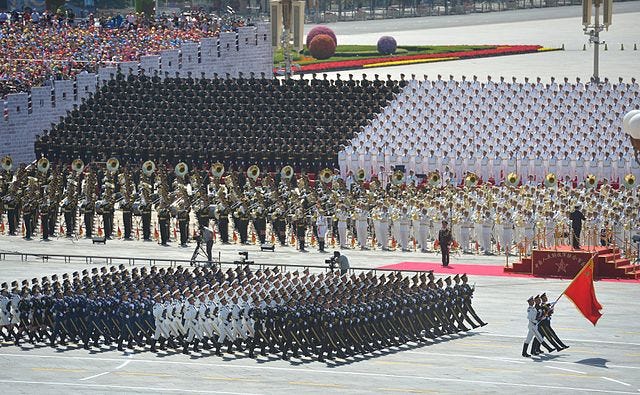
PLA soldiers march in the 2015 parade in Beijing to commemorate the 70th anniversary of the end of World War II. SOURCE: Wikimedia Commons.

The campaign accused American historians of deliberately downplaying China’s role for “political advantage,” claiming US academia systematically ignored how Chinese forces “tied down Japanese military strength” while America remained absent. This reframing serves Xi Jinping’s broader goal of displacing American global leadership and creating “a new type of international relations” by rewriting foundational narratives of the current world order.

For more on this story visit the China Media Project.


More Stories from this Region

In a clear sign of tightening media control, state broadcasters in China now manage the risk of live interviews even before the camera begins to roll.
The People’s Daily’s new deputy editor-in-chief is the first cadre of the post-1980s generation to assume a deputy ministerial position.
The catastrophe that struck the China-Nepal border last month is a case study in information control — and the clearest sign yet that Xi Jinping has rewritten the script…
AI anchors and AI-generated dramas are growing rapidly in China. But how far can a generative persona go before the illusion is broken? Meet Peach Fang.
An investigation report by one of Taiwan’s leading independent media outlets documents the human rights risks posed by app services created in China.
A recent study of posts from China’s security apparatus shows that in recent years the defined scope of perceived risk for foreign infiltration have expanded — including…