
Current Status: Active

Chinese Times

Chinese Times is the only Chinese-language print newspaper in Laos. Officially launched in 2018 at the first Belt and Road Forum for Laos-China Cooperation, the paper’s coverage includes Laos news, economics, culture, tourism, education, and updates on China-Laos collaboration and the local Chinese population. The paper has only a spotty presence online, but maintains a Facebook account with more than 22 thousand followers. Most of the content available on the Facebook account comes from Chinese party-state media, including China News Service and Xinhua News Agency’s GlobaLink service.

Lao News Agency

Lao News Agency, known as “Khaosan Pathet Lao” , the official news agency of Laos, was established on 6 January 1968 in Viengsay, northern Houaphanh province, by the Neo Lao Haksat (Lao Patriotic Front). Initially staffed with only a dozen reporters and technicians, the agency served as a news provider for Pathet Lao radio and the Lao Haksat newspaper during the revolutionary period. KPL became the official national news agency after the Pathet Lao established the Lao People’s Democratic Republic on 2 December 1975. Operating primarily in Lao, English, and French, with headquarters in Vientiane, the state-owned organization maintains provincial branches nationwide and serves as the primary information source for domestic media outlets. The agency describes itself as dependent on government funding and operates within Laos’s single-party system under the Lao People’s Revolutionary Party.

Jiangxi International Communication Center

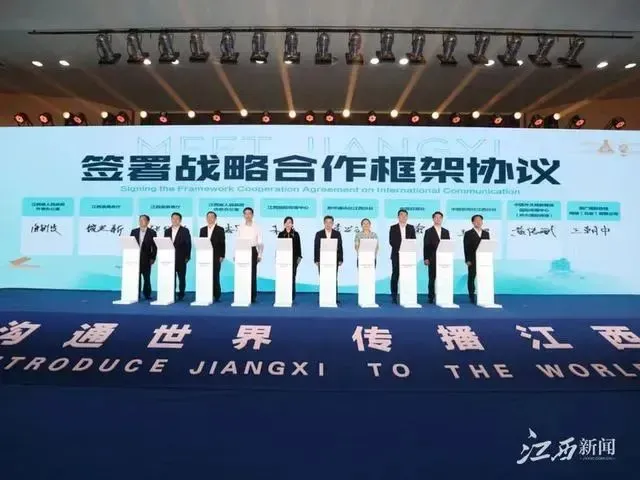
Launched in April 2024 under the guidance of the Jiangxi Provincial Party Committee Propaganda Department (江西省委宣傳部) and operated by Jiangxi Daily News (江西日報社), the Jiangxi International Communication Center aims to serve as the province’s “flagship media for external propaganda.” Officials claim it will leverage Jiangxi’s cultural resources—including rice cultivation, ceramics, traditional medicine, and opera—to create “international communication brand projects” like “Meet Jiangxi” (相約江西), which launched simultaneously with the center. Provincial propaganda chief Lu Xiaoqing (盧小青) instructed the center to “actively promote Xi Jinping Thought” and “tell the story of the Chinese Communist Party’s governance.” The center appointed “overseas promotion ambassadors” from seven countries while signing cooperation agreements with China’s Foreign Languages Bureau (中國外文局), described as “the national team for external propaganda.”

Europa Press

Founded in 1953, Europa Press is one of Spain’s leading private news agencies. Initially established as a book distribution company by five monarchists, it transformed into a full news agency in 1966. The agency broadcasts news 24 hours a day, publishing approximately 3,000 articles per day. Under Antonio Herrero Losada’s leadership (1963-1989), Europa Press survived political pressure and gained prominence by providing the worldwide exclusive on dictator Francisco Franco’s death in 1975. The agency expanded territorially across Spain in the 1990s.

Belarus President Administration

The Belarus President Administration (Адміністрацыя Прэзыдэнта Рэспублікі Беларусь) is a state administration body established on July 22, 1994. It supervises the implementation of presidential resolutions and oversees interaction between the President and legislative, executive, judicial bodies, local authorities, and mass media. The organization was created following constitutional reform and the first presidential election in Belarus, with Alexander Lukashenko serving as President since 1994. The administration provides analytical support to the President and drafts presidential decisions and legislation that is subsequently approved by the Parliament of Belarus, with numerous officials having been subject to sanctions by the United States and European Union following various presidential elections.

People’s Daily

People’s Daily, first launched in 1946 and established on June 15, 1948, is the official flagship newspaper of the Chinese Communist Party (CCP), operating directly under the CCP Central Committee. The paper conveys party consensus through highly regimented content and specialized party terminologies known as tifa (提法), with an estimated circulation of approximately 3 million daily copies in multiple languages. From 1966 to 1976, during the Cultural Revolution, it was part of an influential media triumvirate referred to as “two newspapers and one journal” (兩報一刊) that uniformly featured Mao Zedong’s commentaries across their front pages—a centralized control of messaging later viewed as contributing to the period’s chaos. The paper continues to serve as a primary resource for official CCP discourse, focusing on party positions rather than independent reporting, with Xi Jinping’s recent prominence in its headlines widely interpreted as reflecting his consolidation of power within the party.

East Asian Civilization Research Center

The East Asian Civilization Research Center (东亚文明研究中心) at SWPS University, or CCAW, is an interdisciplinary research institute established in 2003 and headquartered in Warsaw, focusing on political, cultural, linguistic, and literary studies of Mainland China, Taiwan, the Korean Peninsula, and Japan. Founded by the late Professor Krzysztof Gawlikowski, the center evolved from an organizational unit into the Department of Asian Studies within the Faculty of Humanities in 2017-2018. The center participates in the European Union’s Horizon Europe “China Horizons” project examining contemporary Chinese society and culture, and operates a research platform on hermeneutics and translation of classical Chinese texts in collaboration with the University of Warsaw, John Paul II Catholic University of Lublin, and Adam Mickiewicz University.

China-Africa Friendly Economic and Trade Development Foundation

The China-Africa Friendly Economic and Trade Development Foundation (中非友善經貿發展基金會) was established in September 2014 in Beijing as China’s first foundation specifically focused on economic and trade development between China and African countries. Operating under the supervision of the China-Africa Friendship Leadership Group of the Chinese People’s Political Consultative Conference (全國政協中非友善領導小組), the foundation describes itself as a non-governmental organization with the stated mission to “help small and medium enterprises go abroad, strengthen China-Africa economic and trade cooperation, fund China-Africa science and technology trade projects, and encourage export earnings.” Since 2015, the organization claims to have established relationships with embassies from all 53 African countries and over 60 Belt and Road Initiative countries in China. The foundation offers services including fundraising for small enterprises, international exchange facilitation, targeted funding for China-Africa technology projects, and legal training programs, positioning itself as a bridge between Chinese enterprises and African markets within China’s broader Belt and Road Initiative (BRI) in Africa.

Chinese People’s Political Consultative Conference

The Chinese People’s Political Consultative Conference (中國人民政治協商會議) was established on September 21, 1949, during the founding of the People’s Republic of China. The CPPCC served as China’s interim legislature from 1949 to 1954, before the National People’s Congress was established. During its inaugural session from September 21-30, 1949, in Beijing, the CPPCC adopted the Common Program as the country’s basic political framework, selected Beijing as the capital, and chose the five-star red flag as the national flag. The organization functions as China’s top political advisory body and a central component of the Chinese Communist Party’s united front system. The CPPCC consists of representatives from various political parties, social organizations, and sectors of society who provide consultation on political and social issues, though it lacks legislative power.