The Hubei Provincial Committee of the Chinese Communist Party (中國共產黨湖北省委員會) is the highest organ of CCP authority in Hubei Province. As with all provincial-level party committees in China, it sits above the provincial government in the political hierarchy. First established on May 20,1949, the committee oversees all party work in Hubei, controls key personnel appointments across government, media, and state enterprises, and implements directives from the CCP Central Committee. Hubei Daily (湖北日報), which began publication on July 1, 1949, serves as the committee‘s official media organ. As of mid-2026, Guan Zhi’ou (关志鸥) serves as the committee’s Party Secretary, in office since May 30, 2026. The committee’s headquarters are located within the Provincial Committee Compound in the Shuiguohu (水果湖) area of Wuchang District, Wuhan.
The Friends of Hungary Foundation (Magyarország Barátai Alapítvány) is a Hungarian diaspora NGO established in 2011 by 13 founding members, including prominent Hungarian scientists, bankers, and cultural figures based across Europe, the US, and Singapore. Per its founding letter, the foundation exists to inform the international community about Hungary and Hungarians worldwide in a nonpartisan way while celebrating Hungarian achievements abroad. The letter states that the founders “considered it necessary to establish an organization that would value-consciously but impartially inform the Friends of Hungary community and the public about events and achievements related to Hungary and Hungarians living in the world.” The foundation also committed founders to supporting “European Hungary,” backing efforts to culturally unite Hungarians across borders, and protecting minority rights and peaceful coexistence between nations. It also commits founders to supporting “European Hungary,” backing efforts to culturally unite Hungarians across borders, and protecting minority rights and peaceful coexistence between nations. The foundation operates two news portals, Hungary Today and Ungarn Heute, and publishes a magazine mailed to diaspora Hungarians. Based on the Media and Journalism Research Center’s State Media Monitor platform, these news portals have consistently amplified pro-government narratives despite the foundation’s stated nonpartisanship. Board chair István Stumpf, who took over leadership in 2024, served as a government commissioner under the Orbán leadership. Over the years, Orbán has also attended the foundation’s conferences, thanking the group for its role in cultivating diaspora ties to the Hungarian state. The foundation’s ties to Orbán extend to its funding base. Among its donors is MOL Group, an oil and gas company in which the Hungarian state holds shares and over which Orbán’s government has exercised significant structural influence. The government has also transferred large blocks of MOL stock, worth billions of dollars, to foundations run by political allies, rather than retaining the shares.
The Embassy of the People’s Republic of China in Hungary (中華人民共和國駐匈牙利大使館) is China’s chief diplomatic mission in the country, based in Budapest. China established diplomatic relations with Hungary on October 6, 1949. The embassy handles government-to-government relations, visas and consular services, trade and investment promotion, and public diplomacy outreach to Hungarian audiences. During President Xi Jinping’s May 2024 state visit to Budapest, the embassy was the focus of a public controversy as a joint investigation by investigative journalism centers Direkt36 and VSquare found that the Chinese Embassy in Hungary helped organize crowds of flag-waving supporters to greet the president. One Hungary-based Chinese resident said someone claiming embassy ties offered him money to attend the welcome. The Chinese Embassy in Budapest did not respond to Direkt36‘s request for comment on the allegations. Over the years, Chinese ambassadors to Hungary have regularly published op-eds in the pro-government dailies like Magyar Nemzet.
Founded on April 7, 1908, the Brazilian Press Association (Associação Brasileira de Imprensa – ABI) is a non-governmental media organization established by journalist Gustavo de Lacerda on the principle, as noted on the group’s website, that journalism should not be driven solely by commercial interests and profit. Throughout its history, according to a federal government profile, ABI has defended journalists during periods of authoritarian rule in Brazil, including mediating the release of imprisoned journalists accused of subversion under both the Estado Novo regime and the 1964 military dictatorship. In 2021, ABI filed lawsuits aimed at curbing Strategic Lawsuits Against Public Participation (SLAPPs) targeting two domestic journalists. In recent years, ABI has partnered with China to facilitate exchanges across tourism, commerce, and culture, which included signing a strategic cooperation agreement with the Western China International Communication Organization in 2024 to establish the Bridging News Brazil Liaison Office.
Magyar Hírlap is a Hungarian daily newspaper founded in 1968 as a state publication based in Budapest. Privatized after Hungary’s 1989 transition from communist rule, it became known for a liberal editorial stance until Swiss publisher Ringier acquired it in 2000. Hungary’s Economic Competition Authority (GVH) later ruled that Ringier held an excessive share of the newspaper market, prompting a divestiture. Entrepreneur Gábor Széles purchased and relaunched Magyar Hírlap in 2005, after which it adopted a “pro-government, anti-globalist, and patriotic” editorial line supporting the ruling Fidesz party, according to the media-monitoring database Eurotopics. In 2023, independent outlet Telex reported that the paper’s foreign-policy desk cited Orosz Hírek, an anonymous pro-Kremlin outlet republishing banned Russian state media, more than 1,500 times that year. Magyar Hírlap has published online only since 2022.
Hungary Today is an English-language news portal based in Budapest, billing itself as the leading English-language news source for Hungary. The portal, active since 2011, covers politics, economy, culture, and sport. It is published by the Friends of Hungary Foundation (Magyarország Barátai Alapítvány), a Hungarian NGO founded in 2011 to strengthen ties between Hungary and Hungarians living abroad. The foundation relies on private donations, including from state-linked firms such as gas and oil company MOL Group. MOL Group was long seen as closely associated with Orbán and his administration. In 2020, the Hungarian state transferred a 10 percent stake in MOL to Mathias Corvinus Collegium (MCC), a think tank run by Orbán’s then political director, Balázs Orbán. While its “About Us” page says the newsroom strives to “provide a complete, unbiased picture of Hungary,” the Media and Journalism Research Center (MJRC), a research institute that studies media systems worldwide, found that Prime Minister Viktor Orbán has regularly appeared at its annual conferences, and journalists and analysts it interviewed in 2023–2024 said the outlets increasingly function as vehicles for government narratives.
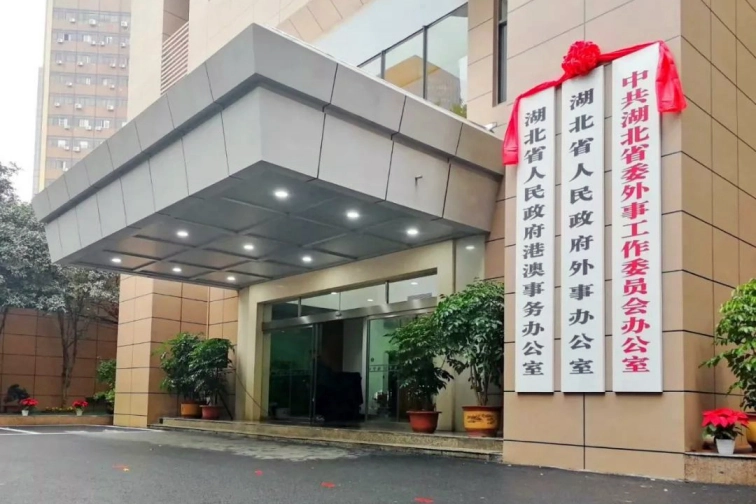
The Office of the Foreign Affairs Working Committee of the Hubei Provincial Committee of the CCP (中共湖北省委外事工作委員會辦公室) was established in 2018, when Beijing’s institutional reform promoted the formation of provincial-level foreign affairs leading groups within regional CCP committees. The office is responsible for handling visa paperwork, official visits, consular protection, outreach to international media, and promoting bilateral ties between Hong Kong and Macao through trade delegations, leadership exchanges, and youth initiatives. Since 2021, the committee office has also co-organized an annual tour for foreign correspondents, called “The World Comes for You” (世界因你而來). The sixth edition in July 2026 hosted nineteen journalists from eighteen countries invited to “tell the true, three-dimensional, and comprehensive story of Hubei” (講述真實, 立體, 全面的湖北故事), a framing consistent with the Party’s goals for positive external messaging.
On May 27, 2026, during the 2026 China-Kyrgyzstan Media Cooperation Forum (2026中吉媒體合作論壇) in Bishkek, China’s Global Times (環球時報), the state-owned tabloid published under the Chinese Communist Party’s People’s Daily (人民日報), signed a cooperation agreement with Kyrgyzstan’s Russian-language daily Slovo Kyrgyzstana. The terms of the agreement were not made public. However, Global TimesquotedSlovo Kyrgyzstana editor-in-chief Elena Zholobova as saying the outlets could “jointly produce quality content that serves the interests of both countries’ readers.” The forum, held under the theme “Deepening China-Kyrgyzstan Media Cooperation, Building a Better Shanghai Cooperation Organization Future Together,” was co-hosted by the People’s Daily and Kyrgyz Tuusu Information Publishing Group, publisher of Kyrgyzstan’s Kyrgyz Tuusu newspaper, and drew nearly 100 media representatives, officials, scholars, and business figures from both countries. At the same event, the People’s Daily and Kyrgyz Tuusu Information Publishing Group signed a separate memorandum of understanding.
In April 2023, the Henan International Communication Center (河南國際傳播中心) signed a strategic cooperation agreement with the Canadian Chinese News Agency (加拿大中華新聞社), one of 16 overseas Chinese-language media outlets that signed similar agreements with the center that month covering news coverage, joint events, and information sharing, according to Xuchang Net, a website operated by the CCP-run Xuchang Daily (許昌日報社) in the prefectural Henan city of Xuchang. The Canadian Chinese News Agency, which operates the portal site ChinaNews.org, was founded in Hong Kong in 2010 before relocating its headquarters to Toronto in 2013. Its president, Chang Jianguo (常建國), told the overseas edition of People’s Daily that the outlet had built an English-language website and regularly held offline events to “tell China’s story well” in international-facing language, so as to give foreign audiences a better understanding of “China in the new era” and strengthen the appeal of China’s international image, language closely mirroring the communication imperatives of the Chinese party-state.