Tag: AI adoption

Ta Kung Pao Attacks Opinion Poll

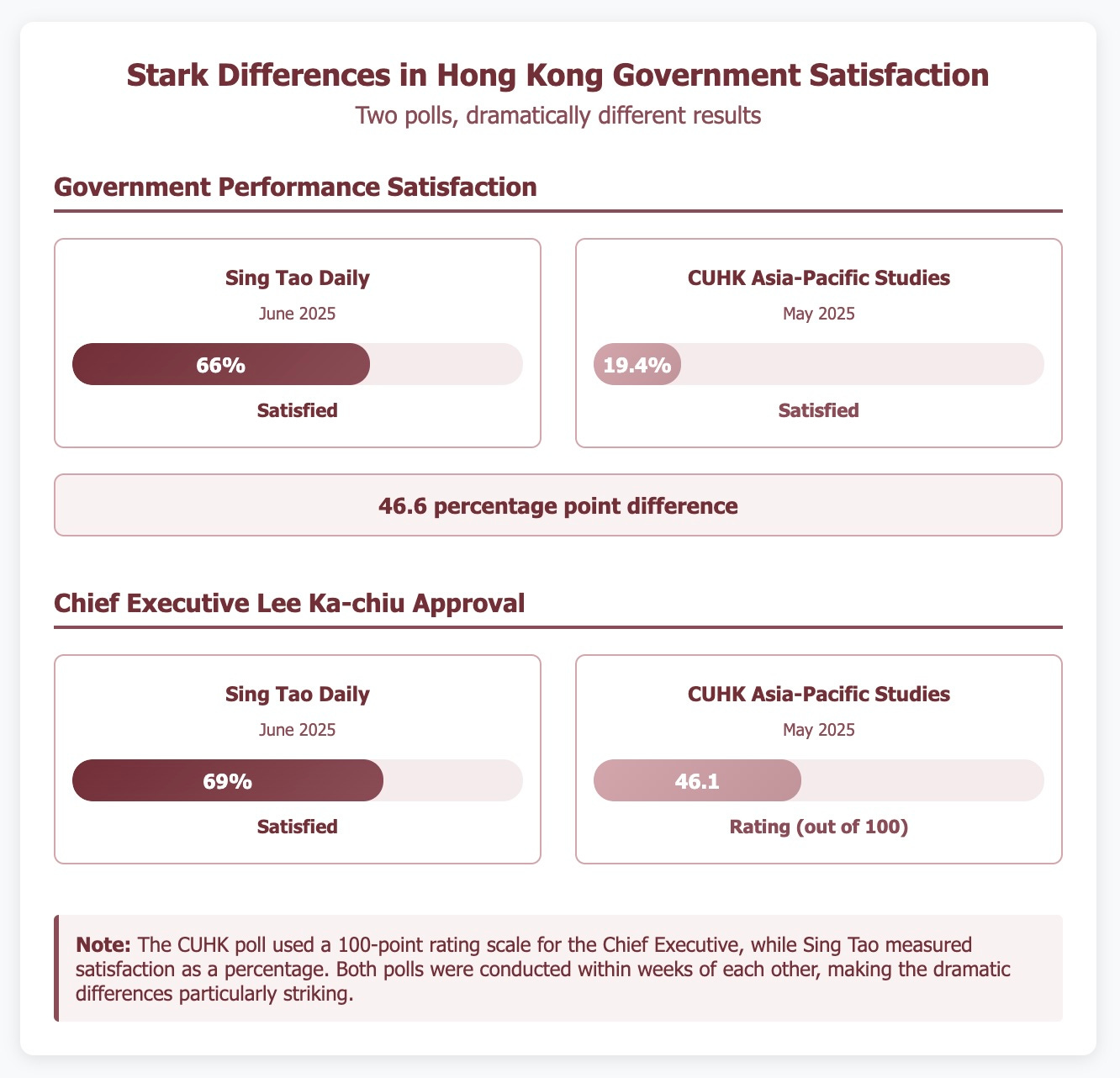
The Chinese central government-backed Ta Kung Pao (大公報) newspaper reported with fury last week that a recent survey on public opinion about the SAR government by the Chinese University of Hong Kong’s Hong Kong Institute of Asia-Pacific Studies (香港亞太研究所) “differed sharply” from similar surveys by other media outlets (see our graphic below). Resorting in typical form to ad hominem attacks, the paper noted that key scholars at the institute include “anti-China instigator” (反華推手) Morton Holbrook and “Taiwan independence advocate” (台獨分子) Hsiao Hsin-huang (蕭新煌). Holbrook is a former US diplomat, Hsiao a Taiwanese sociologist.
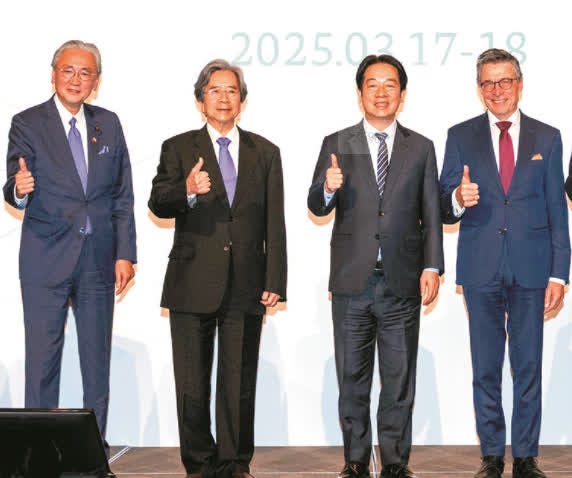
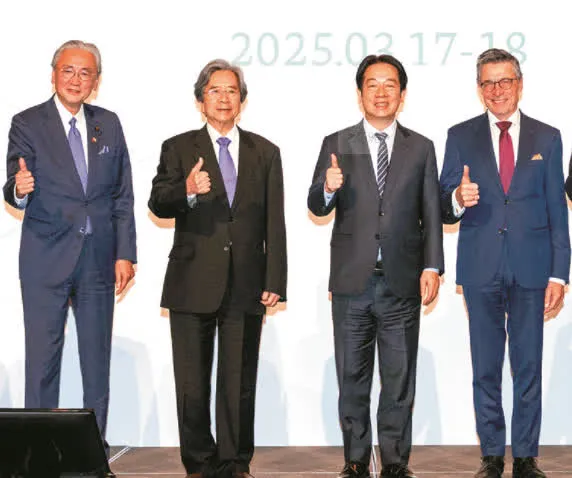
A growling caption to this photo featured in the Ta Kung Pao reads: “Hsiao Hsin-huang serves as so-called ‘Presidential Office Senior Advisor’ in the Taiwan region, alongside ‘Taiwan independence’ hardliner Lai Ching-te.”

CUHK subsequently stripped both of their honorary positions, a spokesperson telling the Ta Kung Pao that the university would “strictly comply” with Hong Kong’s National Security Law. The institute’s website went offline briefly before rebooting with both names scrubbed. Also this week, Hong Kong has cancelled passports for 12 activists living overseas. But at the HKSAR official website, everything is just fine. There is even a quick link where you can download the national anthem.

AI in the Mediagenes

Facing generative AI’s impact on media, Richard Lee (李致緯), the chief technology officer (CTO) of TNL Mediagene, an online media group based in Taiwan and serving an audience across the region, outlined three strategies last Friday in an interview with iThome, a news aggregation service for IT professionals in Taiwan. Lee’s strategies were: developing proprietary AI technologies to enhance personalized content and advertising recommendations; using AI to translate content for overseas and Taiwan markets; and actively positioning company content to be cited by AI models and tools. Lee stressed that by embracing AI rather than resisting it, media companies could adapt more quickly.

Education+

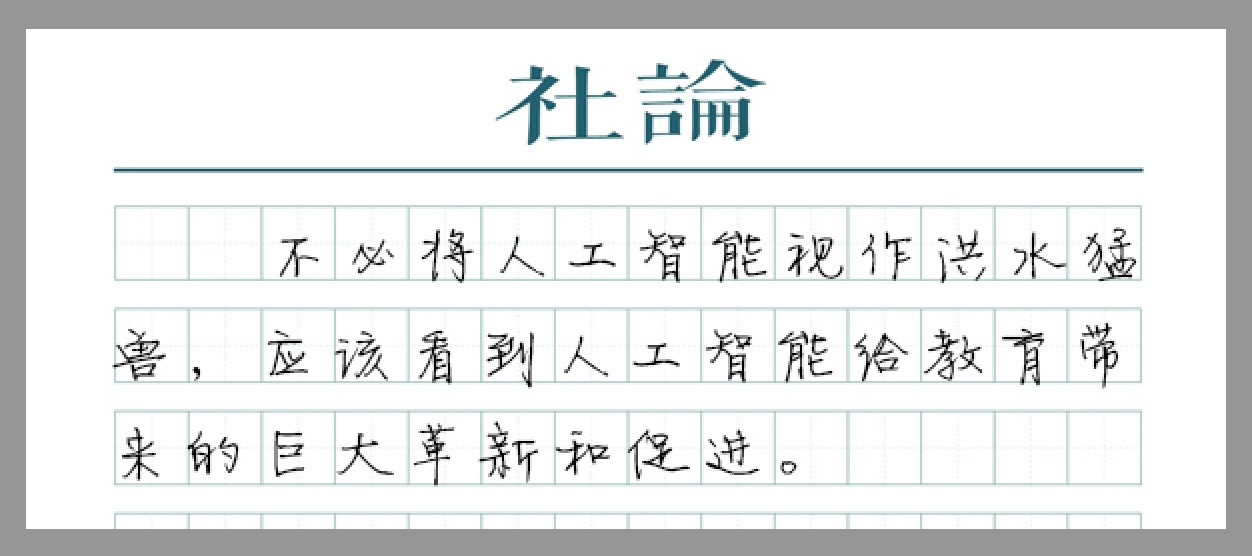
As China’s concerted national “AI+” campaign to leverage the technology for national development has begun to reshape educational priorities in the country, The Paper (澎湃新闻), a Shanghai-based media outlet under the state-run Shanghai United Media Group, published a commentary this week that endorses the country’s new AI education guidelines, released earlier this month. The commentary argues for a “human-centered” perspective that balances technological adoption with critical thinking, explicitly rejecting fears of AI. “It is not necessary to view artificial intelligence as a menacing flood,” the editorial said, addressing concerns about how AI might affect students’ learning abilities.

The commentary argues that AI will improve China’s education system by pushing it to “focus more on cultivating children’s independent thinking and innovation abilities, applying knowledge to practical life, and transforming knowledge into true wisdom.” Since the launch of “AI+” — a government campaign to inject AI into every area of Chinese society and industry — Chinese state media have been touting a positive outlook on the emerging technology. This includes the government’s bold overhaul of the nation’s education system, angling it towards AI.

It bears noting that while China has officially invested a great deal of hope in AI as a driver of advancement in many areas, the challenges facing education — and in particular critical thinking — stem not from technical limitations, but from political restraints on speech and truth-seeking.

For more on AI and education in China, read CMP’s “China’s AI Job Mirage” and “Shrinking Humanities for AI”. For more thoughts on critical thinking in China, see our past interview with Lan Fang and Guo Zhaofan.