FreeWeChat, a platform that archives censored and deleted posts from Tencent’s popular messaging and payments app WeChat, faced a legal challenge this month from the app’s parent company, which demanded, citing copyright infringement and unfair competition, that the site be shut down. Receiving a complaint from Tencent, the host provider complied with the request, despite the fact, FreeWeChat said, that it had “responded in detail, refuting each allegation on both factual and legal grounds.”
FreeWeChat is operated by GreatFire, an organization that monitors freedom of expression in China. In a July 10 statement, GreatFire denied the allegations and characterized Tencent’s legal action as “lawfare” designed to silence the archival platform. The company said it would attempt to host the website elsewhere to continue its operations. FreeWeChat has served as a repository for WeChat content that has been removed by Chinese censors, providing researchers and activists with access to deleted posts and conversations.
This month, Singapore-based digital news outlet Initium Media (端傳媒) published a detailed report on the rapidly diminishing landscape for LGBTQ+ social media accounts in China. The report highlights how Chinese platforms are tightening their grip on content from sexual minority communities, employing both overt censorship and more covert algorithmic methods of suppression.
In one of the clearest recent cases of suppression of social media accounts, the well-established LGBTQ+ account “Comrade Voice” (同志之聲) was pressed to rebrand as “Pride Waves” (驕傲聲浪) in April this year after a public uproar alleging that the platform’s use of “comrade” was offensive to the country’s national identity as a communist state. The word “comrade,” or tongzhi (同志), has been used within the LGBTQ+ community in Taiwan, Hong Kong and China since the 1990s. The uproar over “Comrade Voice,” which has nearly two million followers on Weibo, began when scriptwriter Wang Hailin (汪海林) made offensive remarks about gay men. After the account protested, Fudan University professor Shen Yi (沈逸) led critics who claimed this polluted Communist terminology. Facing the demand that it rename itself “Homosexual Voice” (同性戀之聲), the account opted for “Pride Waves” instead.
According to Initium‘s report, authorities have recently employed accusations of “foreign influence” (境外操控) as a powerful tool to restrict LGBTQ+ advocacy, though there is no credible evidence for such claims. Facing the generalized pressure caused by such claims, several organizations have renamed themselves, altered their content, or ceased operations entirely. Some have also chosen to defend themselves by signaling compliance. Amid claims of foreign influence, “Comrade Voice” founder Hua Zile (花子樂) defended the account, stressing that it had never sought or received foreign funding. At the same time, however, Hua affirmed support for the CCP and socialist ideals.
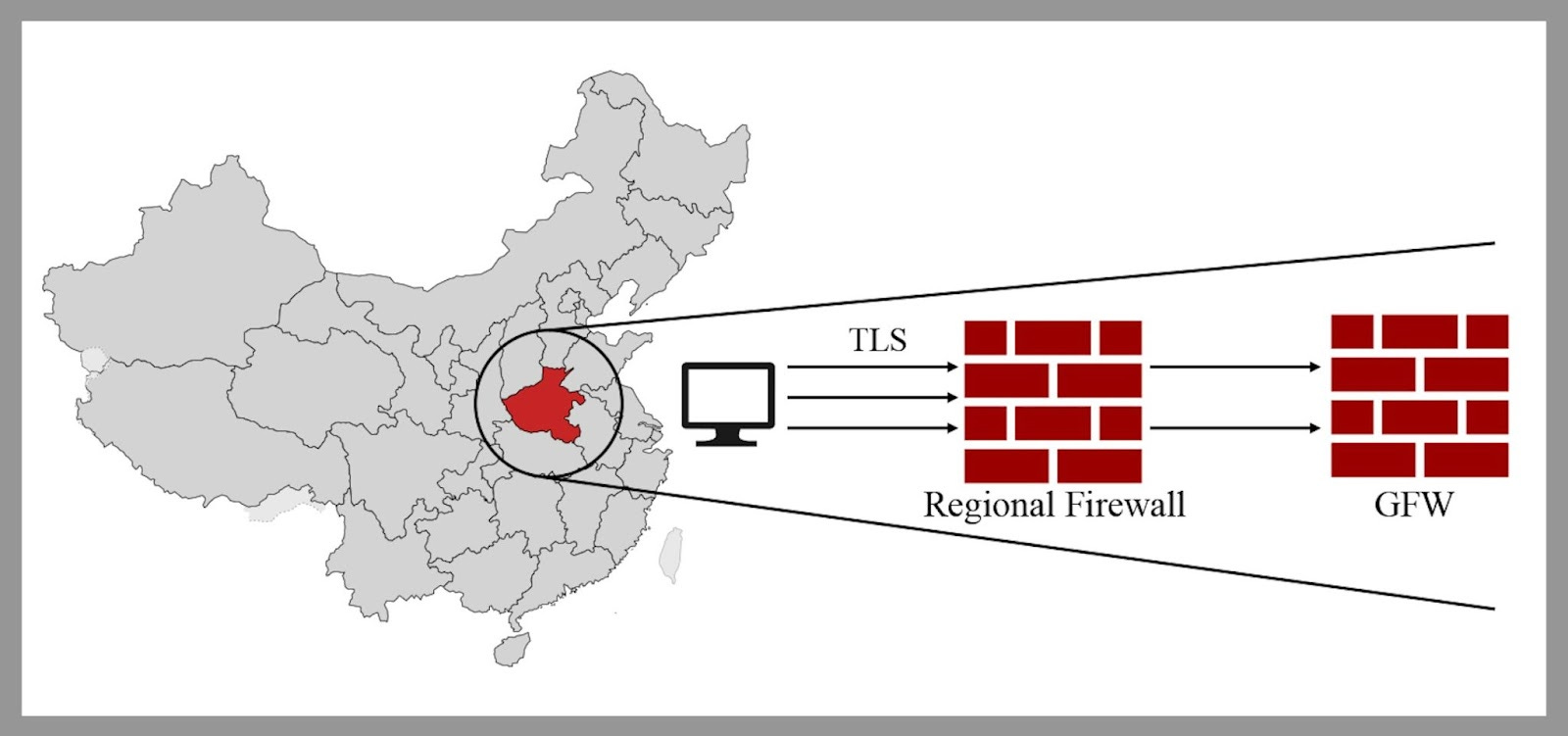
From the outside, China’s so-called “Great Firewall” (GFW), a network of regulations and digital controls the Chinese government uses to restrict content in cyberspace, can appear monolithic — uniformly blocking global websites within the country. But there are wheels within wheels — or rather, walls within walls. An investigation published this week by a team of US researchers, including from the censorship monitoring platform GFW Report, concluded that Henan province has erected its own additional firewall that blocks up to 10 times more websites than filtered by the national firewall.
The team followed a trail of breadcrumbs from Chinese developers, who posted on coding forums like GitHub that they had spotted websites openly available in the rest of China that suddenly went down if they were in Henan. The report tests website access on servers in multiple regions, including Beijing, Shanghai, Guangdong and Jiangsu. The report notes that whereas the national firewall disproportionately targets websites surrounding pornography and news, business and finance received the largest share of blocks within the Henan firewall. The report surmises this could be because the province has previously been hit by a number of corruption scandals in state-controlled banks that have jeopardized social stability, such as the Henan banking crisis of 2022. “It is very probable that the state wants to limit access to information that is relevant to the economy of the area,” the report suggests. Information control targeted to particular provincial sensitivities is an interesting development in China’s digital censorship.
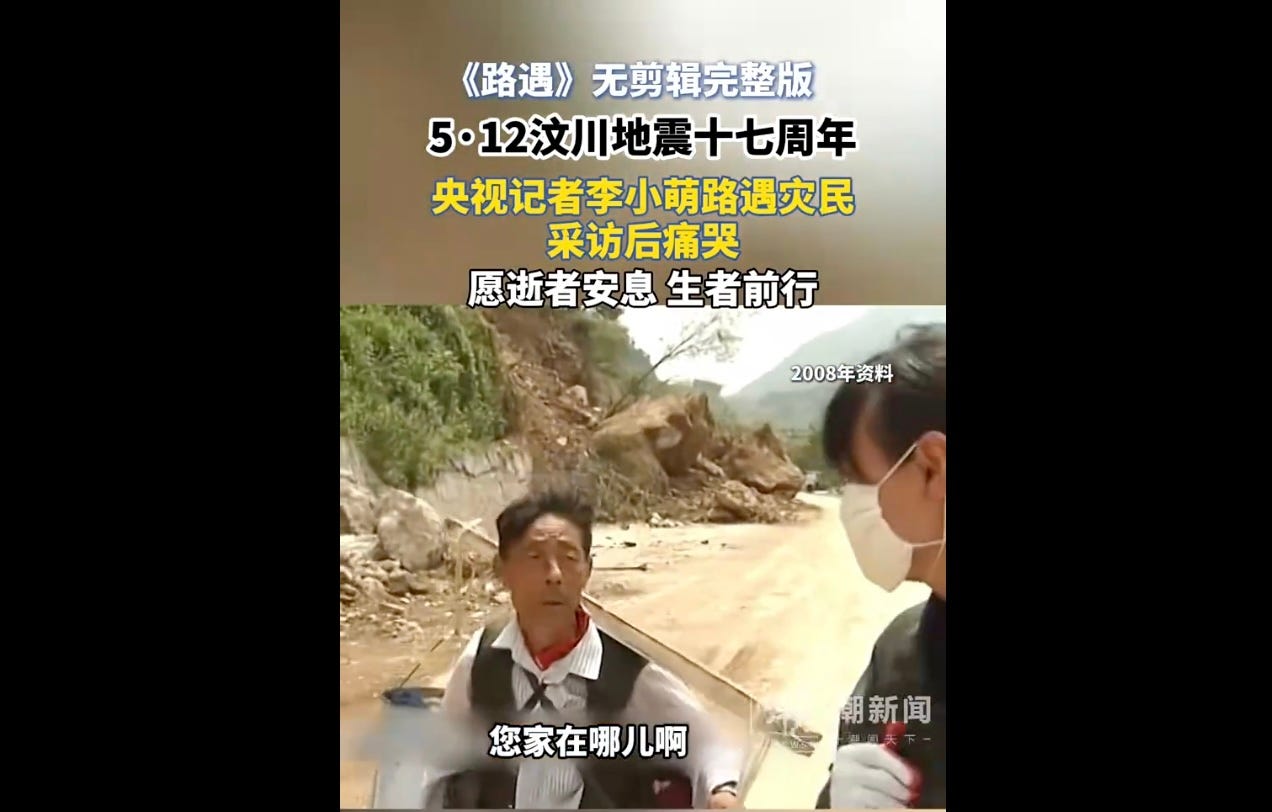
Monday this week marked the 17th anniversary of the Wenchuan earthquake, a 7.9 magnitude tremor that devastated Sichuan province and tragically took the lives of nearly 100,000 people. On the anniversary this year, one particular Wenchuan-related item surged to the top of search engine Baidu and hot search lists on the social media forum Weibo. It involved a vox pops interview given on location one week after the 2008 quake by Li Xiaomeng (李小萌), a reporter from state broadcaster CCTV. In the old broadcast shared on social media on May 12, Li comes across a farmer known simply as “Uncle Zhu” (朱大爷) as she strolls along a collapsed mountain road. Speaking a local dialect, Zhu stoically tells the journalist about the appalling conditions in the area. Through an interpreter he explains to the reporter that he is returning home to harvest his rapeseed crops in order to “reduce the burden on the government” — meaning that he will have some income and not need to be totally dependent on aid. By the end of the interview the farmer is convulsed with sobs, the tragedy of the situation coming through.
Li posted this week on Weibo to commemorate the moment, revealing that Uncle Zhu passed away in 2011. She said: “That conversation, with its unexpected, banal but heartbreaking details, showed all of us in China that people like Uncle Zhu, with their calm acceptance in the face of catastrophe, have the backbone to do what is right.” Other media, including China Youth Daily, an outlet under the Communist Youth League, built on Li’s exchanges with the Uncle Zhu in the years after the quake to commemorate the anniversary.
But a key portion of the television exchange was edited out of this year’s commemorative coverage. Near the midpoint of the original video, Li turns from her conversation with Zhu to interview several other farmers. One farmer explains that his child was killed in the earthquake, “buried in Beichuan First Middle School.” This exchange referenced the widespread collapse in the quake zone of shoddily constructed school buildings, resulting in the death of thousands of children. Revelations of school collapses briefly drove a wave of public anger, and a burst of Chinese media coverage — before the authorities came down hard.
As Dalia Parete wrote last week for CMP, Chinese media are generally subject to strict controls when reporting on breaking disaster stories. but past disasters too are subject to careful narrative control, with inconvenient facts often erased from official memory.
Screenshot of Li Xiaomeng’s May 2008 interview from the quake zone with “Uncle Zhu.”