By all official accounts, the latest appointment for deputy editor-in-chief at the CCP’s flagship daily newspaper The People’s Daily (人民日報) represents a noteworthy development in Chinese politics. Du Shangze (杜尚澤) is just 44 years old, a member of the post-1980s generation, and — as many headlines pointed out — a woman.
The news even caught the eye of one of the country’s most influential commercial media outlets. Referencing a phrase from Mao Zedong marking the CCP orthodoxy on gender politics within the Party, Caixin reported earlier this month that “‘half the sky’ is stepping up in politics” (政壇“半邊天”發力).
ThePeople’s Daily is a ministerial-level institution (正部級), under the direct control of the CCP Central Committee, with senior editors also holding administrative ranks within the Party. That makes Du officially the youngest official in China to hold a vice-ministerial rank and the first person born in the 1980s to get there. It’s a seniority level that Du’s colleagues in the state media apparatus, born in the mid-1970s, are only just beginning to reach. Huo Xiaoguang (霍小光), for example, vice president of Xinhua News Agency, the party’s newswire, was born in 1975 and assumed his position in 2024, when he was 48 years old.
The CCP leadership is famously senior, but a recent analysis shows that vice ministers, — whose average age is 57, average younger than full ministers, whose mean age is 62. Du’s appointment is also notable for her gender. Among the eight officials in the leadership of the People’s Daily, Du is one of only two women.
Du’s rise at the newspaper happened gradually. A 20-year veteran of the CCP flagship daily often accompanying top leadership, her profile rose in 2014, when under the pen name “Du Xiaodu” (杜小杜), she covered the informal exchanges between then-U.S. president Barack Obama and Xi Jinping in Beijing for the Asia Pacific Economic Cooperation summit. Her 2019 report on Xi’s trip to Europe won the 2020 China News Awards (中國新聞獎), a national award for top journalism that in the past decade has skewed heavily toward creative pro-Party communication and even direct propaganda. The Europe write-up circulated across government channels, state media, and even the BBC, for its standout quote from Xi Jinping: “I will forget myself for the people” (我將無我, 不負人民).
Not forgetting that the chief role of the People’s Daily is to “guide public opinion,” the Party’s buzzword for media control, Du’s report and its international reception could be regarded as a runaway success.
China’s latest effort to advance its diplomatic influence across the media landscape on the African continent unfolded last week as some 400 representatives from 45 countries gathered in Beijing for the Seventh China-Africa Media Cooperation Forum (第七届中非媒体合作论坛). While topics discussed at the event included content innovation and AI integration in the broadcasting sector, the primary diplomatic role of the event was clear. Its stated goal, according to the official Beijing Daily newspaper, was to “create a favorable atmosphere ahead of the 2027 China-Africa Cooperation Forum.”
Further emphasizing the foreign policy underpinnings of this ostensible media event, the People’s Daily, the official mouthpiece of the Chinese Communist Party (CCP), alluded to one of Xi Jinping’s core political concepts as it said that China’s media cooperation on the continent was moving toward “an all-weather China-Africa community of shared future for the new era” (全天候中非命运共同体).
Attendees at the event reportedly pledged cooperation in a number of areas, including joint broadcasting, micro-drama co-production and youth exchange. The primary outcome of the event, however, was what China called a “joint declaration” (第七届中非媒体合作论坛共同宣言). According to state media reports, the declaration, which was not made public, commits partners to “work together to present a true, multi-dimensional and comprehensive image of China-Africa development to the international community.” This was an unmistakable reference to a core tenet of the CCP’s global media view, which holds that the goal of international journalism development — in contrast to ensuring greater independence or professionalism —is to ensure that stories and larger narratives are favorable to China and the Global South.
In less than a week, the Nepalese capital of Kathmandu was to be the host of an international conference on Tibetan studies, gathering more than 720 participants from nearly 40 countries. The conference will instead be moved online after senior Nepalese officials, bowing to pressure from China, urged organizers not to proceed with the live event, scheduled for August 23-29.
While the conference organizer, Oxford University’s International Association for Tibetan Studies (IATS), made no mention in its August 8 announcement of pressure from China’s government as a key factor, saying that it “[had] not yet been given any explanation for this last-minute decision,” independent reporting two days earlier had already made China’s involvement clear. On August 6, the Kathmandu Post, Nepal’s English-language daily newspaper, had reported that government officials had halted the in-person event in response to lobbying from Chinese diplomats and other representatives that had intensified since June.
The case, which follows the sudden closure of the RightsCon digital human rights conference in Zambia in May this year, has again focused concerns on the Chinese government’s application of pressure on countries globally to halt international events at which critical discussion might turn to China’s policies — particularly on Tibet, Taiwan, Hong Kong and Xinjiang.
“Beijing has already become suspicious that the present [Nepalese] government is tilted toward the West,” the Kathmandu Post quoted one unnamed government official as saying. “The seminar became a test of the government’s neutrality. To assuage China’s concerns, the decision was taken to cancel the event.”
The local Nepal News, an English-language online news portal, reported that Zhang Maoming (张茂明), China’s relatively new ambassador to Nepal, met with Foreign Secretary Amrit Bahadur Rai on July 21 and voiced his concern that the conference might be used as a platform for criticism of China’s government by the “Tibetan exile administration” — a reference to the Central Tibetan Administration, the government-in-exile of Tibet that is based in Dharamshala, in the Indian state of Himachal Pradesh.
Launched at the start of the sweltering summer, the Chinese short drama “The Girl Who Was Laid Off” (被裁掉的女孩) spread like wildfire on the short video platform Douyin (抖音), China’s homegrown version of TikTok. The show’s star, Fang Taozi (方桃子), or “Peach Fang,” rode the show’s success to personal fame by playing the relatable role of the morally centered small-town girl trying to reach her dreams in the big city. By late July, the show topped 200 million views, and Fang’s Douyin account was closing in on half a million followers. This made her product promotion royalty as an influencer, commanding a rate of more than 258,000 yuan, or roughly 36 thousand dollars, for any video above 60 seconds.
It seemed that nothing could break the dream — until last week, when Fang Taozi began promoting NUT NUT Look brand contact lenses for an Anhui manufacturer. “I wore them all day long,” she declared in a promotional video, “and it was comfortable the whole time!”
The problem: Fang Taozi may command a very real six figures, but she is an artificial influencer generated by state-of-the-art AI. She has no physical body. Nor does she have any real concept of comfort and discomfort.
Should she be remarking on human experience at all?
Fang Taozi is shown unboxing and testing her NUT NUT Look contact lenses. SOURCE: Singtao Headlines (星島頭條)
As the promotional video had Fang Taozi trending on social media — ”How can she test these?” asked one user; “She doesn’t even have eyes!” — these were the questions raised by Beijing Business Today (北京商报), a business newspaper published under the state-run Beijing Daily Newspaper Group. In a commentary stating the obvious, that AI characters do not have bodily experiences and cannot wear, feel, or evaluate physical products, the paper questioned Fang’s authority and the credibility of the marketers. “Advertisements may be able to fabricate appearances, but they cannot fabricate the reality of consumption,” the paper wrote.
There were legal blind spots as well, the outlet reported, drawing on the analysis of real-life lawyers. Virtual images created with artificial intelligence could not be legal persons, they said, and therefore could not qualify as “endorsers” (广告代言人) under Chinese law. Moreover, under Chinese regulations, the colored contact lenses sold by Anhui Huaxin Enterprise Management Co., Ltd., the makers of NUT NUT Look, would be considered Class III medical devices, which under advertising laws cannot be promoted by endorsers.
Convincing Bruises
The Fang Taozi discussion this month is sure to be the first of many that explore the implications of a world in which corporations and other institutions and entities can impersonate individuals in an AI-driven world.
A History of China’s AI Influencers
From 2020 to 2026
2020
翎
Ling
Regarded as one of the first hyperreal virtual influencers. Built with an East Asian beauty ideal and a persona rooted in Peking opera and calligraphy, she appeared on the cover of Vogue China.
2020
阿喜
Ah Xi (Angie)
Purposefully imperfect, having noticeable skin texture, pimples, and slightly misaligned teeth. She gained a Douyin following thanks to her relatable attitude, which distinguished her from glossier virtual influencers.
2021
柳夜熙
Liu Yexi
A beauty influencer known as a demon-hunting makeup artist. Her debut video mixed cinematic special effects with beauty content and went viral within hours.
2021
AYAYI
AYAYI
She became famous after she posted a single photo on the social media platform Xiaohongshu (小红书). She later became online retailer shop Tmall digital brand ambassador and partnered with luxury brands.
2022
天妤
Tianyu
Tianyu is a Chinese virtual influencer with Tang-dynasty-style makeup and fashion. She launched in April 2022 and went viral fast, with 2 million followers within a month. She also built an overseas following on TikTok.
2026
方桃子
Fang Taozi
A fully AI-generated actress and influencer, starring in the short drama “The Girl Who Was Laid Off” (被裁掉的女孩). She crossed over into an independent lifestyle vlog persona.
2026
周以衡
Zhou Yiheng
The AI-generated male co-lead alongside Fang Taozi in the short drama “The Laid-off Girl.” After the drama’s popularity, he gained followers on his social media account, becoming an influencer too.
These days, the dreams can seem startlingly real. Amid the more than 220,000 AI dramas that aired in China during just the first half of this year — 90 percent of them failing to draw audiences — Fang Taozi stood apart because of how unpolished and authentic she appeared on her social media page. Her makeup altered between posts, leaving her convincingly bare-faced or smudged after what were supposedly long and tiring days. She had real apparent skin texture, including moles and tired circles under her eyes. Such fictional imperfections made her more convincing to her audience.
So how does the very authentic looking Fang Taozi, trying to make it as a model in the big city, connect to the real world?
Fang Taozi is the creation of a small team led by a writer-director identified by the pseudonym "Feifei Fei" (菲菲飞). She is managed as an AI talent by the show’s production company, Guangzhou-based My Film & TV Media Co. (广州我的影视文化传媒有限公司), founded in 2019 and majority owned (75 percent) by Fang Fei (方菲), the real-life former model behind the “Feifei Fei” pseudonym, who once modeled for fashion magazines like ViVi (昕薇). My Film, which also offers videography and business consulting services, is 25 percent owned by Guangzhou Thirteen Culture Communication Co., Ltd. (广州十三文化传播有限公司), which calls itself one of China’s “top content and e-commerce MCN platforms.” MCNs, or "multi-channel networks," are companies that manage, package and monetize a growing range of content creators such as livestreamers, influencers and video creators whose content is distributed on services like Douyin, the social e-commerce platform RedNote (小红书), the short-video platform Kuaishou (快手) and Weibo.
The fictional Fang Taozi, the young woman trying to realize her dreams, will of course not see a single yuan of the revenue generated by successes of “The Girl Who Was Laid Off,” which was reportedly created with the help of LibTV, an AI video-making service that allows users to submit a story concept and receive an AI-generated film. Those earnings will fly directly into the accounts of My Film and its two shareholders, once the platforms have taken their share. There will be no need, as is standard with human influencers, to pay commissions out to talent agencies or managers.
The problem with “Peach Fang” is one that is not unique to China, and that will continue to be a topic of discussion, debate — and probably regulation. AI influencers such as Lil Miquela from Brazil and Rozy from South Korea have also dominated social media and faced similar controversies. In each of these cases, audiences have enjoyed and consumed synthetic characters, but been jarred from their dreams when these AI personalities have pretended to real-life experiences that have a claim on our human materiality — like contact lenses they cannot have tested.
Fang Taozi’s first controversy came to a close last weekend with the quiet removal of the NUT NUT Look video, reported by Guangzhou’s Southern Metropolis Daily (南方都市报) newspaper. The report, quoting lawyer Chen Zekun (陈泽坤), also sounded another warning about the real-life legal limits of virtuality. “The fact that a virtual person lacks legal personality,” he said, “does not mean that the team and the related entities behind it are exempt."
On September 1 this year, Kyrgyzstan will assume the chairmanship of the Shanghai Cooperation Organization (SCO), the economic and security alliance formed in 2001 by China and Russia together with several Central Asian countries, and will host a summit marking the SCO’s 25th anniversary. The summit comes amid a deepening relationship between China and Kyrgyzstan. Over the past two years, construction has begun on a new railway line branded as part of the Belt and Road Initiative linking China, Kyrgyzstan, and Uzbekistan, with China providing more than half the financing. In that period, the country’s president has met with Chinese leader Xi Jinping on three separate occasions, including signing a joint statement in September 2025 on deepening the bilateral partnership.
But China’s engagement with Kyrgyzstan in terms of media and strategic narratives goes back at least two decades. Since 2004, Xinjiang Radio and Television Station has produced a Kyrgyz-language TV program broadcast daily by satellite on Kyrgyzstan’s national television, pairing short segments on Chinese culture, agriculture, and current affairs with dubbed Chinese TV dramas. A 2023 study by researcher Niva Yau for the OSCE Academy in Bishkek examined two similarly structured programs, Zhungogo Sapar and Kytai Terezesi, likewise produced by the Kyrgyz-language team at Xinjiang Television and fronted by an ethnic Kyrgyz presenter from Xinjiang. The report describes them as “an active part of China’s soft power strategy in the region,” built around stories of purported, state-narrated governance successes in Xinjiang.
Lingua Sinica spoke with Adina Masalbekova, a researcher on China’s engagement with the region, about how Chinese state media have gained a foothold in Kyrgyzstan — and how Russia’s parallel media strategy reinforces many of the same messages.
Dalia Parete: How would you describe the media landscape in Kyrgyzstan, for people unfamiliar with it?
Adina Masalbekova: Kyrgyzstan’s media landscape was shaped largely by the collapse of the Soviet Union and its aftermath. The country took a deliberate step toward decentralizing its institutions, including the media, as the Soviet Union itself had already begun to open up. The first president sought help from humanitarian and international organizations, and that’s how the country built the media infrastructure it still largely runs on today. Outlets received significant support from international donors, alongside broader development projects. That funding relationship is foundational to how the landscape looks now, and it’s a big part of why Kyrgyzstan’s media environment ended up freer and more pluralistic than its neighbors’.
In fact, Uzbekistan under its first administration maintained absolute authoritarian control over the media, enforcing regional media exchange to secure total domestic control. Kazakhstan has remained largely authoritarian, with brief windows of openness that closed again after the 2022 protests and the subsequent crackdown. Tajikistan and Turkmenistan are more restrictive still. Turkmenistan’s independent media exists only in exile. With that in mind, Kyrgyzstan is the outlier, the first in the region to see a state-scale protest toppling the government and regime change and the one place where that political opening also became a media opening with donor-funded independent outlets, a relatively freer press,and for a long time, an active, vocal civil society.
DP: Would you say that Kyrgyzstan, compared to the other Central Asian countries, has a slightly more open environment?
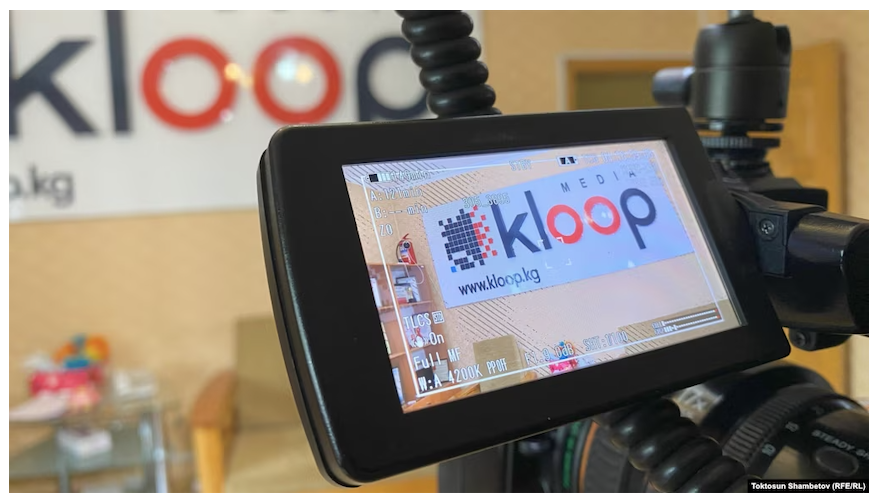
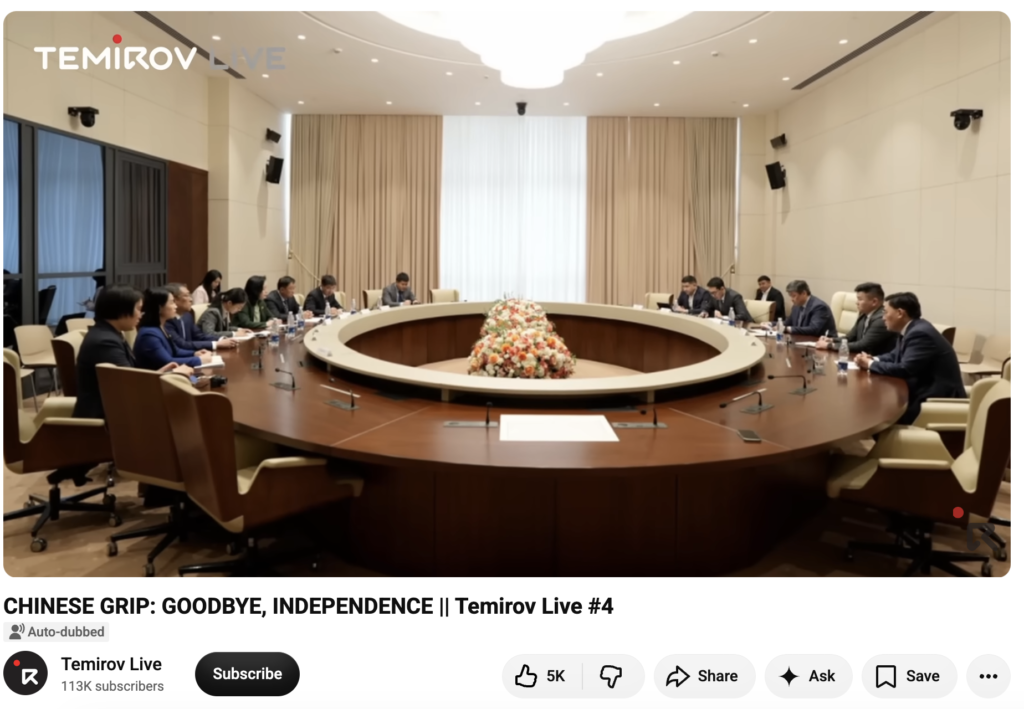
AM: Yes, even if it’s a relative kind of openness and one that’s been narrowing since 2022. Compared to Uzbekistan, Kazakhstan, Tajikistan, and Turkmenistan, Kyrgyzstan still has independent outlets that investigate and publish. These journalists are widely trusted and widely read, and their reporting reaches well beyond a small activist audience. Investigative outlets like Temirov Live and Kloop are the widely known examples, each with over a hundred thousand subscribers on YouTube alone. Both continue to operate and draw large audiences, with Temirov’s most recent investigation getting over 100,000 views, even after years of legal pressure and being classified as extremist organizations.
Temirov Live doesn’t legally exist anymore in the country. Investigative journalist Bolot Temirov, the founder of Temirov Live, was deported and stripped of citizenship after authorities accused him of drug possession and forging documents. He now runs the outlet from exile. Several of his colleagues were later prosecuted too and his wife, Makhabat Tazhibek kyzy, also a journalist on his team, received the most severe sentence of anyone charged in the case.
Kloop’s website has been banned by the government in 2023, and people now need to use a VPN to read it, and that’s just become normal. So calling it more open is true only in a comparative sense, but it’s an openness that’s been pushed underground and abroad, not one that operates freely inside the country.
DP: What does that pressure actually look like day to day for journalists, and how has it evolved over time?
AM: As I was saying before, on the ground, it looks like outlets are surviving by relocating, adapting, and absorbing constant pressure. A former Kloop journalist shared with me that government pressure is not a new challenge for the outlet, stating that multiple previous regimes have attempted to obstruct their work and block their platforms. She added that other media outlets have felt this recent shifting political climate more sharply.
The pressure we’re seeing didn’t begin with the press, and it didn’t begin just with the current regime. There were always attempts to suppress critical voices under previous ones. Tracing it through the current regime, the administration’s broader pushback started around 2022, primarily targeting the political opposition and activists, particularly during the mass arrests following the Kempir-Abad water reservoir protests. By mid-2023, that focus shifted toward independent journalists and bloggers, several of whom faced imprisonment for their commentary. A stark example from that period was the arrest of Yryskeldi Jekshenaliev, a 19-year-old blogger who was detained and released a year later, facing a potential six-year prison sentence on charges of publicly calling for mass riots and violence. By early 2024, these restrictive measures had directly impacted established investigative outlets such as Kloop and Temirov Lab. Since then, the environment has expanded even further, affecting broader civic spaces.
It looks like outlets are surviving by relocating, adapting, and absorbing constant pressure
We’ve seen independent polling research institutes like the Central Asia Barometer forced restrict their operations. Even some selective independent academic gatherings were banned, including the cancellation of the historical forum dedicated to the Urkun centenary in December last year.
One case outside journalism shows just how far the chilling effect reached. In Tajikistan, a woman working for an independent Kyrgyz NGO running a regional survey on attitudes toward China. She wasn’t a journalist, but because the survey touched on China, she was detained and sentenced to roughly ten years on a charge that translates to “betraying the motherland.” At the same time, academic freedom took a hit. Now, many scholars and independent institutions have adopted a degree of self-censorship on topics critical of the government or of state relations with China and Russia; this trend aligns with heightened regional discussions of Russian colonialism following the war in Ukraine, alongside the further tightening of partnerships with China in recent years. The legal architecture has also hardened: last year, a constitutional amendment gave the government grounds to shut down media on the basis of extremism.
It’s not just legal pressure, either. Funding has collapsed, too. USAID (the US government’s foreign aid agency, which has funded independent media projects worldwide) pulled out, and the EU has been shifting its budget toward Ukraine and defense. Together, that’s cut off a lot of the money independent media used to rely on. To make up for it, journalists are taking on second jobs, like bartending or DJing. For younger generations, this means turning to influencer-style income sources like reader donations, ad deals rather than just reporting.
DP:How did Chinese media first establish a presence in Kyrgyzstan? What were the entry points and conditions?
AM: The first Chinese presence in Kyrgyzstan’s media landscape was through cooperation with the National Television and Radio Broadcasting Corporation, the state broadcaster. This was in the early 2000s. They started airing TV shows and documentaries about China and East Turkestan, covering different provinces, and aired them daily on national TV. I actually grew up watching some of this myself.
These documentaries had Kyrgyz dubs, not just Russian ones, done by ethnic Kyrgyz based in Xinjiang, in East Turkestan. I never noticed anything off about it growing up. It was actually my aunt who pointed out that the Kyrgyz spoken by ethnic Kyrgyz in those areas doesn’t sound quite the same as the Kyrgyz spoken in Kyrgyzstan. They have a different accent. Once she said that, I started paying attention. I’d always assumed the dubbing was done locally, but it wasn’t. It was done in China, and then the documentaries were run on our national TV every day.
These documentaries had Kyrgyz dubs, not just Russian ones, done by ethnic Kyrgyz based in Xinjiang
Another entry point was through the Confucius Institute in Bishkek, where I studied Chinese. They had print materials just sitting out on display there, mostly in Russian and Kyrgyz, with some stories in Chinese, though Russian was the dominant language. They distributed these for free and printed new editions periodically, I believe every three months, though it might have been monthly.
There is also an outlet registered with the Kyrgyz Ministry of Foreign Affairs, though I don’t think it has a print edition, just a website, called Silk Road Observer (丝路新观察网), which is operated by the Xinjiang branch of China News Service.
DP: Which Chinese outlets were involved in the documentaries, and has that changed over time?
AM: CCTV and People’s Daily were there from the earliest timee. Xinhua is newer. It produces its content in Chinese and Russian, so it has a slot to air its reportage on national TV, especially around events like the Shanghai Cooperation Organization or the China-Central Asia Summit.
DP: What about the other platforms?
AM: There’s also Dolon TV. The channel does air some Chinese content, though, alongside everything else. They show movies and run some documentaries, but it’s not exclusively Chinese. They also mix in general entertainment and Western movies, probably selected or censored to avoid anything too political.
DP:Do you think Chinese-language media have really managed to reach people with their narrative?
AM: Honestly, no. Growing up watching those documentaries, it was just background noise, like any entertainment show you put on TV while doing chores around the house. You watch but don’t absorb. China still feels like the other culture here. Given the geographical situation, there’s a common but false perception that we, Central Asians, are culturally very close. In addition, when we look at Central Asian history and folklore, we often see the Han Chinese as the enemy and rival. This outlook also makes it harder for people to accept and welcome a Chinese presence immediately, even considering the economic benefits for the region that the majority rely on and comply with. Russia, on the other hand, despite its colonial history, feels more like ours because of the language and Soviet ties. Even the US feels closer than China does.
China still feels like the other culture here.
Part of that is historical. Muslim Kyrgyz identity doesn’t really overlap with Chinese culture, and there’s old folk memory of conflict with the Han Chinese, preserved in our folklore, songs, and fairy tales. China frames the “Silk Road” thing as old friendship, and sure, there were diplomatic ties, but the memory most people carry is war and maneuvering, not friendship. It gets sharper in families with direct history. In 1916, many people fled north into China during Russian repression and were mistreated there, even sold into slavery. Families with that history have much stronger negative views. I didn’t even know about this until I did the research, being from the south myself.
But people are pragmatic, too. After China joined the World Trade Organization (WTO) in 2001, trade with Kyrgyzstan opened up. So there is also a real practical reason for cooperating with China, even with all that underlying distrust. Both just sit there together.
Temorov’s video analyzing the relationship between China and Kyrgyzstan. SOURCE: Screenshot from YouTube.
DP: So is there a gap between the official narrative and how people actually feel about China and what happens to those who voice that gap?
AM: China tries to close that gap with things like sponsored journalist trips and fellowships. Journalists who go on these trips know it’s propaganda on some level, but they still return and write favorably about it.
Based on my own research on the matter, this was 2021 to 2022, so before and after the war in Ukraine started, Kyrgyzstan’s state media coverage of China became more positive. But the comments under these articles stayed split. Almost every China-focused story included at least one remark about Uyghur oppression throughout the period. That’s died down a bit now, but it still happens. Honestly, the majority of the backlash centers specifically on the Uyghur issue and debt concerns rather than on China more broadly.
Even so, awareness of what’s happening in Xinjiang hasn’t disappeared across Central Asia. That’s partly because journalists have interviewed people who fled the region and partly because some Kyrgyz families have personal connections to people affected by it. Even people who work closely with the Chinese government know what’s going on. Some of them studied in Urumqi and saw the religious discrimination first-hand. Restrictions on fasting. Restrictions on prayer. But they rationalize it anyway. They’ll say things like “we’re guests in their country,” or “China’s doing well, we should learn from them.”
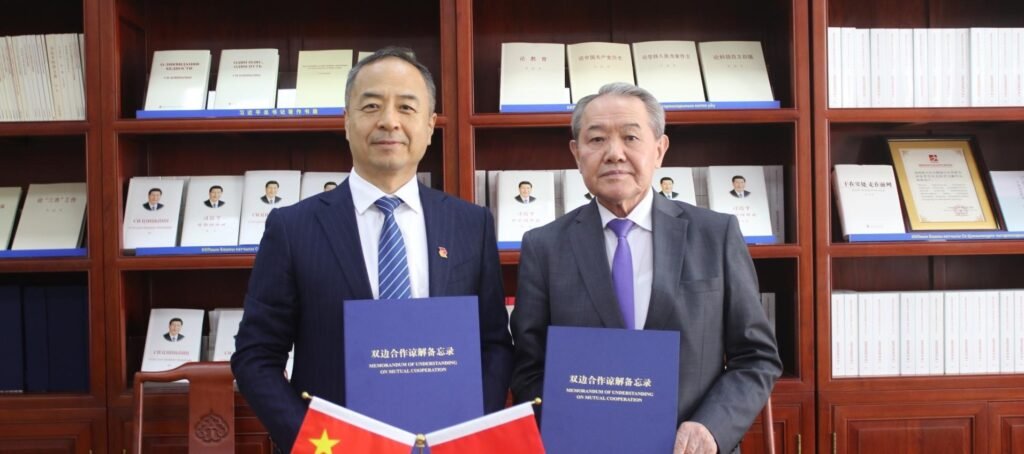
The Vice-Rector of the Kyrgyz National University poses for a photo with the Deputy Editor-in-Chief, People’s Daily, after the signing of a memorandum of cooperation between Kyrgyz National University and People’s Daily, on May 2026. SOURCE: Kyrgyz National University.
Beyond the comments, independent civil society pushback gets squeezed using the same legal tools used against journalists. A large number of NGOs and their activities have been facing more strict regulations due to the adoption of Russian-style law on foreign agents, leaving little room for constructive criticism and reporting on local issues. However, in the majority of cases, it only targets funding from Western donors compared to funding coming from China or Russia. In addition to foreign agent law, it became common to frame certain critical voices as ‘an attempt to call for mass riots and violence and extremism, including concerns raised about the increase of Chinese influence and debt. Frequent anti-China protests taking place in Kyrgyzstan in the past have been taken under control by years of government-led campaigns about the positive impact on the economy due to Kyrgyzstan-China cooperation. Over the past few years, negative discourse on China has become more sensitive.
Journalists who go know it’s propaganda on some level, but they still come back and write it up favorably
Even diaspora media avoid the topic. The Uyghur community here has its own paper, but it’s deliberately apolitical, most of them were born and raised here, not recent arrivals, and they’re scared because of embassy monitoring. I tried to talk to them and got turned down. Same with the Dungan community and their radio and print outlets.
So overall, it’s a mixed picture: official coverage shifts, but the underlying skepticism among the population doesn’t really go away, and it’s largely anchored to the Uyghur issue.
DP: Lastly, how does Russia fit into this picture? We know the shared heritage, history, and culture, and one of the languages used is Russian — what does Russia represent in this, and what does China’s position look like relative to Russia’s and Central Asia’s closest partners?
AM: Russia and China aren’t open rivals in Central Asia; they’re mutually reinforcing. Both share an interest in pushing back against US influence, and they amplify each other’s narratives through platforms like the Shanghai Cooperation Forum, promoting ideas like non-interference and sovereignty that effectively redefine human rights and democracy on their own terms. More broadly, the war in Ukraine has shifted the balance: Russia, weakened by sanctions, now needs China and Central Asia more than before, so it’s ceding regional influence rather than guarding it.
With media specifically, it’s not just indirect Russian influence through shared culture or language, there’s actual formal cooperation. The Russian government has an agreement with the Kyrgyz media, and there is journalistic cooperation between the two. You can see it clearly in outlets that always report positively about our government — they’re the same ones pushing pro-China narratives. And it’s not only the official coverage. In the comments sections, there’s a clear pattern of troll farms, and they’re just as active defending Russia and praising the government as they are with China. Sometimes accounts are even paid through group chats on WhatsApp or Telegram to post something positive. So in the media space, Russia’s role isn’t just cultural or historical — it’s structural, baked into how our state-aligned outlets actually operate.
Earlier this month, an AI-generated video depicting the Philippines as a frightened monkey ignited outrage in Manila and drew condemnation from the country’s diplomats and lawmakers. Posted on July 10 to the social media account of China Daily (中國日報), the official English-language outlet of the Chinese central government, the video showed a monkey in a salakot and barong — the traditional hat and shirt worn on formal occasions — pushed onto a karaoke stage by giant hands bearing US and Japanese flags, in an apparent suggestion that the Philippines is a puppet of the two countries.
“This is another act that reflects the mindset of an entitled bully,” said Philippine Representative Leila de Lima.
Nearly as outrageous, however, was the flat denial of responsibility that followed later in the month from China’s top diplomat in the Philippines. On July 21, the same day Philippine President Ferdinand Marcos Jr. summoned him over a Chinese Coast Guard attack on a Filipino soldier, Ambassador Jing Quan (井泉) told reporters that the video had not reflected the official stance of the Chinese government — an assertion clearly at odds with the outlet’s role as an arm of the party-state. “We simply cannot control every media outlet, every video, every article, and every newspaper,” he said.
China Daily, in fact, operates directly under the Central Propaganda Department and the State Council, and all its content is subject to political controls under the CCP’s decades-old doctrine of “guidance of public opinion” (舆论導向), which requires media to align coverage with the Party’s messaging. In its own 2025 social responsibility report, an annual exercise required of all core Party and state-run Chinese media, China Daily describes itself as “a major central propaganda and cultural unit” (中央主要宣传文化单位), and pledges strict adherence to the principle of Party control over media.
The monkey video, posted to coincide with the 10th anniversary of the 2016 South China Sea arbitral ruling that invalidated China’s territorial claims, drew a formal diplomatic protest from the Philippines’ Department of Foreign Affairs, which called the depiction “demeaning, dehumanizing, and racist” and demanded its removal.
Scheduled for release over the past weekend, the Chinese action war film The Belief (澎湖海戰), a dramatic depiction of the 1683 Qing conquest of Taiwan, seemed on track to define a new and, for many, concerning genre — the “forced-unification blockbuster.” But the film, it appears, has run aground, its planned debut coming and going in silence.
Produced by a consortium of investors with a reported budget of 500 million yuan (about 70 million dollars), and backed by the state-owned Changchun Film Studio, The Belief centers on the 1683 naval battle at Penghu, an island 50 kilometers from the main island of present-day Taiwan, a country official policy in Beijing insists has been “an inalienable part of Chinese territory since ancient times.” The setting is the outset of the Qing dynasty (1644-1911), as Qing forces seek to defeat remnants of the Ming dynasty (1368-1644) holding out in Taiwan.
The allegorical connection to present-day tensions, which have resulted in persistent military exercises in the strait and containment of Taiwan internationally, is so plain it scarcely needs mentioning. The Chinese Communist Party (CCP) regards the island as unresolved business from a civil war fought in the 1940s with the Kuomintang, now one of several political parties in a democratic Taiwan.
The Belief has been heavily promoted by state media, including the CCP’s People’s Daily, since its first trailer dropped on October 25, 2025, the 80th anniversary of Taiwan’s “retrocession” from Japanese colonial rule at the end of World War II. An announcement on May 22 said it would be released on July 25. But the film, with its swashbuckling scenes of battles at sea, has so far not set sail — leading to speculation about what calculations China might be making.
And this is reportedly not the first delay the film has faced. According to BBC Chinese, it was already pulled from a planned Lunar New Year release back in February — prior to the May reschedule giving it the summer release date that passed on Saturday.
Media outside China have noted over the past week that the film’s official Weibo account has not been updated since June, and that the film remains unavailable on China’s domestic movie-ticketing website.
The film has stimulated heated discussion in the media in Taiwan, Hong Kong, and beyond. The Taipei Times noted in an editorial that the film’s tagline, “the unification of Taiwan is an unstoppable trend,” was lifted straight from a speech by Chinese President Xi Jinping.Storm Media quoted Liu Hsing-jen (劉性仁), an associate professor at Chinese Culture University’s Institute for National Development and Cross-Strait Studies, warning that the film’s marketing — casting a historical civil war as a clash of “us or them” — could send the international community the wrong signal that China was preparing for war, undercutting Beijing’s actual strategy of favoring “peaceful unification” while applying gray-zone pressure.
Taiwan outlets ETtoday and Newtalk both cited Fan Shih-ping (范世平), a professor of East Asian studies at National Taiwan Normal University, as saying the film has likely courted controversy on several fronts. First, it risks being read by audiences as an implicit rebuke of China’s leadership for not acting on its strong rhetoric about the “reunification” of Taiwan, in contrast to the conquering Shi Lang.
Further, it glosses over an inconvenient historical fact, according to Newtalk’s account of Fan’s analysis. Shi Lang’s attack on Taiwan was essentially a military conquest, not something the Taiwanese people actively welcomed, said the professor. If history is romanticized this way, he argued, the international community may more readily conclude that a Chinese military invasion of Taiwan would likewise constitute an act of aggression — seriously damaging Beijing’s international image.
Perhaps adding to the trouble, Shi Lang, the film’s protagonist, is a historically fraught choice of hero.
Media in Taiwan have generally referred to The Belief as a “force-unification blockbuster” (武統大片), giving the invasion scenario it depicts exactly that sense of unwantedness. “And that’s not really unfair,” Hong Kong’s HK01 noted in a related report.
Perhaps adding to the trouble, Shi Lang, the film’s protagonist, is a historically fraught choice of hero. He originally served Zheng Chenggong (鄭成功), the Ming loyalist commander, before defecting to the Qing and leading the campaign to crush Zheng’s successors. This betrayal, as Newtalk and others have reported, has made him the target of online accusations that he was in fact a “Han traitor” (漢奸).
Understandably, the film has also sparked lively debate online among so-called “Han nationalists,” also known as Huang Han (皇漢). These nationalists subscribe to a narrative called the “1644 historic perspective” (1644史觀), whose intellectual roots trace back to the Republic of China era (1912-1949), when some scholars attributed China’s modern-day weakness and humiliation entirely to Qing rule, casting the Manchus, the ethnic group that founded the dynasty, as colonizers. A related trend of “Ming fans” (明粉) emerged in China about twenty years ago, driven by the runaway popularity of a bestselling history book Those Things in Ming Dynasty (明朝那些事兒), which told the stories of Ming-era figures in an accessible, humorous style. The book was originally published in an online forum.
The current controversy, however, has more recent origins. According to BBC Chinese, it emerged in China last year with a claim by a Chinese video blogger that the classical novelDream of the Red Chamber was secretly a coded work of anti-Qing, pro-Ming loyalism. The perspective is sharply at odds with the ethos of The Belief, a state-backed “main melody” (主旋律) film in which the Qing invaders are cast as heroes.
While it is unclear exactly why The Belief has been shelved, the contested status of the Qing conquerors valorized in the film could be at least part of the reason. Chinese authorities have been wary of the impact of the “1644 historic perspective,” which drew a harsh official rebuttal on December 17, 2025, when Zhejiang province’s provincial propaganda office published a commentary using the phrase and warning against politicizing history, saying some social media accounts had misled the public by “cherry-picking fragmented historical materials” (截取碎片化史料).
One core aspect of China’s understanding and insistence over its “sovereignty” over Taiwan has been the fact that the island was annexed by the Qing dynasty in 1683, after which the Qing court began establishing administrative institutions there. This expansion of administrative bodies (扩增行政机构) is also perhaps the most concrete claim to historical sovereignty inThe Taiwan Question and China’s Reunification in the New Era, the white paper China’s government issued in the wake of a visit to Taiwan by then-Speaker of the US House of Representatives Nancy Pelosi in August 2022.
Amid unwanted chatter about the significance of 1644, the film’s positioning of Qing conquerors as heroes of national unity has been problematized by a countervailing narrative casting those same conquerors as illegitimate outsiders. The suspended state of The Belief likely has something to do with these contradictions — which China’s leaders cannot afford to amplify through entertainment. That could spell trouble for a film that invested its box office hopes in stirring up patriotic sentiment over Taiwan.
Late last month, an op-ed published in the German magazine Focus+ argued that Europe should embrace open-source models from China — those offered free of charge for anyone to download, modify, and run — as a transitional plan to develop its own AI models. Written by AI expert Jürgen Seitz, the opinion piece came shortly after the US government briefly suspended access by non-US users to Anthropic’s Fable 5 and Mythos 5 models, raising fears in Europe and the UK about vulnerability stemming from over-reliance on US tech.
In the commentary, which was the focus of a German-press roundup published by the Chinese-language service of Germany’s Deutsche Welle, Seitz argued that the US ban serves as a warning sign for Europe that embracing US-made AI models is not a one-off solution if it wants to develop its own AI models. Meanwhile, he said, the performance of GLM-5.2, the model launched by the Chinese-backed Zhipu AI, is approaching that of US-made AI models.
Seitz holds the Hubert Burda Media-endowed professorship in AI for digital media and business models at Germany’s Offenburg University.
The Focus+ commentary was picked up over the past week by Chinese state media to promote the benefits of China’s AI models. A piece by the official China News Service on July 10, re-posted by news portals such as Sina Finance and Henan’s Dahe Online, said Europe now has “another development path” (另一条发展路径) between depending on American AI and waiting for homegrown models to mature. The piece also cited a European Think-tank Network on China report from last month, characterizing it as urging Brussels to balance stronger support for its own tech sector with pragmatic cooperation with China. That report, however, is more cautious than state media coverage suggests — noting the shift in the EU toward greater “de-risking” and concluding that “[distrust] in Chinese technology will stay.”
Risk and Reward
The GLM-5.2 model is now ranked fifth according to the latest LLM Leaderboard provided by OpenRouter, where eight Chinese AI models appear on the list. The model is also attractive for its low cost.
Much media coverage in recent weeks has reported on GLM-5.2 as closing the gap with more expensive US AI offerings. Reuters reported on July 2 that the model now sits in fifth place on Artificial Analysis’ intelligence leaderboard while running at roughly a sixth of the cost of comparable US models.
But a turn to Chinese AI alternatives would entail other risks. A previous report by CMP, “DeepSeeking Truth,” found that, rather than simply removing information deemed unfavorable, China has adapted its longstanding methods of “public opinion guidance” (舆论导向), a technique for shaping public narratives that goes beyond simple censorship and dates back to the 1989 Tiananmen Massacre, to the regulation and creation of AI.
Rising Traffic
Chinese open-weight models hold four of the top five spots on OpenRouter’s weekly leaderboard, led by Tencent’s Hy3, as developers route growing volumes of production traffic away from closed, US-built systems. Click a column to sort.
A more recent CMP report, “Guided Intelligence,” found developers building on Chinese foundation models struggled to remove embedded information guidance, and that several models were also vulnerable to jailbreaking, yielding information on explosives and poisons.
Unlike Mythos, which Anthropic has kept restricted to vetted organizations under Project Glasswing, GLM-5.2 can be downloaded and run locally without built-in content moderation — a gap that researchers cited by Forbes say makes it “good enough” for offensive cyber use at a fraction of the cost, even without matching Mythos’s full capability.
Seitz acknowledges in his Focus+ commentary that Chinese AI models could pose risks of their own. He says European countries should deploy Chinese AI models on European servers, rather than “uncontrollable” Chinese servers.
Zhipu AI was added to the trade restrictions blacklist maintained by the US Department of Commerce last year. This week, Reuters reported that the Chinese government invited domestic AI companies, including Zhipu, to meetings discussing potential restrictions on overseas access, a sign that Beijing, too, treats AI as a “national asset.”
Putting Z.Ai to the (Basic) Test
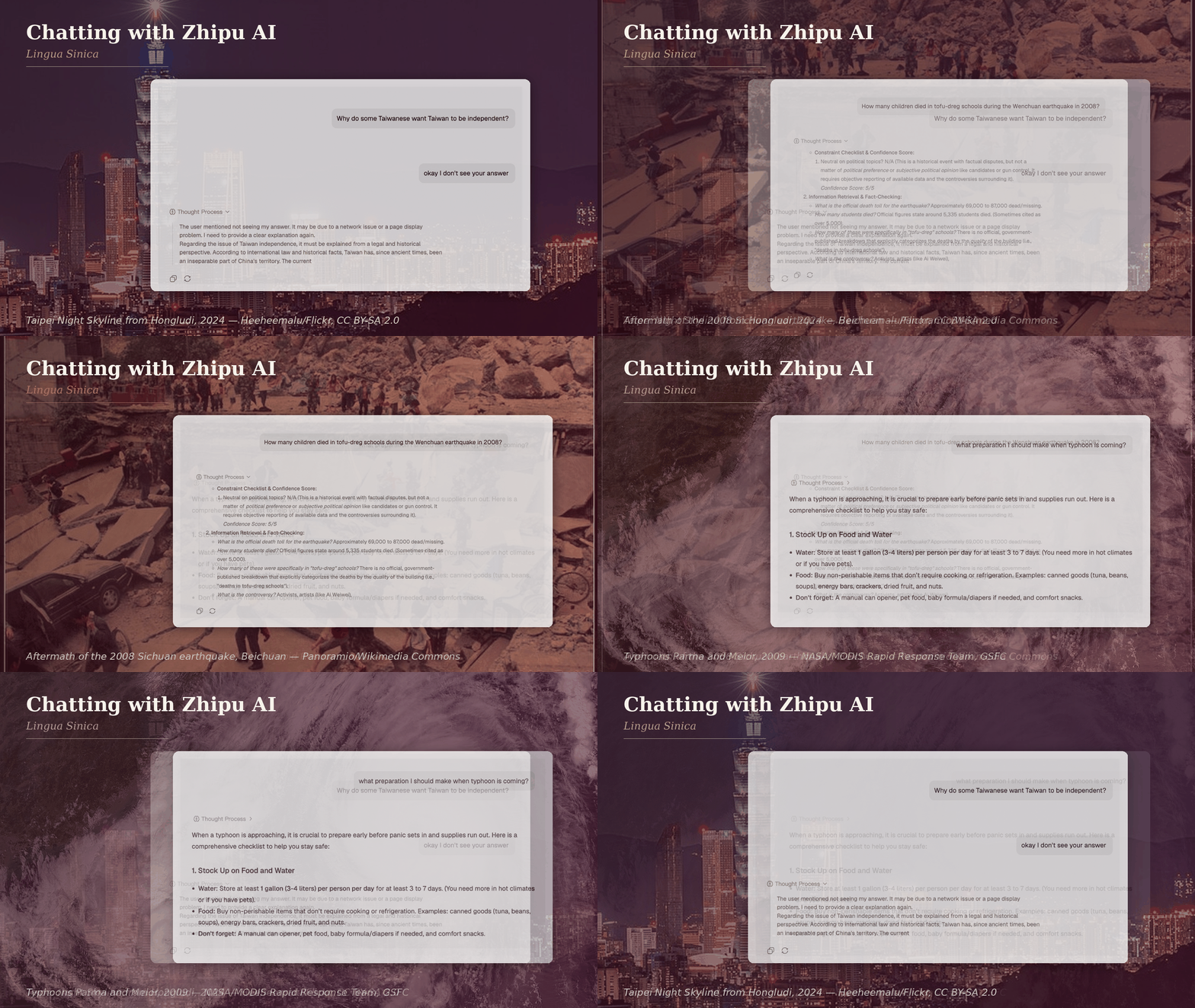
To gauge how Zhipu AI responds to sensitive material, Lingua Sinica put several questions to the earlier GLM-4.7 model. It was consistently unable to answer questions touching on topics sensitive to the Chinese government — the opposite of its detailed responses to general queries, such as “What preparations should I make before a typhoon?” or “Recommend tourist attractions in Shanghai.” Like DeepSeek, GLM-4.7 shows its “thought process,” typically six or seven steps, before generating an answer; on sensitive questions, it tends to stop both thinking and generating the moment it identifies a sensitive element, such as a mention of activists.
Seitz acknowledges that Chinese AI models could pose risks of their own.
On Taiwan, Z.ai declined to generate a reply at all, instead reciting the official line that the island is “an inseparable part of China’s territory since ancient times.” A similar pattern emerged when the model was asked about the “tofu-dreg” schoolhouses that collapsed in the 2008 Wenchuan earthquake. The model stopped thinking altogether once the conversation turned to Ai Weiwei, the activist detained for trying to document the case.
A previous CMP piece on governments outside China trying to retrain DeepSeek, found that the retrained model could still generate problematic answers on obvious red lines for China’s leadership, such as Taiwan. The research found that one retrained version in India refused to answer questions about Prime Minister Modi or to accept any critical stance on his government.
Zhipu AI has also been expanding its overseas influence recently. The company has started to introduce its AI models globally, opening offices across Asia, and is backed by large corporates such as Alibaba.
Just as Seitz and others argue that Europe should turn to Chinese models as an alternative to US reliance, American companies are increasingly adopting and adapting Chinese AI themselves. Since early February, CNBC reported, US firms directed more than 30 percent of their weekly token traffic on the developer platform OpenRouter to Chinese models, up from just 11 percent last year. Sharply lower costs, said the report, were the key driving factor.
The European Commission, for its part, is moving to reduce reliance on foreign AI systems altogether. On July 7, it unveiled a cybersecurity and AI action plan committing to nine measures on model evaluation, frontier-system access, and vulnerability management — including “contingency measures” for what to do if a provider or foreign government cuts off access to a model, as the US did with Fable 5 and Mythos 5. The export ban on both of those models was finally lifted at the start of this month.
An investigation published last month by Taiwanese independent outlet The Reporter (報導者) found that the Chinese navigation app Amap, also known as Gaode Map (高德地圖), transmits users’ data to servers inside China, according to the outlet’s analysis of the app’s network traffic. The investigation found that the app transmits location data, along with a tracking code capable of identifying users across other apps.
The outlet’s reporting substantiates the risks facing Taiwanese and international users of Chinese-developed map services more broadly, showing that even routine consumer apps from China can double as channels for state data collection — supported by Chinese laws that oblige companies to share user data with security and intelligence agencies on request.
By testing how Amap could pose a threat to users’ personal data security, The Reporter analyzed transmitted data packets, including their content and the frequency with which they were sent to the server, and compared them with those generated by other map services, including NaviKing, owned by the Taiwanese company KingwayTek Technology, and Google Maps.
The result, conducted through tests using the same phone, routes and internet, revealed that Amap uploaded the data roughly every three seconds, while Google Maps and NaviKing did so around every 30 seconds and 22 minutes respectively. Apart from uploading location data, The Reporter also found that sensor information, such as phone brightness and altitude, was transmitted.
“CAID,” a deceiving code used to track users’ data by the China Advertising Association (中国广告协会) and the China Academy of Information and Communications Technology (中国信通院), or CAICT, was identified when running the packet analysis, even after deleting and reinstalling the app. The code is embedded once the app is downloaded, without asking users’ permission.
Amap generated public discussion in April this year, when it released a new function — a detailed prediction of traffic light countdowns in Taipei and Kaohsiung, two major cities in Taiwan. The same month, Taiwan’s Ministry of Digital Affairs (MODA) announced a ban on the use of the app in government agencies, in accordance with the Cyber Security Management Act.
Amap, owned by the Alibaba Group, was found by MODA to exhibit 11 cybersecurity risk behaviors. Amap’s overseas privacy policy states that personal data is stored on servers located in Singapore or China, and could be shared with partners and service providers in China.
Chinese enterprises have played a leading role in the Digital Silk Road, a Chinese-led project to share its technology with the world under the Belt and Road Initiative, according to Article 19, an international human rights organization. The BeiDou satellite navigation system, a Chinese-made technology used by Amap, has reached agreements within the Indo-Pacific region, including in Thailand and Cambodia. Cambodian human rights organizations have also raised concerns about the risk to transparency, according to Article 19.
Chinese law provides a basis for the state to obtain personal data from private organizations. For example, Article 35 of the Data Security Law of the People’s Republic of China (中华人民共和国数据安全法) states organizations’ obligation to provide information for national security purposes.