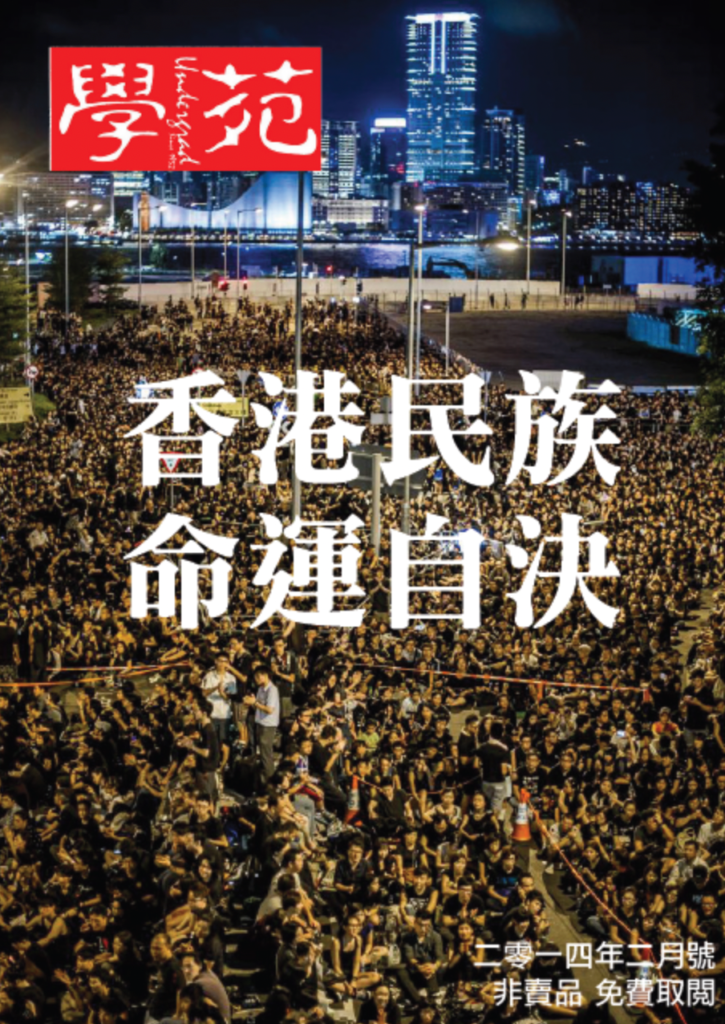
Last Friday, InMedia (獨立媒體), one of Hong Kong’s few remaining independent news outlets, published an unusual apology to readers through its newsletter. The outlet said that its normal operations had been disrupted in recent days by “harassing messages” (滋擾訊息) as it sought to cover hearings looking into the deadly fire at the Wang Fuk Court residential buildings in November last year that killed 168 people. InMedia said in its message that it had filed police reports in two specific cases of harassment by “unidentified persons” (不明人士).
On Tuesday, online commentator Fung Hei-kin (馮睑乾), a former columnist for Hong Kong’s Apple Daily, noted in a Facebook post that not one mainstream Hong Kong outlet had covered the InMedia story in the four days since the outlet’s disclosure. In fact, the only outlet to cover the news at all, said Fung, had beenEpoch Times, the right-wing American media outlet backed by the Falun Gong religious group — a brief report that added no new information. Fung likened the silence over the InMedia case to that which followed revelations by the independent Hong Kong Journalists Association (HKJA) in September 2024 that reporters from thirteen news organizations had been harassed or threatened in the preceding few months. The chilling effect on the press could clearly be inferred from the silence, said Fung. “The more you think about it,” he wrote, “the more chilling it becomes.”
At a media forum over the weekend in Zhengzhou, the capital of Henan province, foreign influencers took the stage to explain how their lives in China had offered a more “authentic” understanding of the country. Indian travel blogger Anayat Ali and Belgian influencer Lucas Deckers said that immersion in local life had given them a more realistic portrait of China than headlines alone could convey — the subtext being that Western media coverage of the country is inherently biased and deeply unfair. Also present was Adam Foster, head of the US-based Helen Foster Snow Foundation, whose mission is to preserve the legacy of Edgar Snow, the journalist and author of Red Star Over China, who today remains for China’s leadership the paragon of the useful foreign journalist.
In a twist that would almost certainly perplex professional journalists elsewhere in the world, this talk about authenticity in portrayals of China unfolded at a forum uncritically proclaiming the virtues of artificial intelligence for media production. Understand the context, however, and this alliance of AI and untruth makes perfect sense, throwing into sharp relief AI’s emerging role in both domestic media control and global propaganda and disinformation.
The theme of this year’s Internet Media Forum, co-organized by the Cyberspace Administration of China (CAC) and held in Henan province on March 28–29, was the “2026 Digital Intelligence Empowerment: Positive Energy Production and Dissemination Conference.” That is a mouthful, but the concept is simple enough: AI has the power to revolutionize the Chinese Communist Party’s demand that journalism and media serve its interests by emphasizing positives and suppressing critical coverage.
CAPTION: A robot stands before the conference backdrop in Zhengzhou. The slogan reads: “2026 Digital Intelligence Empowerment: Positive Energy Production and Dissemination Conference.” Photo: China Daily.
Across much of the world, the rise of artificial intelligence has prompted fierce and often anguished debate about the future of the media, and the role of the journalist. When is AI a “strategic ally” for the truth-seeking journalist? How can we balance the valuable aspects of AI with its myriad dangers? How can we make sure that substantive, relevant and even hard-hitting journalism — so critical for democracy — can be discovered amid the inundation of synthetic text, image and video?
In a recent report adding to a rising tide of output on the subject, the Center for News, Technology and Innovation (CNTI) weighed in earlier this month. “For newsrooms, the use of generative AI tools offers benefits for productivity and innovation,” the report said coolly. “At the same time, it risks inaccuracies, ethical issues and undermining public trust.” At a recent press talk in Vietnam on AI and the “crisis of trust” in news facing media, hosted by the Embassies of Canada, Norway, New Zealand, and Switzerland in collaboration with the United Nations Development Program, UNDP representative Ramla Khalidi returned to basics: “The most important thing in journalism, for me, is trust. When trust is lost, you are no longer a voice that can be relied upon.”
In China, where media are defined as tools to manufacture public trust in the Chinese Communist Party (CCP) and the state, such concerns are not even secondary. If there are journalists in China wringing their hands over the impact of AI on professional reporting or public trust, those conversations are happening privately, and quietly. The whole notion of the public interest as fundamental to journalism has been eclipsed under the leadership of Xi Jinping by the most robust application of press controls seen at any time in the reform era since the late 1970s. The possible exception is the three years immediately following the Tiananmen Massacre, which gave rise to the concept of “public opinion guidance” — a policy that to this day delivers on the firm conviction that the CCP must control news and public discourse to maintain the stability of the regime.
In one of his earliest actions as the country’s top leader, Xi Jinping in 2013 introduced an internal Party directive called “Document 9” that expressly opposed the idea of public interest journalism, which it panned as “the West’s idea of journalism.” “The ultimate goal of advocating the West’s view of the media is to hawk the principle of abstract and absolute freedom of press, oppose the Party’s leadership in the media, and gouge an opening through which to infiltrate our ideology,” the directive said.
Later that same year, as Xi cracked down aggressively on more independent voices on Chinese social media — the now mostly forgotten “Big Vs” — the Party introduced the concept of “transmitting positive energy to society” (传播社会正能量). If the role of the press in China had become more ambiguous through the 2000s, amid a precarious but determined movement of journalistic professionalism, it had now become clear again. Its place was to serve the larger goals of the Party and the nation, not of the public.
i
Positive Energy
传播社会正能量
▼
“Positive energy” (正能量) has been a key phrase in the Xi Jinping era to refer to information controls and official messaging, both domestically and internationally. The term generally refers to the need for uplifting content as opposed to critical or negative coverage — and particularly content that puts the Party and government in a positive light. Although the term began appearing in various contexts in 2012, it was given a much larger profile at the Central Forum on Arts and Literature in October 2013, when Xi Jinping called on cultural creators to produce works that “inspire minds, warm hearts and cultivate taste.” In the context of news control, “positive energy” is closely associated with “guidance of public opinion,” a cornerstone of the CCP’s media control regime since June 1989.
Today, it is virtually impossible to talk about the truth in China in any way other than that bandied about on the stage at the 2026 Internet Media Forum. “Authenticity” is fundamentally about positivity. And this means that discussions in China about the impact of AI in the media revolve almost exclusively around its production-related advantages.
A series of thematic sessions held alongside the main forum in Zhengzhou is a case in point. Discussions treated propaganda and corporate public relations as a seamless continuum, discussing how official and corporate messaging can “go viral” by adding a more human touch to narratives. The session brought together participants including Chang’an Avenue Insider (长安街知事), a public account under the capital’s state-run Beijing Daily, the new media department of the CCP’s People’s Daily, and Weibo’s executive editor-in-chief.
On Monday, a commentary at People’s Daily Online drove the point home, suggesting that AI could be effective in “adding warmth” to positive energy — in other words, that propaganda could be made to feel more human and relatable. The piece, published the day after the forum closed, described AI as having “deeply penetrated the full chain of content planning, newsgathering, editing and distribution” in mainstream media. Once again, there was not the merest frisson of concern. The integration of AI with content meant for public consumption, and of course public opinion guidance, was celebrated as a milestone.
During panel discussions at the forum, the People’s Daily Online commentary noted, keywords like “professionalism,” “staying grounded,” “seizing trends,” and “innovation” were on everyone’s tongues. Even the deeply human concept of “empathy” (同理心), which has entered into sharply different discussions of journalism in the West, made an appearance. All of these are qualities with the potential to ground journalism in the human experience, and form the connective tissue between journalism and the public it is meant to serve. In this context, however, they are production techniques and rhetorical devices to be achieved with helping hand of artificial intelligence.
It was no accident that posters and images of the Zhengzhou forum came with the usual heavy dose of robot imagery. AI robots took to the stage alongside dancing child performers, the pairing an oddly dissonant state message about the humanity of AI. China’s dream of an army of compliant Edgar Snows, all reporting empathetically on the elevated humanity of the Party, cannot be far off.
On March 2, just days before China’s annual parliamentary sessions opened in Beijing, the country’s state-run women’s organization held its annual ceremony to mark International Women’s Day — a holiday recognized by the United Nations in 1977 as a global call for women’s rights and equal participation in public life. But the organization’s vision of the limits of that participation was clear from the start, as its chair, Chen Yiqin (谌贻琴), a senior government official, called on women to follow the party, contribute to China’s next five-year development plan, and promote family civilization to “consolidate the family foundation for Chinese-style modernization.”
It was the beginning of a barrage of official messaging in which women were not subjects but instruments of state policy. China Women’s News (中国妇女报), the organization’s official newspaper, ran its usual coverage. Model workers were honored, and speeches made about the “wisdom and strength” of women in the service of national rejuvenation. On March 8, International Women’s Day itself, the paper ran a full-page spread titled “THIS Is Our Women’s Day!”
The question of who exactly was subject to that “our” had in fact been settled three days earlier by China’s premier, Li Qiang (李强), as he delivered his annual policy address to the country’s National People’s Congress. He pledged to build a “fertility-friendly society” (生育友好型社会), offer housing support for first-time married couples, extend parental leave, and expand childcare subsidies, which he said had already reached more than 30 million infants. With births plunging to a record low of 7.92 million in 2025, the premier’s message was clear: women have a primary role in resolving China’s demographic emergency — and the state will pay for their cooperation in these goals.
The price of that bargain, so familiar to women around the world, is silence and marginalization. And just as the state prepared its empty message of female empowerment, this was enforced with precision. In the days leading up to International Women’s Day, authorities shut down at least 10 WeChat public accounts that had built communities around the real concerns of women. Taken together, those accounts offered a different vision of participation — one the party-state was not prepared to tolerate.
These were not fringe voices. For years, Chinese women have been telling a different story — on WeChat, on Weibo, on Xiaohongshu — about why they do not want to marry, do not want children, or simply do not see motherhood as the defining purpose of their lives. But for a state bent on managing demographic trends, these voices are regarded as a form of contamination.
Weeks ahead of International Women’s Day, as the Cyberspace Administration of China (CAC) launched its latest periodic “Clear and Bright” (清朗) campaign, social media platforms were ordered to purge not just the usual content deemed harmful to the state but also speech that “promotes not marrying and not having children” (鼓吹不婚不育) or that “provokes gender antagonism” (挑动性别对立) — language that has tended in recent years to radicalize feminism in all of its forms.
Platforms were ordered to set up dedicated task forces and proactively purge content from front pages, trending lists, and comment sections. Then, on the evening of March 6, as the Women’s Federation held a reception celebrating International Women’s Day with foreign dignitaries, the purge directly impacted feminist and sexual minority communities online.
From the evening of March 6 into the early hours of March 7, at least ten WeChat public accounts focused on gender rights vanished one after another. Among them were “Xiaowusheng Psychology” (小悟生心理), which writes about the mental health of marginalized communities; “Dongxia Primavera” (冬廈Primavera), a platform discussing feminism and left-wing youth issues; the Gen Z feminist account “Letters from Two Stranger Girls” (两个陌生女生的来信); “HerStoryNow,” a grassroots feminist community space; “Free NORA” (自由娜拉NORA), which advocates for victims of human trafficking and people with mental disabilities; “Belonging Space,” a counseling and community platform; “Ai Dasun”(艾大荀) which focuses on public welfare, science popularization, and related social issues; “Pride Voice” (骄傲声浪), renamed from the once prominent LGBTQ Weibo account “Voice of Comrades” (同志之声); and “Exile LandAi Dasun” (流放地), which publishes essays, fiction, and personal narratives by sexual minorities.
Screenshots of four WeChat accounts banned around International Women’s Day, March 2026: “Free NORA” (自由娜拉); “Dongxia Primavera” (冬厦); “Belonging Space”; and “Ai Daxun” (艾大荀).
For those who follow China’s online feminist communities, this playbook from the authorities is all too familiar. Nearly 10 years ago, on March 6, 2018, “Feminist Voices” (女权之声), the country’s most influential feminist account with a following of at least 180,000 on Weibo and 70,000 on WeChat, published an article titled “The Ultimate Women’s Day Celebration Guide” (最强妇女节过节指南) — which called on women to mark the holiday not with shopping discounts or the flattery of being called a “goddess,” but by joining a campus anti-sexual harassment campaign that had grown out of China’s nascent #MeToo movement.
Two days later, on March 8, as official outlets like China Women’s News ran their usual tributes to International Women’s Day that put the achievements of the Party first, “Feminist Voices” was permanently banned. Similar waves of enforcement against accounts devoted to women have followed nearly every year since. In an article this year called “Multiple Gender Equality Accounts ‘Arranged’ Ahead of International Women’s Day,” writer and independent commentator Li Yuchen (李宇琛) observed that the early-March crackdown has become almost a form of ritual. “This operation has already formed a stable, institutionalized rhythm,” he wrote.
The action this year has not been limited to public accounts. Individual voices on social media have also been targeted. In February, Xinjiang stand-up comedian Xiao Pa (小帕) became another casualty. On February 5, she posted on Weibo: “I’ve been lying at home with a fever for two days. I was thinking that if I had a husband and children, I’d probably have to force myself up against the wall right now to cook for them.” Her account was quickly muted and remains restricted.
China Media Group poster for “Flowers Blooming for the Nation” (花中开国 ), a Women’s Day special programme airing on March 8, 2024, on CCTV’s General Arts Channel and the CMG Video platform.
Three weeks later, the platform’s official moderator account “Weiboxia” (围脖侠) explained the reasons behind the closure. Xiao Pa, it said, had violated requirements of the CAC’s “Clear and Bright” campaign against content that “incites gender antagonism” and stokes “marriage fear” and “fertility anxiety.” Posts expressing support for the comedian were also quietly scrubbed from the platform.
Even caution has offered little protection. On March 7, author “Ai Daxun” (艾大荀), a public-welfare worker who writes about social work, women’s rights, and civil society, published a farewell essay after her WeChat account was pulled down. Called “Written at the Moment My Public Account Was Banned,” the post described the constant paranoia that prevails when one writes under tightening restrictions.
In 2025, “Ai Daxun” had tried to organize an offline book club in Guangdong ahead of International Women’s Day, only to have it canceled two nights before the event. She never attempted such an event again, and said she had grown accustomed on a fundamental level to the atmosphere of self-censorship. She was someone who knew every sensitive keyword and every shifting red line on Chinese cyberspace. “I might even be the mildest among the accounts you follow that still track social issues,” she wrote. “But even so, my account was banned. I kept retreating and treading carefully, yet as the red lines kept tightening, there was still no way around them.”
Each year around March 8, the cycle repeats. Accounts disappear, keywords are scrubbed, and communities scatter and regroup elsewhere. For those trying to speak about gender, feminism, or women’s rights in China’s digital public sphere, the space left to speak grows smaller still.
Meeting in Beijing last week, China’s annual political gathering, the “Two Sessions,” introduced plans for the country’s economy and society over the coming year. Technologies like AI were a clear focus in the premier’s government work report. But not all of the gadgets taking center stage in media coverage were so high-tech. Enter the vintage hot water bottle.
On March 12, as the annual plenary meetings of the country’s top legislative and advisory bodies concluded, the Ningbo Daily published a story in which reporter Cheng Liangtian (成良田) described becoming curious about the apparently long-used hot water bottles passed out at the conference. A staff member explained, according to the report, that the National People’s Congress “has always emphasized thriftiness.” The reporter then discovered that the model, now discontinued, had been manufactured three decades ago.
Cheng concluded by drawing a not-so-journalistic link between the humble vessel and the mystique of Chinese Communist Party power: “Through an old hot water bottle, one glimpses the spirit of diligence and frugality that defines a great party,” he wrote.
What can explain such a strange fuss over water bottles? And why is the Ningbo Daily reporter getting so warmed up about this oddball topic?
With this month’s political meetings touching on issues with the potential to unsettle — unemployment, sluggish consumer spending, a flagging economy — focusing on the minutiae of thrifty housekeeping can serve as an effective distraction. Or so the authorities hope. China’s economic outlook is far from optimistic. The GDP growth target set at this year’s Two Sessions was 4.5 to 5 percent — the lowest in 35 years. And as early as January, Cai Qi (蔡奇), one of the country’s top leaders, instructed propaganda officials to “place economic publicity in a position of importance” and tighten “guidance over public sentiment.”
Small diversions have long served larger propaganda goals in China. In his 2018 book China’s Digital Nationalism, Florian Schneider, a professor at Leiden University who studies political communication in the PRC, describes how the authorities treat China’s media networks as an “info-web” — using their central position within it to inject officially approved “symbols and statements into discourses about the nation, its leaders, and their sovereignty.” Journalists for state media in China learn too that one of their most critical roles is to help create this symbolic world, at the expense of reporting facts. In this system of meaning creation, the battered hot water bottle can be a perfectly serviceable tool.
Hot water bottles at the NPC are a minor but telling case in point, one of many such non-news diversions communicated during the course of the meetings — including the ubiquitous AI robot, a symbol of the country’s tech dominance and ambition. The props invite the public to celebrate frugality as an imagined virtue of the CCP leadership, while turning their gaze away from real social and economic challenges.
The story quickly went viral. The hashtag “The Great Hall of the People’s Hot Water Bottle Has Been Used for 30 Years” (#人民大会堂的热水瓶用了30年#) trended on Weibo, where it was picked up and amplified by state and commercial media outlets.
Even the manufacturer — a company in Jiaxing, Zhejiang province — weighed in, telling reporters that it had been sending staff to the Great Hall every year for 16 years to carry out maintenance, and that “no matter how material life changes, frugality is always the foundation.”
Not all readers, however, were warmed by the nostalgic glow of the water bottle story. On Weibo, alongside supportive comments, some users pointed out the irony that keeping the old bottles going had likely cost more than simply replacing them. Another declared that “the most hilarious and farcical video of the year has arrived.”
On Reddit, where Chinese-language communities often include diaspora users and those accessing the platform via VPN, the verdict was blunter still: “What is the government doing with this kind of stunt other than performing and spreading a sense of panic? They keep telling residents to spend more, while the government itself puts on this pointless show.”
As inconsequential as the news story was, it did not go unexamined. Wuyue Sanren (五岳散人), a former Chinese media insider turned independent commentator now based in Kyoto, took to his YouTube channel to raise questions about several of the story’s key claims. Drawing on his experience working within China’s state media system, he noted that bottles and other such objects — far from being frugally preserved — are routinely cycled out of use every three-four years as necessary. He also questioned why the timeline in subsequent reports had quietly shifted from “30 years” to “16 years” of use. One likely reason, he said, was that the media indeed calculated, as social media users had snidely remarked, that ongoing maintenance costs would have exceeded simple replacement costs, undermining the core narrative of frugality.
A Xinhua News Agency report on robots, this one speaking to the elderly in Shenzhen, is one of hundreds in state media during the “Two Meetings.”
So why keep them? Wuyue Sanren set aside the rational explanations — frugality, tradition, and so on — and pointed to something else more basic: superstition. For all the Party’s public denunciations of superstitious thinking, he said, a quiet fear in the leadership runs just beneath the surface. Changing out objects associated with political continuity, even worn-out hot water bottles in a ceremonial hall, could portend unwanted power shifts. “On the one hand, they are always emphasizing that superstition is bad,” said Wuyue Sanren. “On the other hand, they have a constant sense of dread.”
But perhaps the most succinct response to the water bottle ballyhoo came again on Reddit, from a user who ridiculed the state media fixation on nostalgia and emotion: “Classic propaganda apparatus,” they wrote. “Moved by its own storytelling.”
Sometimes “streamlining” is just another name for deep and painful attrition. Over the past two years, this and other euphemisms — like “optimization” and “transformation” — have swept like a wildfire across China’s local broadcast sector. Taken together, they tell a simple story about the rapid contraction of local television and radio under a barrage of cost-cutting directives from the central government. The goal is two-fold: cutting costs, and shifting resources toward newer forms of digital production — part of a broader rebuilding of China’s media infrastructure that the China Media Project has called “Centralization+.”
Announcing the closure of two of its local channels this month, the top state-run broadcasting group in the municipality of Chongqing spoke of “optimizing and integrating media resources” and “adapting to new trends in media convergence.” In practice, this meant shutting down channels the government considers redundant and shifting resources — money, staff, and content — away from traditional broadcast and onto the internet and digital products. The announcement, released by China’s main broadcasting authority, SARFT, makes clear that Chongqing is following directives from the government and national work conferences. This isn’t a local editorial choice but a centrally directed plan.
Chongqing is not an isolated case. It is part of a nationwide wave of broadcast closures that has been accelerating since 2023, when SARFT launched its campaign to “streamline and specialize” China’s radio and television landscape. According to the Chinese industry tracker website Shexiangren Wang (摄像人网), at least 51 TV channels were shut down across China in 2024, and in 2025 that number jumped to at least 75, hitting provincial-level broadcasters in Shanghai, Gansu, Shaanxi, Jiangxi, Xinjiang, and Hunan, among others. Guiyang, the capital of Guizhou province, became the first provincial capital in the country to be reduced to a single television channel in 2025. A separate report from SARFT’s research center confirmed that 79 channels and frequencies were formally eliminated in 2024.
Part of the story is how uncompetitive local channels have become, owing both to technological change and to institutional inertia: CCP-run media tend to be inflexible and formulaic, shaped by the bureaucratic structures that govern them. Shexiangren Wang notes that education channels offered little beyond policy meetings. TV shopping, with its long-duration pitches and infrequent purchases, could not match the speed and scale of e-commerce — what Shexiangren Wang called the “short, fast, and flat” model of online retail. Movie and drama channels, meanwhile, were stuck with aging content and shrinking advertising revenue. The closures have targeted public channels, education channels, shopping channels, and movie and drama channels — categories the government considers redundant or uncompetitive with internet platforms, all outpaced by digital offerings delivering the same content faster and on demand.
The campaign of attrition at local broadcasters does not seem to be slowing down. The Shexiangren Wang report indicates that Guangdong, Sichuan, and Shenzhen are all expected to close or merge additional channels in 2026. The broader pattern is clear: the government is shrinking traditional broadcast — meaning fewer channels and fewer editorial voices — while redirecting money, talent, and content toward digital offerings.
Local Television Channel Closures in 2025
Over the past year, at least 75 channels shut down across 57 cities, as Beijing pushes to consolidate the country’s sprawling state media system and cut costs at the local level.
Rather than a simple retreat from broadcast, the closures reflect a deliberate reorientation. The Chongqing announcement calls on the group to “fortify the main position of internet communication” (筑牢互联网传播主阵地) — language drawn from a broader Party framework that treats media platforms as ideological territory to be held and defended. It also calls for “systematically transforming mainstream media” (推进主流媒体系统性变革) — a phrase that carries specific weight in the Chinese context, where “mainstream media” refers to Party-run outlets tasked with setting the public agenda and shaping opinion.
The imperative is to remake those outlets into something citizens will actually use. That is a hard sell in a media landscape dominated by platforms like Bilibili, a video site built on user-generated entertainment, and Xiaohongshu, known outside China as RedNote, a lifestyle and social commerce platform where hundreds of millions of users go for content that is personal, playful, and not entirely oriented around the ideological goals of the party-state. A 2025 People’s Daily article used the same language to describe Party media’s role as the frontline of ideological control, calling on state outlets to “advance onto the internet main battlefield” (挺进互联网主战场) as a “main force” (主力军).
Rather than a simple retreat from broadcast, the closures reflect a deliberate reorientation.
While real success in the media market will likely remain a challenge, the authorities seem encouraged by the numbers for new state-led digital offerings. Provincial state media app downloads grew by an average of nearly 35 percent in 2024 — 34.9 percent in downloads and 45.2 percent in registered users — according to SARFT’s research center’s annual report. Platforms like Mango TV (芒果TV), a video streaming platform under the state-run Hunan Broadcasting System; Elephant News (大象新闻), an app-based news product from Henan’s provincial broadcaster; and Touch News (触电新闻), the digital product from Guangdong’s provincial broadcaster, each crossed 100 million downloads, with 28 provincial apps surpassing 10 million.
The closures and the digital push are, in the end, two sides of the same coin: a leaner broadcast sector that costs less to maintain, and a rebuilt online presence the Party hopes will keep it not just relevant, but dominant, where the public’s attention has shifted.
One issue conspicuously absent from the official framing of these closures is what happens to the people who worked there. The announcements speak of “optimizing resources,” but say nothing about how employees at Chongqing Economic Radio or the Fashion Shopping Channel — the outlets impacted by the most recent restructuring in Chongqing — might have been affected. Precise figures on job losses across the sector are difficult to come by. Official announcements are silent on the question, and broadcasters do not typically publish staff counts. The data that does exist points in one direction. Beijing’s broadcast sector alone shed more than 2,600 jobs in 2024, according to an annual statistical report from its city-level broadcast authority. The nationwide toll, across more than 125 channels closed in 2024 and 2025, is almost certainly substantial.
_________________________
To learn more about the trend of local “media convergence” in China and the remaking of the infrastructure of “international communication” (国际传播), or “external propaganda” (外宣), download our CENTRALIZATION+ paper below, produced with funding from the Swedish Psychological Defense Agency (MPF).
In a case that again exposed China’s use of political pressure abroad to silence voices it views as threats to its state narrative, the Chinese consulate in Strasbourg has pressured a local theater and city officials to cancel a planned stage production with Taiwan’s National Theater and Concert Hall.
According to French media, the Chinese consulate in Strasbourg called the theater in early February to register its displeasure about the play, which was scheduled to run from March 5 to 22.
When theater director Barbara Engelhardt did not respond, the deputy consul general wrote directly to the City of Strasbourg, the theater’s principal funder, demanding the show be cancelled on the grounds that it would harm Sino-French diplomatic relations.
The play — Ceci n’est pas une ambassade, or This Is Not an Embassy — is co-produced by German theater group Rimini Protokoll and Taiwan’s National Theater and Concert Hall, and directed by Stefan Kaegi. It employs documentary theater to simulate the opening of a Taiwanese embassy — describing Taiwan as a country whose international recognition is inversely proportional to its economic importance. The production premiered in Berlin in 2024 and has since toured widely across Europe. It was programmed as the opening event of Le Maillon’s Démocraties en jeu (Democracies at Stake) Festival, a series of performances and discussions exploring threats to democratic governance, running from March 5 to 22.
The Strasbourg performances touch a raw diplomatic nerve with Beijing. China claims Taiwan as its own territory and routinely pressures governments, institutions, and cultural organizations worldwide to avoid any portrayal of Taiwan as a sovereign state.
Mayor Jeanne Barseghian said she responded by reaffirming France’s protections for artistic freedom and reported the incident to the Regional Directorate of Cultural Affairs. France’s AFP newswire reported last week that the Chinese consulate had not responded to a request for comment.
Neither the Chinese Embassy in Paris nor China’s Ministry of Foreign Affairs has publicly commented on the incident. No mention of it has appeared in Chinese state media.
The reports prompted swift coverage in Taiwan. The story was picked up by at least two Taiwanese outlets on March 4. The Liberty Times (自由時報) newspaper, an outlet generally regarded as partial to the ruling Democratic Progressive Party (DPP), ran the story in its arts section, framing the play as the first international theater work to directly address Taiwan’s national status and diplomatic situation.
The Liberty Times article featured the full three-part statement from the Taipei Representative Office in France — the country’s de facto embassy in Paris — which praised Strasbourg’s mayor and French cultural authorities for not bending to China’s demands. The office said that Taiwan’s voice must not be silenced, and called on audiences to attend as an act of solidarity. “Any form of censorship and suppression,” it read, “will only draw greater international attention to Taiwan’s resilience.”
SET News (三立新聞), the news division of Taiwan’s major private broadcaster Sanlih E-Television (三立電視), covered the story in its politics section, leading with the pressure from China’s consulate in Strasbourg. Citing the Liberty Times report, the outlet added that the Taiwan Cultural Center in Paris had confirmed that the shows had not been cancelled, and that local support for the project remained strong.
“The fact that the Chinese government chose this moment to do this only makes it clearer who the anti-democratic side is.”
The news hit Taiwanese media just as China was marking the opening of its annual “two sessions” — the National People’s Congress and Chinese People’s Political Consultative Conference — with state media pushing the familiar message that China’s political system, entirely monopolized by the Chinese Communist Party, is democratic and consultative. Premier Li Qiang’s government work report to the NPC called on officials to “accept democratic supervision” from the CPPCC — a body whose members are appointed, not elected.
On March 5 — the opening day of the NPC — cast member Chiayo Kuo (郭家佑) took to social media to address the situation in France. “We’re here for a festival about democracy,” she wrote. “The fact that the Chinese government chose this moment to do this only makes it clearer who the anti-democratic side is.”
In November 6, 2025, just four days before the official opening of the IndieChina Film Festival in New York, the event’s director, Zhu Rikun (朱日坤), announced that it had been cancelled. In his statement, he said that if he did not halt the festival, given “the situation currently unfolding, anyone involved with the event — directors, forum participants, peripheral figures, volunteers, even audience members — could face threats or harassment.” He had made the “extraordinarily painful decision,” he said, not out of “fear or capitulation,” but out of consideration for the safety of all participants and audience members connected to the festival.
Before relocating to the United States, Zhu Rikun was for decades deeply involved in China’s independent film exhibition and production scene. He helped to organize the inaugural “China Documentary Exchange Week” (中国纪录片交流周) in 2003, and co-founded an independent film forum called, “The Human Way, the Cinematic Way” (人之道, 影之道), the forerunner of what would later become the Beijing Independent Film Festival (北京独立影像展).
Zhu’s own independent documentary, The Questioning (查房), captures the moment police interrogated him in a hotel room. And this work also helps to explain why the inaugural IndieChina festival he founded in New York became a target of transnational suppression by Chinese authorities.
The DVD cover of Zhu Rikun’s The Questioning. SOURCE: Zhu Rikun on X.
In reporting on the recent fate of IndieChina, media outlets have uniformly used the term “independent film festival” to describe this and other organized film screenings that have faced similar situations. When we look more closely at the various groups now trying to organize Chinese-language film screenings abroad, however, it becomes clear that the ecosystem of the “independent Chinese-language film screening” is much broader — and that the category itself is being pulled in different directions by the very different realities facing each event and the groups involved.
Through interviews with multiple independent Chinese-language screening groups in Europe, this reporter attempts to give readers a day-to-day sense of the circumstances facing acts of independent screening (独立放映).
Part One: Before the Screening
The independent Chinese-language screening groups currently active in Europe have emerged largely within the past five years. This is because a large number of Chinese people with an interest in film — and some with prior screening experience — emigrated to Europe during this period, making these groups a byproduct of the latest wave of emigration. Films, like the people who love them, literally ran (润) to Europe. Intertwined with the Covid-19 pandemic, China’s “dynamic zero-Covid” policy and the aftershocks of the anti-lockdown protests rippled out to Europe, and the stimulation of those external events prompted many of these new arrivals to start thinking about doing something here.
i
Runology
润学
▼
CMP Dictionary · May 18, 2022 · David Bandurski
An online neologism popular from April 2022, “Runology” (润学) derives from the English verb “run,” matching the pinyin of the Chinese character 润. It refers to the study of how to emigrate overseas — a response to worsening economic conditions and shrinking freedoms in China, particularly for young people.
The term surged during the Shanghai lockdown in spring 2022. It is often framed as one of three paths available to Chinese youth: grinding through “involution” (内卷) in a hyper-competitive job market with little reward; “lying flat” (躺平) by rejecting ambition altogether; or practicing Runology — and leaving.
See alsoInvolution (内卷)Lying flat (躺平)
Tang Mingxuan (唐明轩) had accumulated rich experience in independent film screening back in China, co-founding a film collective focused on sexuality and gender, and his professional background was also in film. When he arrived in Europe, he brought with him the operating model and programming approach of that earlier collective, and on this foundation built a new screening group in his adopted city.
Many people share a background similar to that of Tang Mingxuan, though Jiang Bu (蒋不) is perhaps a more typical example. Jiang was active in Chinese civil society even before he entered university, and he later studied at the Beijing Film Academy. Shaped partly by his experience in grassroots organizing and partly by his dissatisfaction with the atmosphere on campus, he always gravitated toward the kind of independent documentaries made by figures like Ai Weiwei (艾未未), Hu Jie (胡杰), and Ai Xiaoming (艾晓明). “For me around 2011, I genuinely believed that you could use this kind of work, making independent documentaries, to have an impact on Chinese society, what people called ‘the surrounding gaze transforming China.’ I thought it was a path for public intellectuals and artists to engage with reality and take part in public action.”
There are also many people who came to Europe with little or no screening experience, and essentially had to learn from scratch how to host a film screening. Chen Zhe (陈哲), one of the founders of “Xinfeng” (信风), had only the vaguest sense of what “independent screening” meant before trying to organize screenings locally, and had never attended a screening event before leaving China. Wei Wenxi (韦文熙) and Lin Aili (林艾历) had each been involved to varying degrees in screening activities before moving abroad, but both only encountered the finer details of organizing screenings after arriving in Europe.
i
The Surrounding Gaze
围观
▼
CMP Dictionary · January 4, 2011 · David Bandurski
Rooted in Lu Xun’s concept of kanke wenhua (看客文化) — the cold indifference of crowds watching their fellows dragged off to execution — the “surrounding gaze” (围观) has taken on new meaning in the Internet age. Rather than passive spectatorship, it now describes the potential of networked publics to concentrate opinion around issues and events, nudging change through accumulated micro-participation.
The term is often associated with the slogan “the surrounding gaze changes China” (围观改变中国). Peking University professor Hu Yong has called it a “bottom-line” form of public participation: modest on its own, but capable of bridging the historic fracture between activist minorities and an indifferent majority — with micro-forces (微动力) doing the work that organized movements never could.
See alsoCulture of the gaze (看客文化)Micro-forces (微动力)
Despite his lack of experience, Chen Zhe still took that first step into organizing film screenings. As he describes his thinking at the time: “This is something that someone should be doing — and since it seems like no one is doing it, we might as well do it ourselves.” There were then a few Chinese-language works that he felt were really decent and were being screened and attracting some attention across Europe. He felt that naturally these films could be screened privately in homes or living rooms — but they also deserved to be seen in cinemas, where people could sit down together and even discuss them.
As Chen Zhe found that some European cities had cinematic screenings and his city did not, he felt that making it happen was his “inescapable responsibility” (责无旁贷). Seizing that opportunity, he and the other founders organized several screenings, which served as the seed from which “Xinfeng” later developed.
Lin Aili’s motivation for founding “79 Square Meters” (79平米) was similar to Chen Zhe’s. In Northern Europe, where Lin now lives, the cultural environment is relatively homogeneous, and opportunities to see Chinese-language films are rare. As contentious issues such as China’s “zero-Covid” policy sparked considerable discussion within the local Chinese community, she hoped to use Chinese-language films to bring people together for conversation — and so “79 Square Meters” held its first screening.
The motivations of these various “screeners” (放映员) may differ, but all have faced a common dilemma: Is film screening an end in itself, or a means to other goals? For Jiang Bu and his group, on-the-ground activism in Paris had gradually ebbed after China’s lockdown policies ended, and they wanted to create a space that was less overtly activist in orientation — one that could reach a broader audience and then engage like-minded people for possible future action. “No Change of Term” (不换届) was their attempt to integrate activism with everyday routines.
Shen Jingping (沈静平) prefers to position their group as a “cultural salon” focused primarily on queer and feminist issues within Chinese-speaking communities, treating film screening as one among many possible activities. Shen might organize events around specific holidays or commemorations — for example, if there is a suitable film around Transgender Day of Remembrance on November 20, they might screen the film. They also direct more resources toward independent filmmakers, reserving their limited screening opportunities for works that rarely get to meet audiences directly.
Among those interviewed for this article, Wei Wenxi is the one most inclined to see film screening as an end in itself. As a film lover, he felt keenly after arrival in Europe that Chinese-language films — and particularly independent films — were too seldom screened. So he joined multiple film screening groups in the hope of somehow making a contribution. He also found the process of curating screenings genuinely interesting. The groups he has been involved with range from those with an issue-oriented or activist focus, like those described above, to ones that are more commercially oriented and already better integrated with the film industry.
Part Two: The Screening Takes Shape
Each of these groups has forged its own distinctive form of “independent screening,” shaped by differing motivations, experience levels, missions, curatorial tastes, and strategies — and each has left its distinctive trace both on and off screen.
The screening groups run by Shen Jingping and Tang Mingxuan are both based in Western Europe, where Chinese communities are larger and local residents speak more complex languages and dialects. Given this relatively diverse and fluid audience composition, Shen and Tang must carefully anticipate on-site conditions, especially when making decisions about subtitling. “79 Square Meters,” located in Northern Europe, has a more fixed audience, and attendance at each screening is more predictable. The relationship between the group and its audience is often closer than in other independent screening contexts.
As Chen Zhe found that some European cities had cinematic screenings and his city did not, he felt that making it happen was his “inescapable responsibility.”
Compared to other groups, “No Change of Term” has a clearer activist character, and so leans toward screening independent documentaries on topics such as Uyghurs, Tibetans, and broader Chinese human rights issues. But because it also wants to lower the threshold for audience comprehension and engagement with discussion, it will sometimes choose works that are more art-oriented, even if the public or political dimension of these works is less explicit.
Choices about screening venues more directly reflect the realities — sometimes actively chosen, sometimes passively determined — that distinguish one independent screening operation from another. Screenings can take place in cinemas or in various kinds of cultural spaces. The cost of a venue, the group’s budget, the terms of cooperation with the venue, the kinds of interaction the space allows — all of these factors can be either constraints or motivations shaping a group’s choices.
By disposition and background, Jiang Bu is drawn to a more “guerrilla” (游击式) mode of screening. “If the content of a film suits that kind of format, we could grab twenty iPads and watch the whole thing in a subway car,” he says. But he also acknowledges that other members of “No Change of Term” had persuaded him on the reasons why screenings in proper cinemas still matter: “The reason we show these films is precisely because they never had a chance to be formally screened in China. We want people to sit down together and enjoy them fully.”
“79 Square Meters” has a strong preference for independent cultural spaces. In Lin Aili’s view, their group is more grassroots, and the potential audience in their city is not large enough to sustain the costs of cinema screenings. “I know that in Berlin or Paris, they screen Asian films in cinemas quite often. But we don’t really like that kind of formal setting. We want a place where people can have a drink and chat and get to know each other. I prefer a more intimate, community-oriented screening model.” “Xinfeng” also gravitates toward such spaces, though it does not rule out cinema screenings. As relative newcomers on the screening scene, however, they want to develop a better understanding of the diverse venues available locally, and so they are ready to seek out more possibilities as they arise.
Chinese indie filmmaker Huang Wenhai (黄文海), author of The Exile Gaze (放逐的凝视), a history of independent film since the 1990s, supported by the China Media Project.
Despite the variety of films screened, the diversity of audiences, and the range of venues, nearly all of these independent screening groups place a premium on the post-screening discussion. Jiang Bu goes so far as to say that for “No Change of Term,” the post-screening discussion is the real point. In many cases, it matters less which film they screen. Even when they use a cinema that charges by the hour, and the relative cost is high, their post-screening discussions can run for an hour or even 90 minutes. And precisely because the content of those discussions tends to be more sensitive, they almost never announce their post-screening guests in advance, nor do they publish summaries of the discussions.
The post-screening discussions hosted by other groups typically last somewhere from 30 minutes to an hour. When inviting particular guests to speak, “Xinfeng takes concrete measures to verify the reliability of their experiences and what they plan to share in advance, providing audiences with a foundation of mutual trust when more sensitive topics are to be discussed.
Part Three: Beyond the Screening
Independent screening groups also face pervasive challenges. For these mostly volunteer-run operations, the relatively heavy demands on funding and members’ time are a significant burden. In response, some groups have tried to broaden their range of activities. Over the past five years, many independent screening groups have emerged across Europe, but a considerable number have also gone quiet or ceased to be active. Their rise and fall is inseparable from these constraints.
For Jiang Bu, with his extensive experience in organizing, it is a constant challenge, amid these various constraints, deciding how to allocate work among members and coordinate progress. Most of the core members of “No Change of Term” live in Paris and have no immediate plans to leave, so the team is relatively stable and built on a foundation of mutual trust. Even so, it can be a challenge to align the varying areas of interest among members. “Personally, I’d like more different voices to be part of film selection decisions,” says Jiang. “But some members aren’t necessarily engaged at the selection stage — and sometimes even after a film has been circulated, only a handful of people will have watched it.” Still, he says, almost everyone shows up for every event, and are actively involved in the on-site work like ticketing and hosting. “I don’t see this as a problem or a failure of duty, but it’s true that different people have different understandings of their role,” Jiang says. “Some tend to see themselves as volunteers or on-site crew.”
Wei Wenxi has witnessed firsthand what Jiang Bu describes, but from a different vantage point. Based on his observations, some groups have a relatively clear leadership and management structure, with core members who hold more authority and decision-making power. When a screening plan prompts audience complaints on social media, some core members may respond hastily without internal consultation, creating unnecessary pressure that then spills over to ordinary members. Given this kind of hierarchical organizational structure, larger conflicts can erupt. Some volunteers have even publicly posted criticisms after leaving a screening group. Different positions within the hierarchy may determine why members interpret the same situation so disparately.
Funding is the lifeblood that sustains any screening organization. Venues can be costly, and screening in a cinema raises costs dramatically. Most films also require a one-time licensing fee for each screening from agents and distributors, even if a “friendly rate” discount is sometimes available in consideration of a group’s independent status. And this is before factoring in the cost of subtitle production, poster design, miscellaneous expenses, and of course the production of DCPs — or digital cinema packages, the standard format used worldwide for digital cinema projection. Although these groups largely depend on the spare time available to members, all of the groups interviewed for this article said they try, within their means, to provide some form of compensation to members and volunteers who contribute their time and labor.
The most direct way to break even is to charge audiences a registration fee. But if ticket prices are set too high and attendance is poor, not only does the organization absorb significant losses, but the event fails also to achieve the very purpose that motivated the screening in the first place — getting people to sit down together, watch a film, discuss it, and connect.
External grants are a realistic and viable option, but funding typically comes with conditions attached. “No Change of Term” is among the more actively grant-seeking organizations interviewed, but Jiang Bu acknowledges that funding can sometimes become a constraint. “We mainly apply for grants in the human rights field, and funders have corresponding expectations for projects,” he says. “For example, [they demand] that the films screened directly address Chinese human rights issues. That practical constraint has also shaped our current curatorial preferences.”
Chen Zhe’s attitude is thoroughly pragmatic — “cook according to the rice you have,” as he puts it. Unable to price tickets on par with mainstream cinemas, his group has tried to explore more flexible licensing arrangements, such as sharing revenue with rights holders based on actual ticket sales, rather than paying a flat licensing fee upfront. But Chen also stresses that lack of spare time among core members is the greater constraint on “Xinfeng,” more crucial than financial shortfalls. Planning and executing a screening requires a burst of effort over a short period, and he and the other core members all have their own primary jobs. With no new members currently joining, they cannot maintain year-round programming and can only hold events during seasons when members are relatively free.
Tang Mingxuan’s group has built a strong relationship of mutual trust with its venue, and so can use the space for free. The rights holders they have worked with do not always proactively charge licensing fees either, which means they can offer free admission to audiences. They have also tried collaborating with queer and feminist groups, selling self-made merchandise at screenings in hopes of covering other expenses.
Planning and executing a screening requires a burst of effort over a short period.
One distinctive feature of independent film screening, compared to other forms of activism, is that the entire screening network is tightly interconnected. To know what films are available to screen and how to reach rights holders, these organizations are pushed to build connections within the field and share information. Networks extend not only within Europe but also across Eurasia and across the Atlantic.
Jiang Bu, as someone who was active in China’s independent film community, carries with him a web of personal relationships that plays a vital role in “No Change of Term’s” day-to-day operations — allowing the group to reach out to a large number of filmmakers and secure screening opportunities. Once one screening organization successfully navigates all the steps to bring a film to the screen, that success story spreads rapidly through the network to other organizations and groups, ultimately allowing more audiences in Europe to see the film.
Among the longer-term plans at “No Change of Term” is to provide more material support for these informal connections. They are working to build an archive cataloguing the Chinese-language independent films available for screening, with an entry and description for each film as well as information on how to contact rights holders. Drawing on this archive, any independent screening organization or group could quickly find out what is available to screen and how to obtain a license. And their ambitions go further still. They hope to provide new screening groups with technical assistance and some financial support, enabling those groups to carry out low-cost screenings adapted to local conditions. This might ultimately achieve a vibrant Chinese-language independent screening network globally.
This vision at “No Change of Term” is one that Chen Zhe arrived at independently. For Chen, his original motivation for doing screenings was simply that no one was showing “the films I wanted to see.” Starting from this simple fact, he has a straightforward view of who should be screening films. Anyone can do it, he says, and everyone should be doing it together. “There are a lot of local community groups now, and I hope more of them, not necessarily independent screening groups per se, will start showing films so that we can all share the risk.” A dispersed, decentralized screening network is more in keeping with his tastes.
Coda: The Aftershocks of IndieChina
Precisely because of the tightly networked, cross-regional nature of independent screening, some of the people interviewed had been watching as Zhu Rikun, now outside of China, built IndieChina from the ground up — and had witnessed the festival’s eventual collapse. Jiang Bu, Chen Zhe, and Lin Aili all experienced this process firsthand; Jiang Bu in particular has had more personal contact with Zhu Rikun. After Zhu Rikun announced the cancellation of IndieChina, Jiang Bu offered him direct assistance, including helping him reach out to the media for coverage.
Each person’s circumstances and past experiences also shape how they interpret what happened to IndieChina. When Lin Aili first heard the news, she was very surprised. The entire IndieChina project had seemed so substantial, with such a long preparation period. If the Chinese authorities had truly wanted to interfere, she felt they could have done so much earlier, not just days before the festival was about to open. Jiang Bu, who has more understanding of the details with IndieChina, found the whole affair even more bewildering. “There have been all kinds of Chinese-language independent film festivals in New York before, and none of them have faced suppression this serious,” he says. “Many of the directors and staff members who were harassed in China are spread across multiple provinces, which means this was a coordinated cross-provincial operation.”
“They’ve really treated this thing as if it were some kind of existential threat,” he says of the Chinese authorities.
The “aftershocks” of the incident have gradually spread to screening organizations on the European side of the Atlantic. “Xinfeng” had at one point considered screening some of the films selected for IndieChina, and had planned to reach out to Zhu Rikun after the festival concluded. That possibility is now out of reach. Some independent filmmakers have also declined screening invitations from “No Change of Term,” citing the risk of spillover from the New York incident.
For Lin Aili and Shen Jingping, however, the incident has only strengthened their determination to screen more films. Lin Aili notes that “79 Square Meters” is focused primarily on women’s and queer issues. While there is some tension with state controls, it is not necessarily highly sensitive, and she believes that as long as they manage risk carefully and keep a low profile, they will not face similar suppression. For her, what happened to IndieChina is actually more of an inspiration to keep going.
Amid the daily grind and the occasional shock of extremes like IndieChina, there is the lingering knowledge that each time the screen lights up could be the last. Though each group faces its own challenges, all remain hopeful about the future. They navigate the murky terrain of everyday operations in search of more sustainable models, hoping to continue bringing Chinese-language films to local audiences. Their hopeful call, never stated outright but conveyed in unison through their actions, is simple: may we all meet again before the opening credits roll.
Note: The organization names “79 Square Meters” (79平米) and “Xinfeng” (信风), and the personal names Lin Aili (林艾历), Wei Wenxi (韦文熙), Tang Mingxuan (唐明轩), Shen Jingping (沈静平), and Chen Zhe (陈哲) are all pseudonyms. To protect the safety and privacy of those interviewed, some details — including times, locations, and personal backgrounds — have been lightly obscured where this does not affect factual accuracy.
Over the weekend, an app rather jarringly named “Are You Dead Yet?” (死了么) hit #1 on Apple’s paid charts in China — and quickly sparked debate over whether its blunt name crosses cultural lines around death and fortune. Developed by a startup based in Henan province released in March 2025, the app costs 8.00 yuan ($1.15 USD) and offers a simple yet increasingly necessary function: people who live alone check in daily (with one click) to confirm they’re okay. If consecutive check-ins are missed, the user’s emergency contacts receive automatic alerts about their well-being.
The app addresses a critical safety need for China’s surging solo-living population. As of 2020, there were 125 million single-person households, where sudden illness or accidents can often go unnoticed. That number is expected to balloon to 200 million by 2030. After the app’s launch, downloads jumped 100-fold to 12,000+ within less than 24 hours, according to Chinese media.
It was the name that sparked heated debate on Chinese social media this week. Netizens, particularly on the short-video platform Douyin (抖音), criticized the name as too harsh and inauspicious, saying it lacked positive vibes. Many proposed the softer “Are You Alive?” (活着么) as an alternative. This reaction reflects deeper tensions around Chinese taboos about death — the preference for positive expressions over direct confrontation with mortality. Developers pledged to consider renaming the app as they expand features like SMS notifications and elder-friendly versions. Beyond what we name it, this app shows how digital tools are stepping in where traditional support systems — family, friends, community — have grown weaker.
A partnership deal with Egypt’s most widely circulated daily newspaper, announced earlier this month, enables the government-run China Daily to distribute its English-language print edition to audiences in eight Egyptian cities, including the capital, Cairo. The arrangement, which appears to make use of the existing circulation network of Al-Ahram (金字塔報), one of the region’s most influential Arabic news sources, will place the China Daily in a wide range of locations — including embassies and consulates, government offices, universities, research institutions, hotels, and bookstores.
A video shared by the China Daily announcing the partnership showed copies of the China Daily running off presses at an unspecified Al-Ahram print facility before being placed on newsstands and in bookstores. The edition was identified under the masthead as “Global Weekly,” which elsewhere in the world is a 32-page China Daily tabloid released every Friday. The headline for the online and video report on the partnership declared: “China Daily Printed in Egypt for First Time.”
China Daily is operated by the Information Office of China’s State Council, which is essentially the foreign office of the Chinese Communist Party’s Central Propaganda Department (中共中央宣傳部). The newspaper has struck similar arrangements with media outlets around the world, including the Washington Post, the Wall Street Journal, the Los Angeles Times, the Hindustan Times, Kenya’s Star newspaper, and many others. Last year, the paper, which China’s government regards as one of its chief propaganda voices overseas, partnered with France’s Le Figaro to publish the inaugural French edition of its “China Watch” supplement, which in Chinese is revealingly referred to as the “China International Image Special Issue” (中國國家形象專刊) — a testament to its role not as a news source but as government communication.
The deal with Al-Ahram, a state-owned Egyptian media outlet that, founded in 1875, is one of the oldest newspapers in the Arab world, is the latest move in China’s broader push to expand its media presence in North Africa and the Arab world.