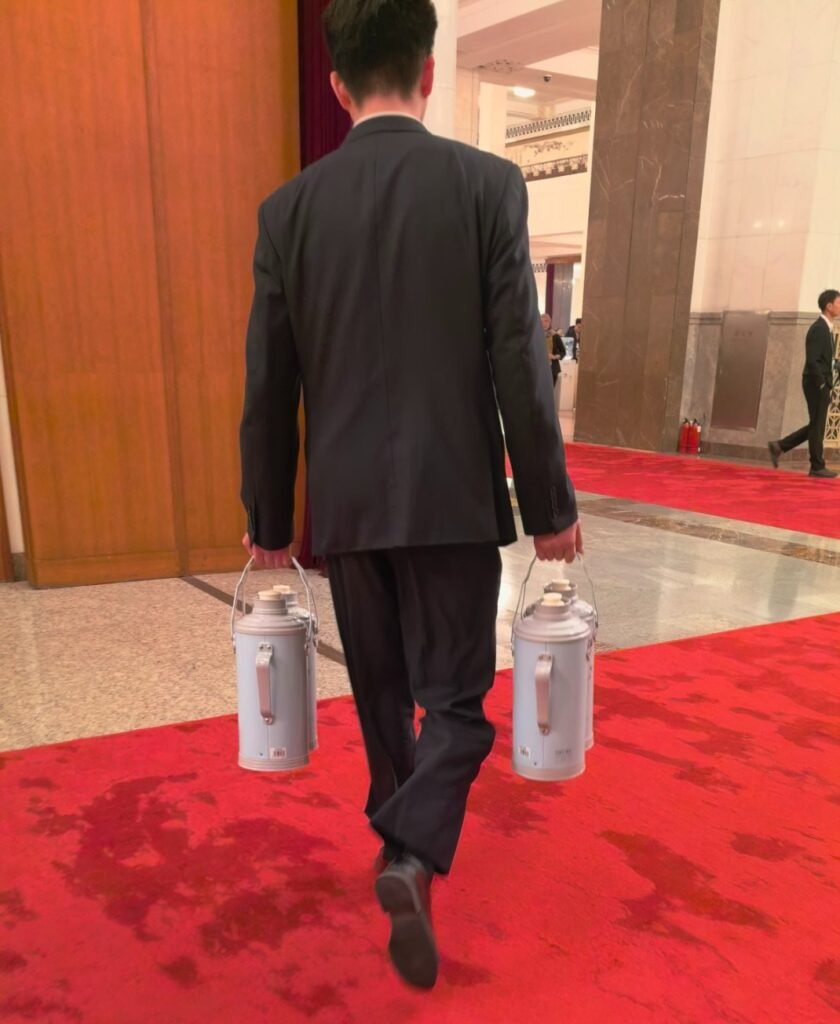
Meeting in Beijing last week, China’s annual political gathering, the “Two Sessions,” introduced plans for the country’s economy and society over the coming year. Technologies like AI were a clear focus in the premier’s government work report. But not all of the gadgets taking center stage in media coverage were so high-tech. Enter the vintage hot water bottle.
On March 12, as the annual plenary meetings of the country’s top legislative and advisory bodies concluded, the Ningbo Daily published a story in which reporter Cheng Liangtian (成良田) described becoming curious about the apparently long-used hot water bottles passed out at the conference. A staff member explained, according to the report, that the National People’s Congress “has always emphasized thriftiness.” The reporter then discovered that the model, now discontinued, had been manufactured three decades ago.
Cheng concluded by drawing a not-so-journalistic link between the humble vessel and the mystique of Chinese Communist Party power: “Through an old hot water bottle, one glimpses the spirit of diligence and frugality that defines a great party,” he wrote.
What can explain such a strange fuss over water bottles? And why is the Ningbo Daily reporter getting so warmed up about this oddball topic?
With this month’s political meetings touching on issues with the potential to unsettle — unemployment, sluggish consumer spending, a flagging economy — focusing on the minutiae of thrifty housekeeping can serve as an effective distraction. Or so the authorities hope. China’s economic outlook is far from optimistic. The GDP growth target set at this year’s Two Sessions was 4.5 to 5 percent — the lowest in 35 years. And as early as January, Cai Qi (蔡奇), one of the country’s top leaders, instructed propaganda officials to “place economic publicity in a position of importance” and tighten “guidance over public sentiment.”
Small diversions have long served larger propaganda goals in China. In his 2018 book China’s Digital Nationalism, Florian Schneider, a professor at Leiden University who studies political communication in the PRC, describes how the authorities treat China’s media networks as an “info-web” — using their central position within it to inject officially approved “symbols and statements into discourses about the nation, its leaders, and their sovereignty.” Journalists for state media in China learn too that one of their most critical roles is to help create this symbolic world, at the expense of reporting facts. In this system of meaning creation, the battered hot water bottle can be a perfectly serviceable tool.
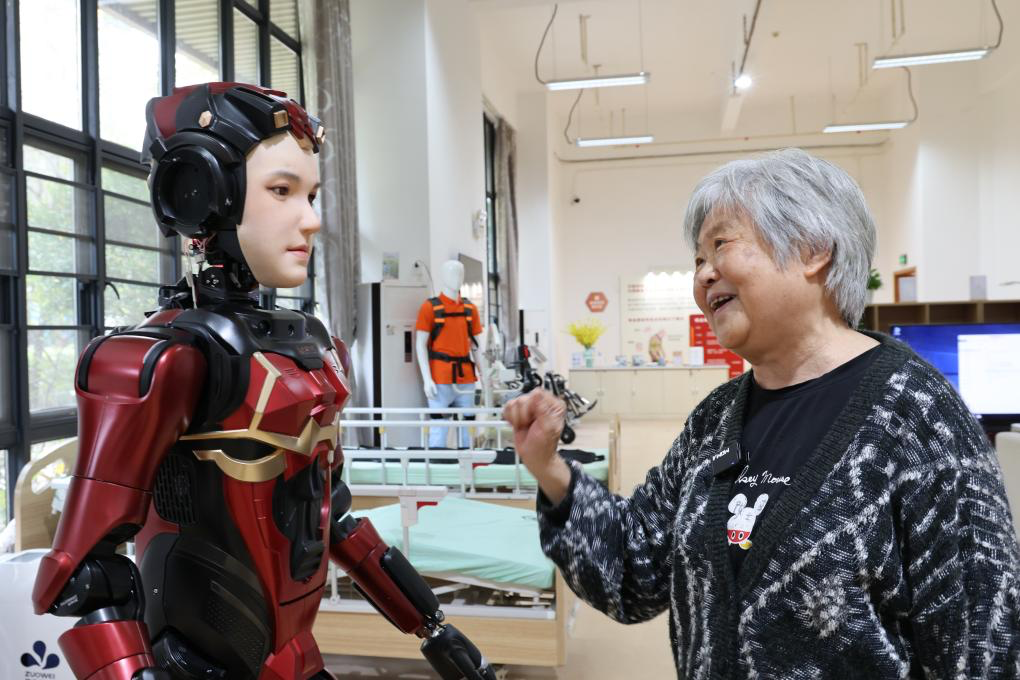
Hot water bottles at the NPC are a minor but telling case in point, one of many such non-news diversions communicated during the course of the meetings — including the ubiquitous AI robot, a symbol of the country’s tech dominance and ambition. The props invite the public to celebrate frugality as an imagined virtue of the CCP leadership, while turning their gaze away from real social and economic challenges.
The story quickly went viral. The hashtag “The Great Hall of the People’s Hot Water Bottle Has Been Used for 30 Years” (#人民大会堂的热水瓶用了30年#) trended on Weibo, where it was picked up and amplified by state and commercial media outlets.
Even the manufacturer — a company in Jiaxing, Zhejiang province — weighed in, telling reporters that it had been sending staff to the Great Hall every year for 16 years to carry out maintenance, and that “no matter how material life changes, frugality is always the foundation.”
Not all readers, however, were warmed by the nostalgic glow of the water bottle story. On Weibo, alongside supportive comments, some users pointed out the irony that keeping the old bottles going had likely cost more than simply replacing them. Another declared that “the most hilarious and farcical video of the year has arrived.”
On Reddit, where Chinese-language communities often include diaspora users and those accessing the platform via VPN, the verdict was blunter still: “What is the government doing with this kind of stunt other than performing and spreading a sense of panic? They keep telling residents to spend more, while the government itself puts on this pointless show.”
As inconsequential as the news story was, it did not go unexamined. Wuyue Sanren (五岳散人), a former Chinese media insider turned independent commentator now based in Kyoto, took to his YouTube channel to raise questions about several of the story’s key claims. Drawing on his experience working within China’s state media system, he noted that bottles and other such objects — far from being frugally preserved — are routinely cycled out of use every three-four years as necessary. He also questioned why the timeline in subsequent reports had quietly shifted from “30 years” to “16 years” of use. One likely reason, he said, was that the media indeed calculated, as social media users had snidely remarked, that ongoing maintenance costs would have exceeded simple replacement costs, undermining the core narrative of frugality.
A Xinhua News Agency report on robots, this one speaking to the elderly in Shenzhen, is one of hundreds in state media during the “Two Meetings.”
So why keep them? Wuyue Sanren set aside the rational explanations — frugality, tradition, and so on — and pointed to something else more basic: superstition. For all the Party’s public denunciations of superstitious thinking, he said, a quiet fear in the leadership runs just beneath the surface. Changing out objects associated with political continuity, even worn-out hot water bottles in a ceremonial hall, could portend unwanted power shifts. “On the one hand, they are always emphasizing that superstition is bad,” said Wuyue Sanren. “On the other hand, they have a constant sense of dread.”
But perhaps the most succinct response to the water bottle ballyhoo came again on Reddit, from a user who ridiculed the state media fixation on nostalgia and emotion: “Classic propaganda apparatus,” they wrote. “Moved by its own storytelling.”
The term “sasaeng fans,” or sī shēng fàn, originated in South Korea and refers to obsessive fans who engage in stalking behavior, invading celebrities’ privacy through harassment, illegal photography, and relentless pursuit. The phenomenon has spread across the entertainment sector in East Asia, and media in China now widely use the translated term. These fans develop intense parasocial relationships that escalate into dangerous stalking behaviors, disrupting idols’ personal lives and safety. “Just How Terrifying is Sasaeng?” asked one headline last week on Sohu.
Hong Kong actress Cecilia Yip (葉童) is pulled from her vehicle by a “saesang fan.”
Liu I-lo remained buried in journalism work, even on the eve of being informed of the layoffs at WHYNOT, or Wainao (歪脑), the Chinese-language platform launched in 2017 under the US-run Radio Free Asia (RFA) news service.
“In our final breath, we rushed to get a lot of articles out, publishing what we could. In the last two weeks, we hurried to process all contributor payments, kept phone numbers active so writers could continue receiving payments — and we made our best effort to ensure we compensated for unpublished pieces,” he recalls. “We self-funded our SOPA submissions to completion,” he added, referring to the prizes for journalism excellence given each year by the Society of Publishers in Asia.”Even in the worst-case scenario that we were completely destroyed in the end, there were awards to win. What’s more, we did our job well, whether keeping pace or speeding things along.”
Liu was not alone. For many journalists at RFA and Voice of America (VOA), the last few months have been particularly difficult. It hasn’t just been about losing journalism jobs, but about the journalistic values they were able to practice at these outlets — and facing the possibility of having no real place to exercise those values again, or even lacking the capacity altogether.
Beginning in March 2025, the funding for multiple media outlets under the US Agency for Global Media (USAGM) – the independent U.S. agency that has funded media broadcasters like RFA and Voice of America (VOA) — was abruptly frozen. VOA, which primarily broadcast to East Asia, laid off nearly 100 people, while RFA underwent massive layoffs, with most staff placed on unpaid leave without work authorization. As of August, only 81 employees worldwide remained employed, with most programs suspended.
For this article, we spoke with multiple journalists who worked in various departments and positions at RFA. They discussed how they faced the sudden news of dismissal and how they have contemplated concerns about the future since, from the perspective of their personal lives as well as their journalistic values. Given ongoing professional considerations, the three sources agreed with Tian Jian to speak anonymously. They are identified here as Chen Mai, Jhou Sin, and Liu I-lo.
Project Layoff
In late November 2024, just after Donald Trump was elected to the presidency, USAGM internal staff were all discussing “Project 2025,” a policy blueprint prepared by the Heritage Foundation, a conservative American think tank. An entire chapter in this 900-plus-page document discussed the “reform” of public media, including USAGM’s overseas broadcasting.
Jhou Sin, a former employee of RFA’s Cantonese service, said in an interview that employees knew as early as late 2024 that there would be personnel reform after the election. No one expected mass layoffs.
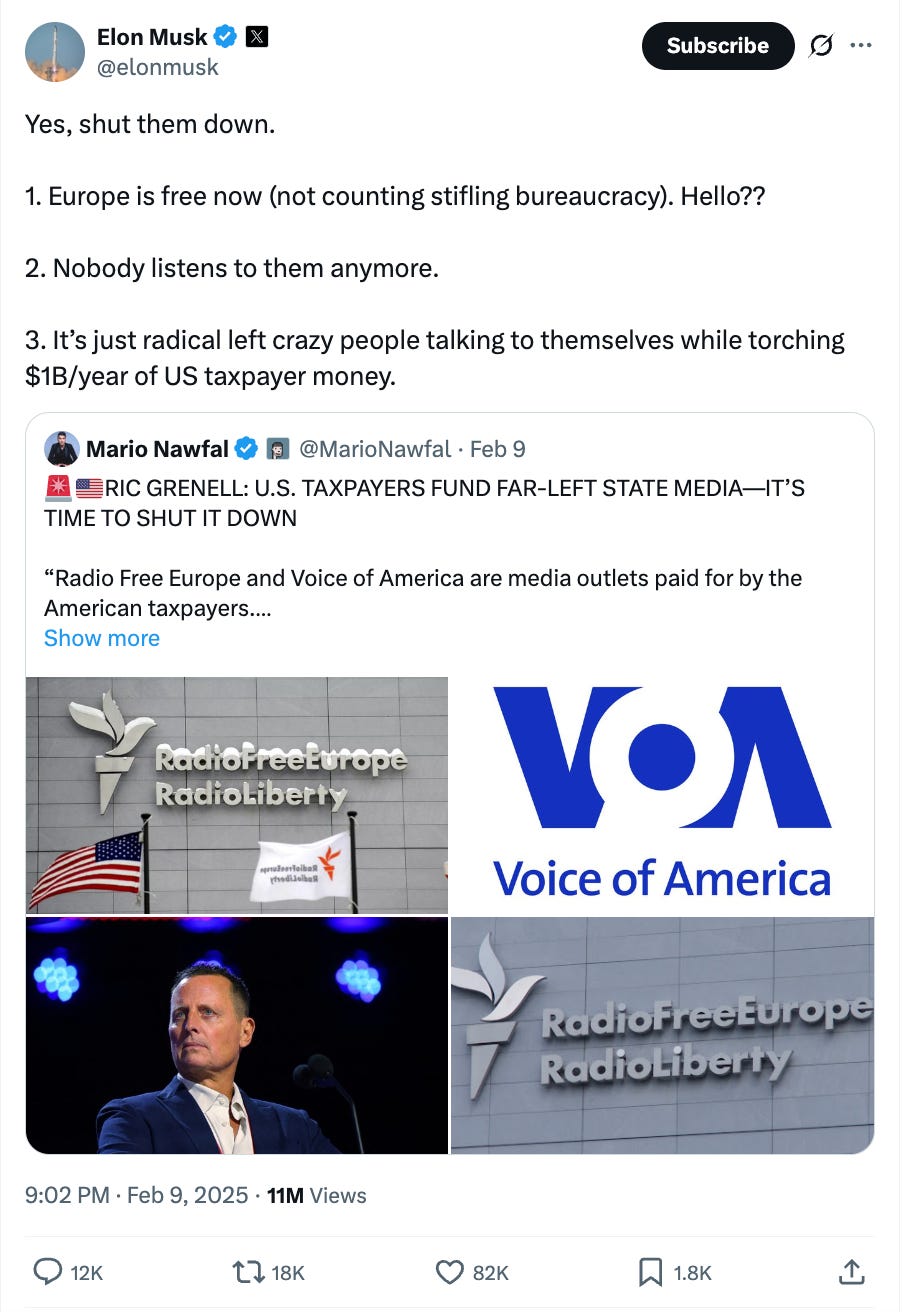
“We vaguely knew Trump would ‘reform’ us after taking office, but we didn’t know what methods would be used. Everyone could only guess, thinking that VOA and RFA might merge, or that the Mandarin and Cantonese services might combine,” said Jhou. But soon after, Elon Musk, then head of the Department of Government Efficiency (DOGE), criticized USAGM on X. Shortly after, DOGE took over USAGM, and waves of budget freezes, unpaid leave, and batch layoffs followed.
Layoffs at USAGM organizations came days after Elon Musk, then head of DOGE, criticized RFA and VOA on X.
Liu I-lo’s recollection is similar to Jhou Sin’s. At the time, the company made employee retention decisions based on various labor laws and visa statuses in different locations and bureaus, trying to maximize protection of employee interests. Each individual’s situation was different, but with operating funds shrinking by the day, there was no other choice but to make increasingly poor decisions.
“Most DC colleagues were furloughed, overseas staff at the time didn’t know what would happen, contractors had their contracts immediately terminated, our part-time colleagues were suspended one after another, colleagues in the UK and Canada were also laid off, followed by major layoffs at the Taipei office,” Liu recalls.
“This is what being a journalist is. Even if the sky falls, you have to do reporting.”
During those months, Liu said, although RFA was still operating, management became increasingly sensitive about certain types of content.
“When we saw news about USAID being heavily targeted, everyone already knew we shared the same vulnerabilities,” said Liu. “Those non-profits funded by USAID — we initially tried to report on them. But these pitches were rejected by upper management. Because you knew you would be next. So actually many ideas in the editorial department were rejected by upper management.”
Other topics of concern to target audiences, including human rights, gender, and geopolitics, were also often softly rejected by senior management. As ideological lines became clear, many articles and videos already published were “temporarily removed,” as management explained. For other topics in planning or already in progress the phrase was “publication postponed.” Liu recalls that during that time almost every weekly editorial meeting involved trying different approaches to softly resist — this being a tactic generally associated with more repressive environments like that in Hong Kong.
“You have to think, USAID has humanitarian crisis-level funding under it. If [the U.S. government] doesn’t even care about that, why would it care about small-scale matters like ours?” Liu said.
Subsequently, waves of unpaid leave and batch layoffs began. Liu I-lo recalls that after colleagues were informed of layoffs, they were constantly busy with various forms of administrative cleanup. “This is also what being a journalist is,” he said. “Even if the sky falls, you still have to do reporting. Suppose the Earth is going to explode tomorrow, would you do a report today?”
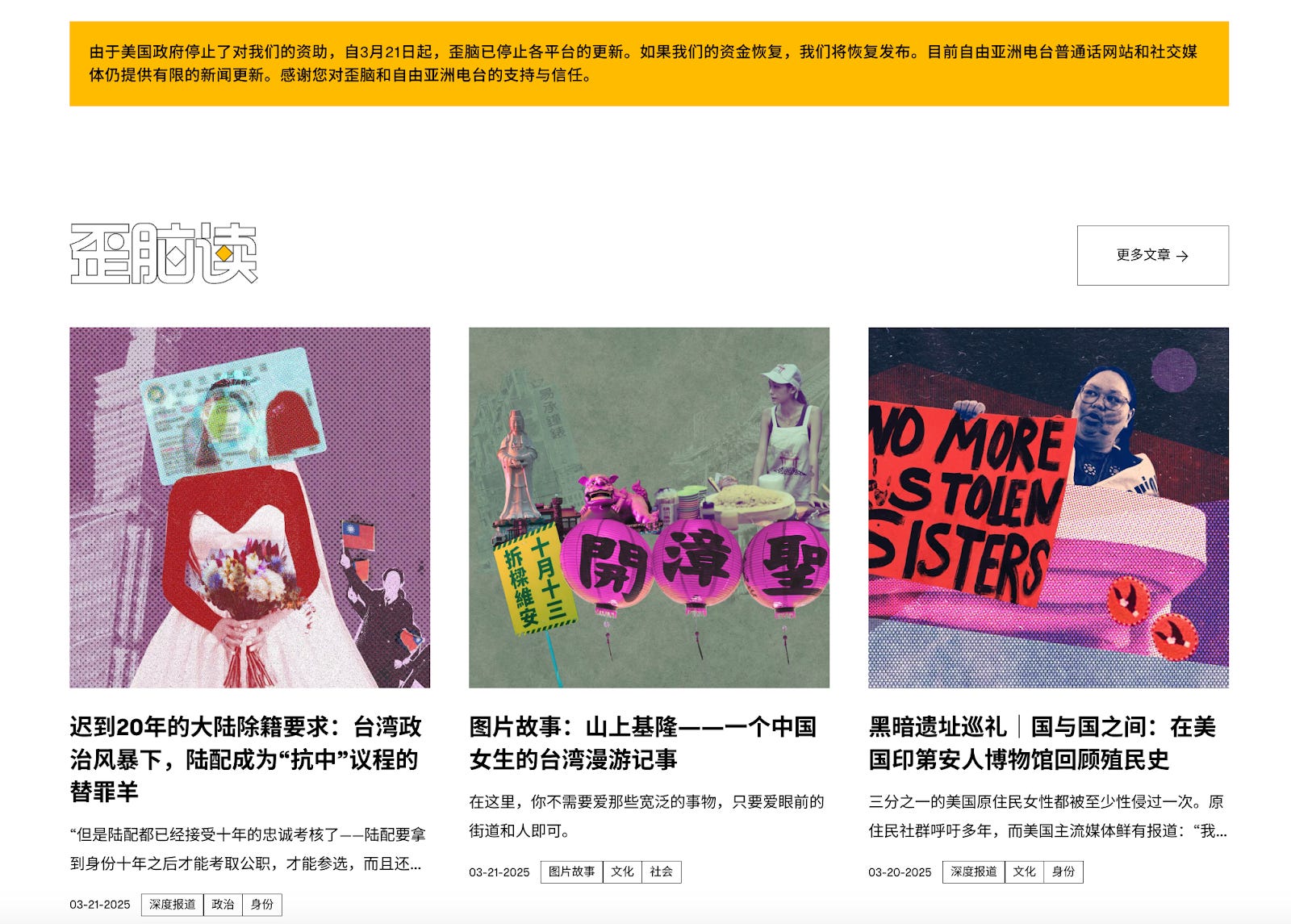
On March 22, WHYNOT was the first outlet within the agency to shut down. On social media, they published a farewell message: “WHYNOT’s website and social media will stop updating on March 22 and 24, respectively; the website and social media can continue to be viewed normally until further notice. We look forward to reuniting with all WHYNOT readers when the skies clear after the rain.”
A message on WHYNOT’s website states that it has “stopped updating on all platforms due to the suspension of US government funding.”
The Cantonese service, where Jhou worked, announced its closure on June 30 and stopped updating on July 1.
“I feel I have already earned three months more than others, not earning money, but earning time,” Jhou said. “Being pessimistic, I knew I would definitely be laid off; it was just a matter of time. At first, I felt confused, but later I gradually adjusted to doing whatever I could. We wanted to be the last group to close the door, and if it really had to end, then we wanted to end it decently.”
RFA was formally established in March 1996, its mission to “broadcast news and information to listeners in Asia who are otherwise denied access to full and free information.” This was nearly seven years after the Tiananmen Square massacre, which had ushered in a period of renewed press control in China — even as the economy was expanding and the Internet revolution just around the corner.
The Cantonese service of RFA was established two years later, in 1998, soon after the transfer of Hong Kong’s sovereignty to the PRC under the “one country, two systems” formula. Protections for press freedom in the territory continued to make it an ideal space for local language journalism that could be broadcast across the region, even reaching audiences across the border in Guangdong.
The situation changed dramatically with the passage of Hong Kong’s National Security Law in 2020. As many local journalists from such media as Apple Daily and Ming Pao were purged by the Hong Kong authorities, RFA’s Cantonese service became an increasingly popular source of news for Hong Kong people.
“With the anti-extradition movement, the National Security Law, and the departure of [journalism] colleagues from Hong Kong, the Cantonese service has experienced a lot of turbulence in recent years,” said Jhou. “But even under so much turbulence, everyone still produced strong reports.”
Yielding to China
Chen Mai worked as a designer at RFA and was also laid off in May 2025. Born in Hong Kong and currently living in Washington, D.C., he has already started looking for a new job.
Chen joined RFA in 2019 and contributed to many major digital feature productions, including several award-winning reports.
“Coming to RFA was quite important for me at the time. The feeling then was, ‘we can make something important,’ which somewhat alleviated my political depression,” said Chen, referring to his emotions around the direction of Hong Kong.
Having come to America just a few years ago and now facing layoffs, he still believes he ultimately had to leave Hong Kong. What is more difficult is seeing other colleagues who are stuck due to issues with their immigration status.
Chen added that RFA has multiple language services, including Cantonese, Tibetan, and Uyghur services, and that “those in the most difficult situations are employees who have worked for years in these small language services.” Not only do they face issues with their visa status, but it is also difficult for them to find new jobs in the short term, with some still hoping the outlet might restart operations.
There has been no sign that will happen — even as many argue that the loss of the services is to the detriment of press freedom globally.
After RFA stopped receiving funding in March, CEO Bay Fang said: “The termination of RFA’s grant is a reward to dictators and despots, including the Chinese Communist Party, who would like nothing better than to have their influence go unchecked in the information space.”
Former US Ambassador to Russia Michael McFaul, a former MSNBC commentator and Washington Post columnist, similarly described the cuts as “giant gifts to China,” with people in Hong Kong, Tibet, Xinjiang, and elsewhere now receiving a diminishing volume of information about human rights from outside sources.
Jhou Sin believes the US government certainly has its own considerations in terms of RFA and VOA content and its goals, but at the very least, USAGM regulations guaranteed editorial independence and editorial oversight, which meant substantial resources going to media that had a duty to professional reporting. “In comparison, other diaspora media don’t have such resources,” said Jhou. “Thirty minutes of daily programming, lots of features and commentary, and a high-frequency of updates on social media.” These had an appreciable impact on the news environment in Hong Kong, he believes, and he said he could foresee that after the end of RFA, the flow of news in Hong Kong could decrease significantly.
“Bay [Fang] was right, this is the biggest gift to the CCP. With the end of the Cantonese service, I also believe Hong Kong’s pro-government media may increase their propaganda efforts,” Jhou said.
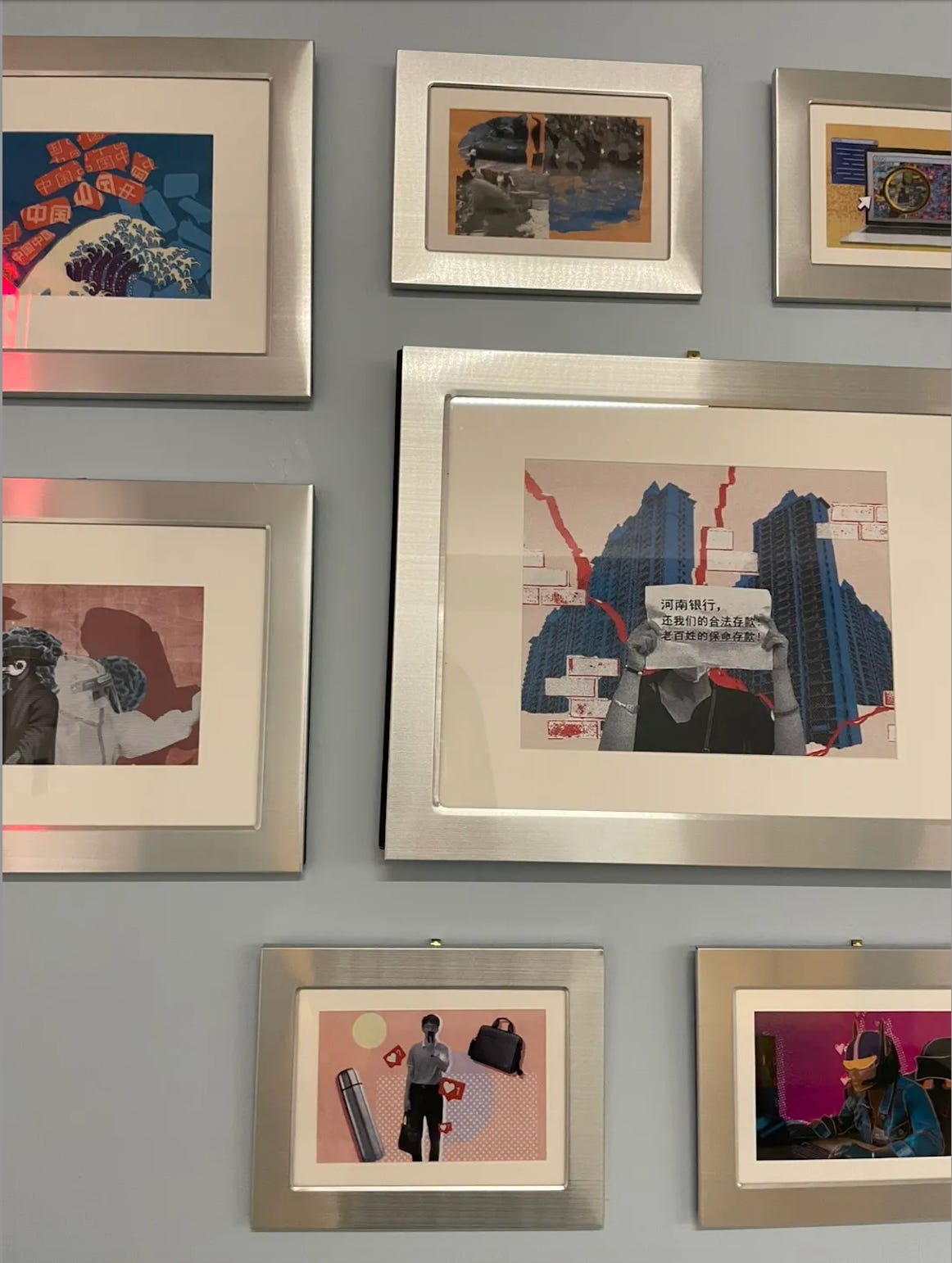
The WHYNOT office contains several framed images from past stories. Photo by Xu Jiaqi.
Of course, many in the region have also criticized journalists working at RFA and VOA for taking US government money and producing what they deem to be propaganda for “foreign hostile forces” — a phrase China has long used to broadbrush critics as conspirators.
“This matter itself is quite strange,” Liu said in response to those criticisms. “If I could write my reports without constraint in China and Hong Kong today, would I still need to go [to RFA]?”
“Critics will say that everyone is just issuing American meal tickets, thinking they’re doing good deeds, but under the entire world system as led to date by America, these articles are nothing more than cups of water trying to put out a burning cart of firewood,” said Liu, referring to efforts by Western-funded Chinese-language media organizations to fill the void left by the collapse of independent journalism in China. “For me, there’s nothing particularly special about this so-called [criticism]. It’s just whether a piece of reporting can be done well, whether there’s sufficient space to do it. Because Chinese-language media is now in a state of collapse, but if it can stir up even a small ripple, then it’s worth doing.”
Continuing Resistance
After his work at RFA ended, Liu interviewed everywhere — mainly for visa reasons. He didn’t limit himself to journalism, applying for jobs at convenience stores, sushi restaurants, and retail shops, and for restaurant server and sales representative positions.
No more journalism? He admitted that a senior Chinese-language journalist and editor’s resume is completely useless where he currently lives.
“I was targeted by the government before; now I’m being targeted by the government again.”
“When I looked for work, asking where they needed servers, saying I could speak Chinese and English, and Cantonese too, they said ‘very good, very good,’ but they didn’t have time to train me and needed someone with experience. This is a vicious cycle — how can I gain experience if I need it to land a job in the first place?”
He started by calling a local Chinese-owned sushi restaurant. “The boss was from Fuzhou and immediately said a lot of discouraging things — babbling on about how the hours here are long, no one will teach you — and then had me start helping in the kitchen. The boss was indeed willing to teach me: cutting avocados, cutting mangoes, peeling the thin skin off imitation crab. I worked this job for a few days. Then one day, I got the time wrong and was fired immediately.”
Following this experience, Liu edited his resume, removing the content about his past roles as a “senior journalist” and replacing it with restaurant kitchen experience.
“The funniest thing was, I used my previous journalist resume to apply for a staff position at a store, asking if it could be passed to the manager. There was no reply. Later, after editing a new resume, I saw that store again, applied again, and this time got an immediate reply.”
For now, Jhou Sin doesn’t need to worry about visa issues. But his life has descended into a state of confusion — as he finds it difficult to engage with issues around him.
Jhou Sin has felt uncertain about the future since his layoff from RFA. Photo by Jhou Sin.
“Before, I spent so much time every day desperately thinking of story ideas, proactively reading different news sources,” he said. “Now I have no motivation left. I wake up and barely read the news, just casually browse, because there’s no goal to aspire to. Why come up with story ideas anymore? So instead I feel somewhat empty.”
This is not the first time Jhou has experienced unemployment. The first time was when he was working for local media in Hong Kong.
“I was targeted by the government before; now I’m being targeted by the government again,” Jhou said. “The first time I lost my job, I thought I didn’t want to work in this profession anymore. That sense of powerlessness was strong. But at that time, my current supervisor used his silver tongue to convince me to come work here [at RFA]. It wasn’t easy then to pick up my enthusiasm for journalism again, and now once again it has to end. That old sense of powerlessness has returned.”
Chen Mai is job hunting now, too. Compared to other American cities, Washington, D.C. has more severe unemployment issues due to massive layoffs across government agencies. He is contemplating whether he should change fields or continue to work in the media.
The experience has served as a reminder not to self-censor due to political pressure.
“My point is that we absolutely cannot censor ourselves, cannot modify content according to readers’ preferences or interviewees’ partiality, and cannot self-censor because of pressure from above,” Chen said. “I experienced all of this at RFA, but even if you are subject to political censorship, you cannot rationalize this. You need to resist. You need at least to debate.”
“Once we become submissive, thinking that [accomodation] can protect us, we still get targeted in the end,” Chen added. “And being targeted has nothing to do with content actually having an issue. All these compromises are irrational and will only make you less like a news organization.”
Regarding journalism work, Liu I-lo stands by his professional record. “I’m confident that everything that came from my hands was professional work. I never considered RFA to be American propaganda. Even if that was the goal, we would make an effort to resist.”
At the Society of Publishers in Asia (SOPA) awards ceremony in June, WHYNOT won two awards, adding to its count. A report about detained Chinese journalists Wang Jianbing (王建兵) and Huang Xueqin (黃雪琴) won the award for excellence in human rights reporting, while a series on the 35th anniversary of the June 4th Incident won first prize in news innovation. Because the editorial department had long since ceased operations, however, no one appeared that day to accept the awards in person.
Hsu Chia-Chi is a journalist focusing on political, cultural, and human rights issues in Taiwan, Hong Kong, and China. She previously worked for WHYNOT.
Chinese media personality Mimi Yana (米米亞娜), known for her feminist writing and coverage of women’s issues, launched her Substack account on August 9 following what she described as her forced departure from journalism earlier this year.
In her introductory post, Mimi Yana said that she was “kicked out of the journalism industry by Trump” (被特朗普踢出了新闻业) in early 2025 while working in the United States. Writing that she had “no power to control my own destiny” on “a land that promised democracy and freedom,” she described the experience as accelerating her political disillusionment. She did not spell out the circumstances of her departure, though this was likely related to federal grant arrangements affecting her outlet. The setback led her to delete all social media accounts and avoid reading news for an extended period. “This blow accelerated my disillusionment with politics,” she wrote.
Mimi Yana’s second Substack essay, published August 17 and titled “When Politics Fails, Can Art Answer Our Contemporary Dilemmas?”, explored her search for alternative ways to understand the world following her exit from journalism. The lengthy piece detailed her experiences viewing art exhibitions in Paris museums while grappling with political despair, examining works from David Hockney’s digital paintings during the pandemic to female artists like Suzanne Valadon who challenged male-dominated artistic traditions. The essay blends cultural criticism with personal reflection, questioning whether aesthetic experience might offer insights where political analysis fails.
hink “state media” in China and you’re likely to conjure an image of the People’s Daily (人民日报). The daily newspaper, directly run by the Chinese Communist Party’s (CCP) Central Committee since 1948, prides itself on being the “mouthpiece” (喉舌) of the Party leadership. And a role this important demands regimentation and structure: a staid face to communicate the thoughts of the CCP core.
But while it is the most representative of the Party leadership, the People’s Daily newspaper, first launched in 1946, is not the only face of this Party-run media group. The paper’s parent organization, the People’s Daily Press (人民日报社), is in fact a sprawling media empire. The group oversees a portfolio of 34 periodicals as well as a wide array of newer digital products. It runs a health magazine, a history journal, a newspaper for gearheads, and even the RV Times (房车时代), a periodical for recreational vehicle enthusiasts.
The story of the group’s growth over the years is the story of the PRC media space as a whole, where commercialization and partial privatization were actively encouraged in the reform era, and where more recent developments have made it clear once again that the Party maintains ultimate control.
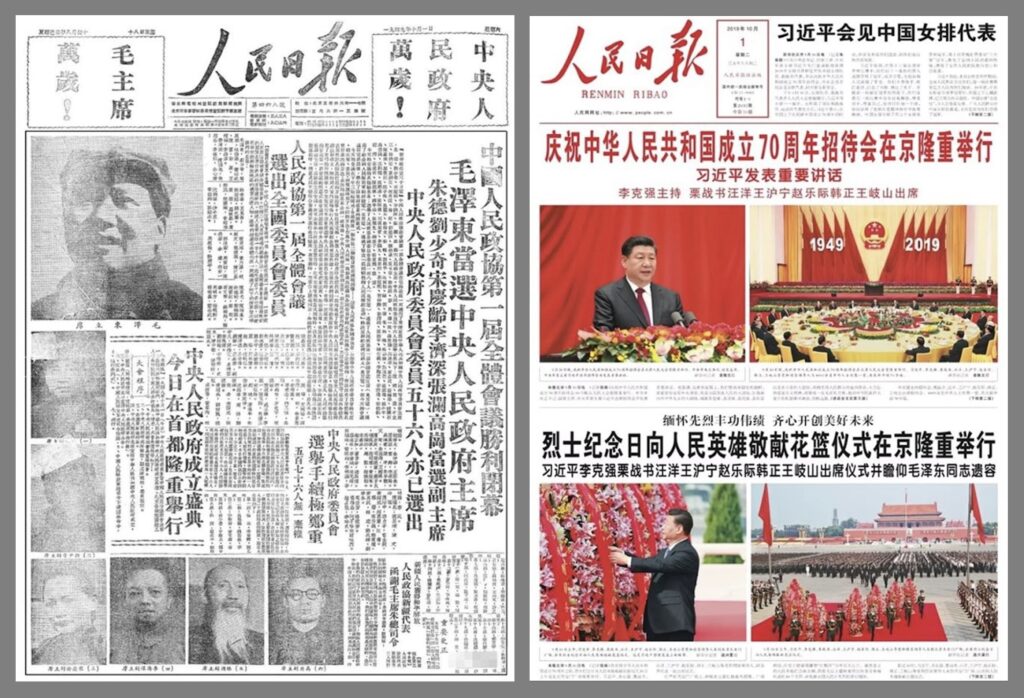
The People’s Daily on the day the People’s Republic of China was founded on October 1, 1949, and the PRC’s 70th anniversary in 2019.
A Fresh Wind Through Chinese Media
In the China of Chairman Mao Zedong, the People’s Daily was one of only a handful of officially sanctioned newspapers run by the CCP — known, fittingly, as “Party-papers” (党报) — to cover the entirety of the newly founded People’s Republic of China. It adhered strictly to Mao’s notion of “politicians running the newspapers” (政治家办报), according to which any printed articles, particularly lead editorials (社论), had to be aligned with the interests of the Party. During the Great Proletarian Cultural Revolution (文化大革命) of 1966-1976, those interests were Mao’s personal political interests, and the chairman’s writings dominated the “two newspapers and one journal” (两报一刊) system, in which the three most influential PRC publications, including the People’s Daily, the People’s Liberation Army Daily and Red Flag journal, reigned supreme.
In the early years of China’s reform and opening up under Deng Xiaoping (邓小平), the number of nationwide publications in China remained small for a country of its size. In 1979 there were just 69 “Party-papers” in print. This contrasts sharply with the latest figures from the National Press and Publication Administration (国家新闻出版署), or NPPA, an agency under the Party’s Central Propaganda Department that supervises print publications in China. The NPPA recorded 2,405 newspapers published in the country in 2023.
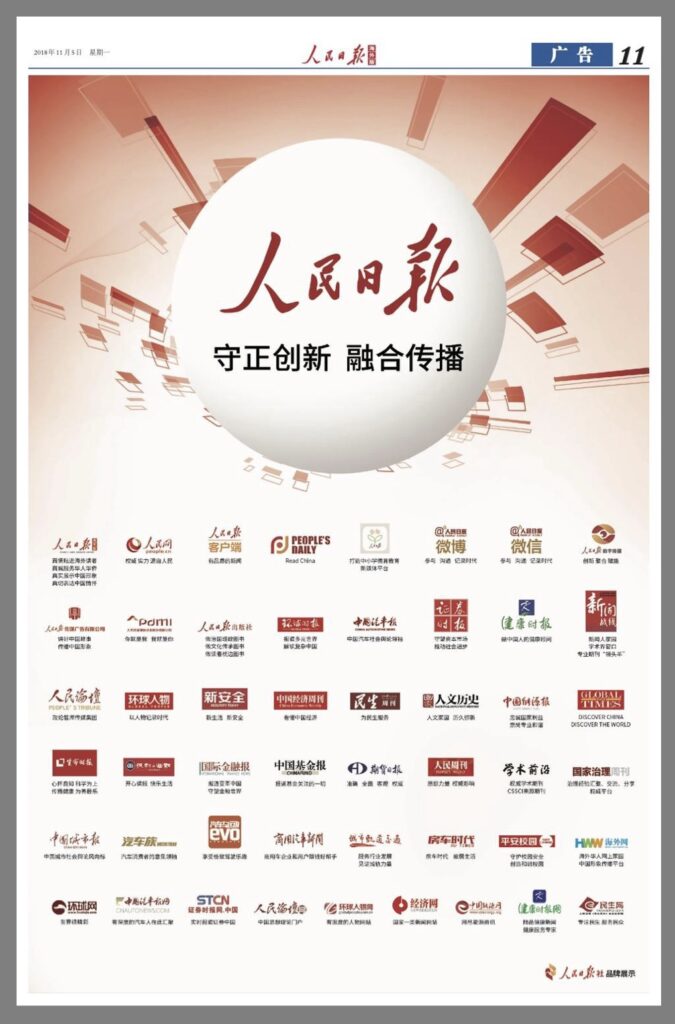
An advertisement is the People’s Daily showcasing the many brands under the People’s Daily umbrella.
This number began its climb from two to four digits in the 1980s, as economic reforms brought a rethink of the role in the media. The term “news reform” (新闻改革) signaled a new openness, including an assessment from the leadership under Deng Xiaoping that the “falsehood, bluster and emptiness” (假大空) of the media from the 1950s onward had to a large extent contributed to the chaos of the period, from the Great Famine through the Cultural Revolution.
Tragically, the push toward greater freedom of speech in the 1980s, seen in the launch of more reform-oriented newspapers like Shanghai’s World Economic Herald (世界经济导报), was brought to a brutal end by the Tiananmen Massacre of June 4, 1989.
But by the mid-1990s, as economic reforms were reinvigorated and accelerated, the spirit of change again swept over the media in China. This era also saw significant liberalization in the industry, with the number of periodicals rising rapidly as a result. Publishing was never a free marketplace of ideas — government licenses remained necessary for any operation — but new voices did begin to emerge. More market-oriented “metro papers” (都市类报纸) served China’s rapidly urbanizing population, oriented around the consumer — of goods and information. The equation meant more readers, more sales, and more ad revenue, a new way for outlets to exist independent of state financial support, even as political ties to the system remained paramount. From time to time, these papers challenged the authorities by reporting more openly on corruption and other political and social issues.
Even the People’s Daily joined the trend, launching its own metro newspaper, the Beijing Times (京华时报), in May 2001. In what has been called the “golden age for metro newspapers,”higher salaries and more comfortable working conditions made the Beijing Times and other commercial competitors attractive to a new generation of young journalists. According to a 2017 account, the “direct approach” and “sharp commentary” found at the Beijing Times in the 2000s made it “like a fresh wind sweeping through Beijing’s then-dull media market.”
Going Public with the People’s Internet
The rise of the internet in China after 1994 was another jolt for the media industry, even though it was heavily regulated from the start to ensure that news gathering remained in the hands of the Party. Inside China, Chinese-language internet portal sites like Sohu.com, launched in 1996, and Sina.com, launched in 1998, could serve as content aggregators — reposting content from Party media and registered commercial spin-offs — but could not themselves maintain teams of journalists. But they revolutionized the consumption of information, even inviting discussion in the comment (跟帖) section underneath news articles.
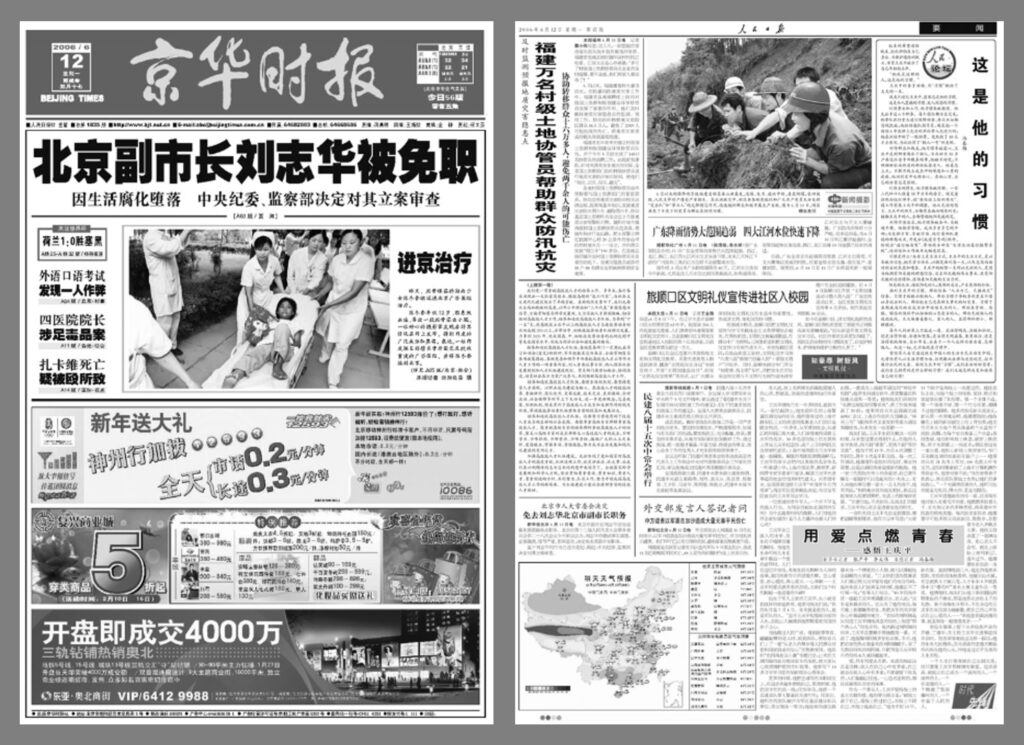
Contrasting reports from 2006 on corruption charges against the vice-mayor of Beijing illustrate the differences between Party papers and their commercial spin-offs. At left, the Beijing Times places the corruption story prominently on the front page. At right, the People’s Daily includes only a small note on page 4.
The People’s Daily was quick to follow suit, entering this space on January 1, 1997, with the launch of its online portal, People’s Daily Online, or renminwang (人民网). As the group’s “About Us” page explains, the emerging online space offered “unique advantages” including “communication value” (i.e., more interactivity) and “technological value.” Today, the official portal site continues to publish a digitized and downloadable version of the People’s Daily print edition, runs the Chinese Communist Party News Network (中国共产党新闻网), and moderates a “leader’s message board” (领导留言板). This last feature, which China’s government has cited as an example of democratic governance, claims to allow citizens to directly pose questions to officials or express their views, but in fact is little more than an officially curated comment service — serving to promote the idea of Party responsiveness rather than enable real accountability.
People’s Daily Onlineis structured more like a conventional company. Listed on the Shanghai Stock Exchange as People.cn Company Limited (人民网股份有限公司) since April 2012, it has its own investor relations page and publishes its annual returns, the latest of which boasts revenues of 2.1 billion RMB (290 million dollars). Like any other company’s annual reports, People.cn’s are replete with references to the firm’s profits. But unlike those of most publicly listed companies, their reports blend profit talk with performative loyalty to the Chinese Communist Party. Investors are reminded, in the management analysis section, that the company strictly adheres to “Xi Jinping Thought on Socialism with Chinese Characteristics for the New Era.” Career openings at the company also list “loving the Party” and having “strong political integrity” as job requirements.
Building an Empire
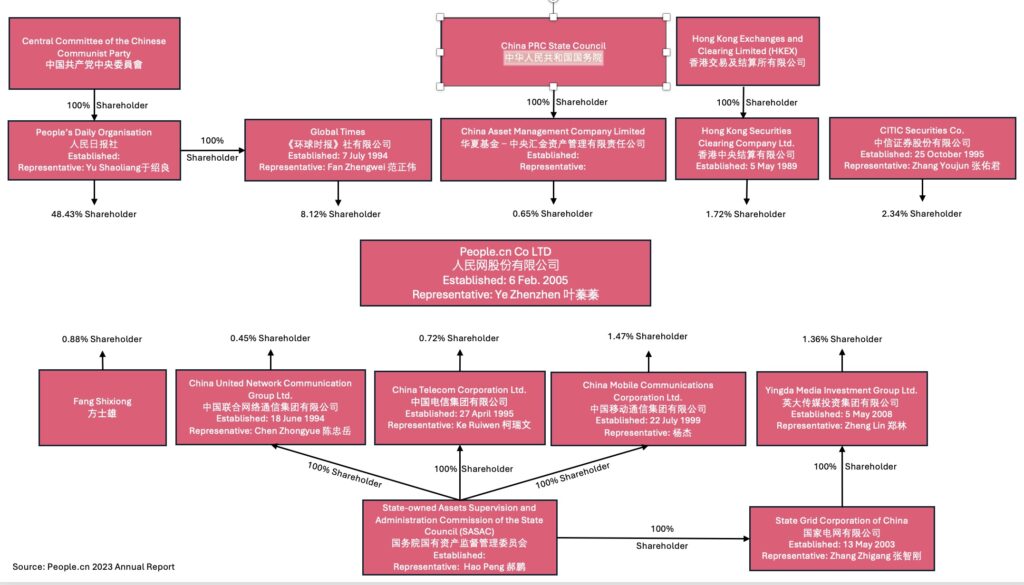
But while the print edition of the People’s Daily falls directly under the CCP’s Central Committee, People’s Daily Online has a series of private buy-ins from investors that complicate its identity. The group’s annual reports reveal their top ten shareholders, compiled into the diagram below. Amongst others, the company’s biggest investors include state-owned investment bank CITIC Securities (中心证券), state-owned telecommunications giant China Mobile (中国移动通信), and the Hong Kong Securities Company (香港中央结算), wholly owned by the Hong Kong Exchange and Clearing Limited (HKEX) that runs the territory’s stock exchange. While the print edition is run unambiguously as part of the Party-state, its online counterpart retains some reform-era features of a legitimate digital news company — although just a little digging reveals that the Party-state is still firmly in control.
Screenshot
Combined with the shares held by the Global Times — a nationalistic tabloid wholly owned by the People’s Daily — the People’s Daily Press has a controlling 56.55 percent stake in People.cn. Even the apparently private minority buy-ins, however, are in fact different arms of the Party-state itself. Take, for example, China Asset Management (华夏基金), which holds 0.65 percent of People’s Daily Online shares and is registered under the State Council. Other investors like China United Network Communications Group (中国联合网络通信), or “China Unicom,” China Telecom (中国电信), and China Mobile Communications are all state-owned enterprises (SOEs) overseen by the State-owned Assets Supervision and Administration Commission of the State Council, which is directly under the management of China’s central government.
So how profitable is the People’s Daily Online? A 2019 article in the industry publication China Newspaper Industry (中国报业) summed up media developments over the previous year in China with a series of bearish keywords. The top three: “decline” (下滑), “loss” (流失), and “avalanche” (雪崩).
While the print edition of the People’s Daily falls directly under the CCP’s Central Committee, People’s Daily Online has a series of private buy-ins from investors that complicate its identity.
But People’s Daily Online doesn’t seem to be faring so poorly.Their 2019 Annual Report logged a 40 percent profit increase from the year before, and they kept growing the next year. Despite a pandemic slump, their profits are on the rise again.
How the outlet manages to be so profitable, however, is not necessarily down to just newsstand sales, subscriptions, or advertising revenue. In the United Kingdom, the People’s Daily Online’s London bureau (People’s Daily Online UK Limited) is based near Hyde Park’s famous Speakers’ Corner, a historic site for free speech and public debate — and famous, too, for having some of the most expensive real estate in the country. The latest financial statement for the UK bureau shows a loss of 2.8 million US dollars, offset only by the 3 million US dollars provided by its head office in Beijing. We have also documented this phenomenon at China Daily USA, where the stateside operations of the state-run newspaper are run at a considerable loss thanks to millions in direct funding from China Daily HQ.
The People’s Daily Online also runs Global Times Online (环球网), the digital edition of the nationalistic tabloid Global Times (环球时报). Ownership of the newspaper is split 60-40, respectively, between the People’s Daily Online and the Global Times Press (环球时报社) — the latter of which also sits directly under the CCP Central Committee. Haiwainet (海外网), the website of the overseas edition of the People’s Daily, is split along the same lines by the People’s Daily Online and the People’s Daily Press.
China Energy and Automobile Communication Group (中国能源汽车传播集团有限公司) is responsible for the People’s Daily’s stable of specialized trade publications (专业行业报). The Group is wholly owned by the People’s Daily Press — again, directly under the Central Committee. Its properties include China City News (中国城市报), a weekly bulletin aimed at “party and government leaders” involved in “urban planning, construction, and management,” as well as China Automotive News (中国汽车报), a print weekly and digital news outlet for fans of cars and engineering.
One Voice, Many Channels
For most companies around the world, corporate social responsibility reports are used to demonstrate how the business has had a positive impact on society and the environments in which it operates. It is underpinned by the idea that for-profit institutions still have a responsibility to the broader community. The People’s Daily Press files its own “social responsibility reports” (社会责任报告), but theirs have a distinctive twist: instead of demonstrating their philanthropic deeds, they are used to demonstrate their unwavering loyalty to the Communist Party.
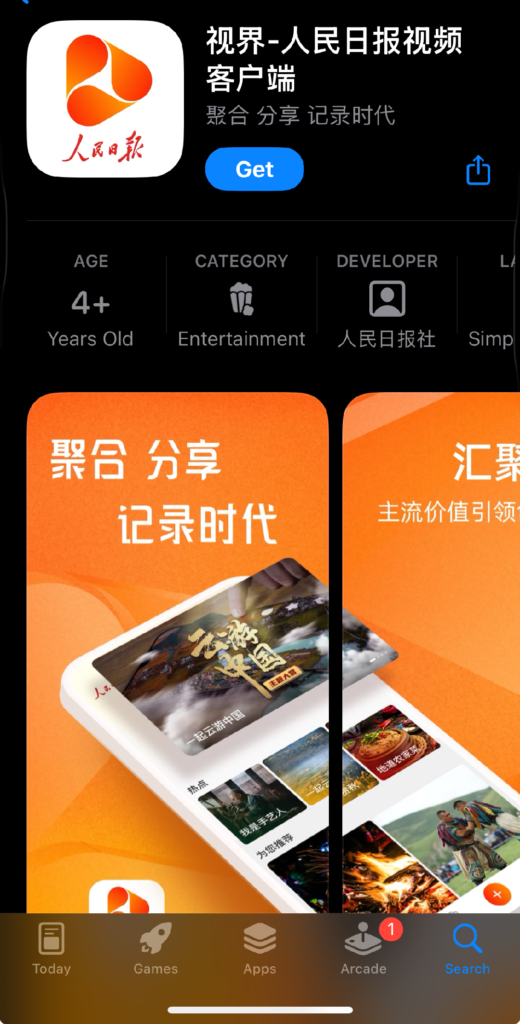
In their latest report, they remind readers that the outlet “strictly adheres to the principle of politicians running the newspapers” — the phrase that was first raised by Mao in the 1950s as he asserted his dominance over the media as a means of consolidating political power, and has since come back in vogue as Xi Jinping has similarly tightened controls on the media. This means that all of the group’s ventures are bound ultimately to the same basic principle: Party first, profit second. This is true whether they are app-based new media outlets like Visual World (视界), at right, sending state-produced video material straight to your mobile, AI text generation tools like “Easy Write” (写易), or just the dry, Xi-filled pages of the flagship People’s Daily newspaper.
Mao’s old phrase, applied in state media today to stake the CCP’s claim over emerging digital media, encompasses the enduring truth behind the many faces of the People’s Daily empire. While this media giant continues to transform through the process of Party-led commercialization that began in the reform era — seen in its diverse inventory of media properties — its core remains unchanged. It is still, in its own words, “the throat and tongue and eyes and ears of the CCP Central Committee.” The principle holds true whether it is reporting on the latest Party plenum or the latest make of luxury camper.
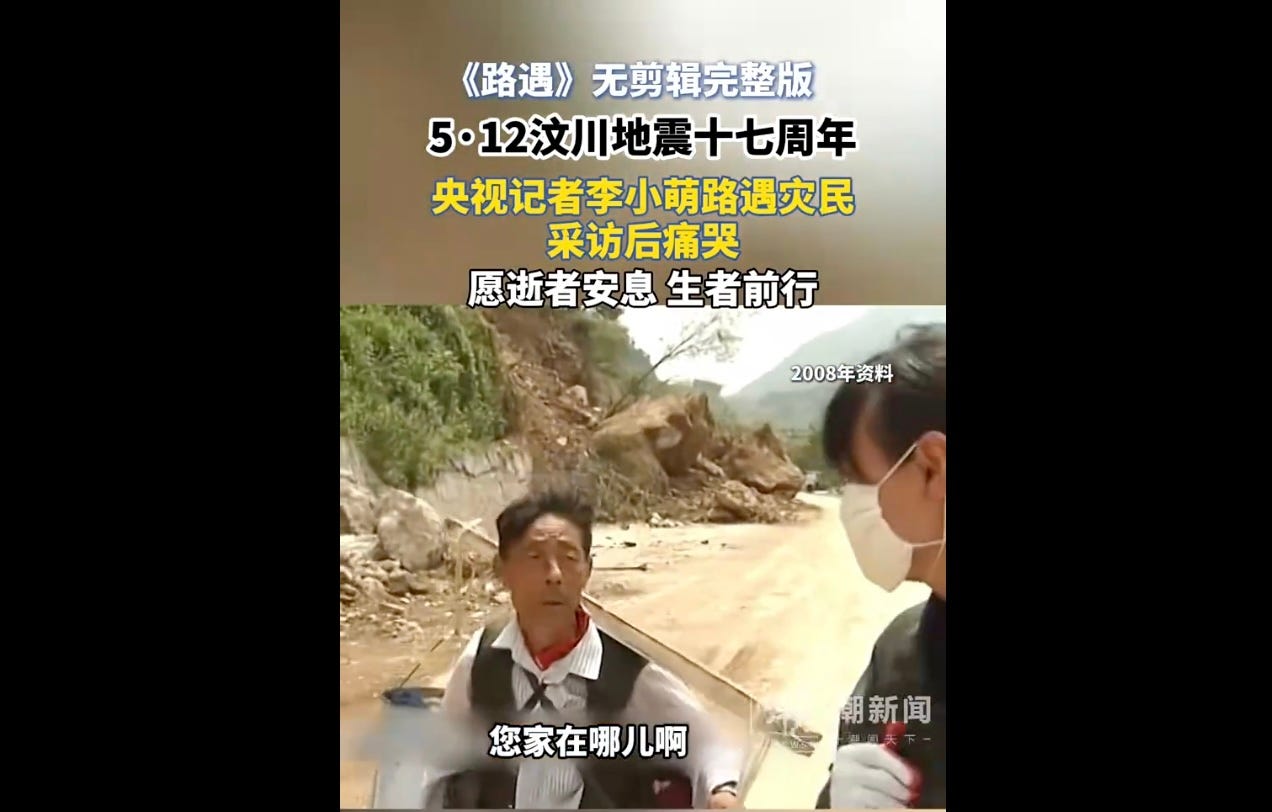
Monday this week marked the 17th anniversary of the Wenchuan earthquake, a 7.9 magnitude tremor that devastated Sichuan province and tragically took the lives of nearly 100,000 people. On the anniversary this year, one particular Wenchuan-related item surged to the top of search engine Baidu and hot search lists on the social media forum Weibo. It involved a vox pops interview given on location one week after the 2008 quake by Li Xiaomeng (李小萌), a reporter from state broadcaster CCTV. In the old broadcast shared on social media on May 12, Li comes across a farmer known simply as “Uncle Zhu” (朱大爷) as she strolls along a collapsed mountain road. Speaking a local dialect, Zhu stoically tells the journalist about the appalling conditions in the area. Through an interpreter he explains to the reporter that he is returning home to harvest his rapeseed crops in order to “reduce the burden on the government” — meaning that he will have some income and not need to be totally dependent on aid. By the end of the interview the farmer is convulsed with sobs, the tragedy of the situation coming through.
Li posted this week on Weibo to commemorate the moment, revealing that Uncle Zhu passed away in 2011. She said: “That conversation, with its unexpected, banal but heartbreaking details, showed all of us in China that people like Uncle Zhu, with their calm acceptance in the face of catastrophe, have the backbone to do what is right.” Other media, including China Youth Daily, an outlet under the Communist Youth League, built on Li’s exchanges with the Uncle Zhu in the years after the quake to commemorate the anniversary.
But a key portion of the television exchange was edited out of this year’s commemorative coverage. Near the midpoint of the original video, Li turns from her conversation with Zhu to interview several other farmers. One farmer explains that his child was killed in the earthquake, “buried in Beichuan First Middle School.” This exchange referenced the widespread collapse in the quake zone of shoddily constructed school buildings, resulting in the death of thousands of children. Revelations of school collapses briefly drove a wave of public anger, and a burst of Chinese media coverage — before the authorities came down hard.
As Dalia Parete wrote last week for CMP, Chinese media are generally subject to strict controls when reporting on breaking disaster stories. but past disasters too are subject to careful narrative control, with inconvenient facts often erased from official memory.
Screenshot of Li Xiaomeng’s May 2008 interview from the quake zone with “Uncle Zhu.”
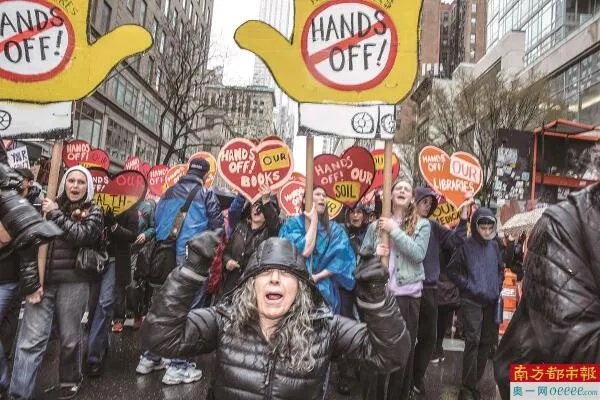
Talk about selective reporting. While protest activity in China remains largely invisible in domestic media, American demonstrations receive front-page treatment. This narrative, emphasizing the apparent disorder of democratic and populist politics in America, is the message that media consumers across China are presumably meant to take away from the wave of protests happening in cities across the country last week.
Chinese coverage of American demonstrations was extensive in its reach, though the official Xinhua News Agency and China Central Television served as the sole sources for most reports, with nearly identical phrasing across outlets. Guangzhou’s Southern Metropolis Daily (南方都市報) reported on April 7 that “more than 500,000 people participated in 1,300 protest events across America” against the Trump administration. The article noted that “even ‘red counties’” — those generally supportive of Republican Party candidates and policies — had seen sizable protest crowds waving banners with messages like “King of Corruption” and “Make Lying Wrong Again.” The Paper (澎湃), a Shanghai-based online outlet, published an extensive gallery of photos showing demonstrations across major US cities on April 5, describing the events as “the largest collective protest since Trump took office.”
While providing comprehensive coverage of American unrest, Chinese media outlets remain silent on domestic protests — even in the once relatively free environment of Hong Kong. The city’s police commissioner, Chow Yat-ming (周一鳴) stressed earlier this month when discussing national security that citizens should consider it their “personal duty” to report violations. The contrast could hardly be clearer. American protests merit detailed coverage, while Chinese ones warrant police scrutiny. If only the Trump administration hadn’t frozen funding for one of the only projects actually monitoring dissent in China.