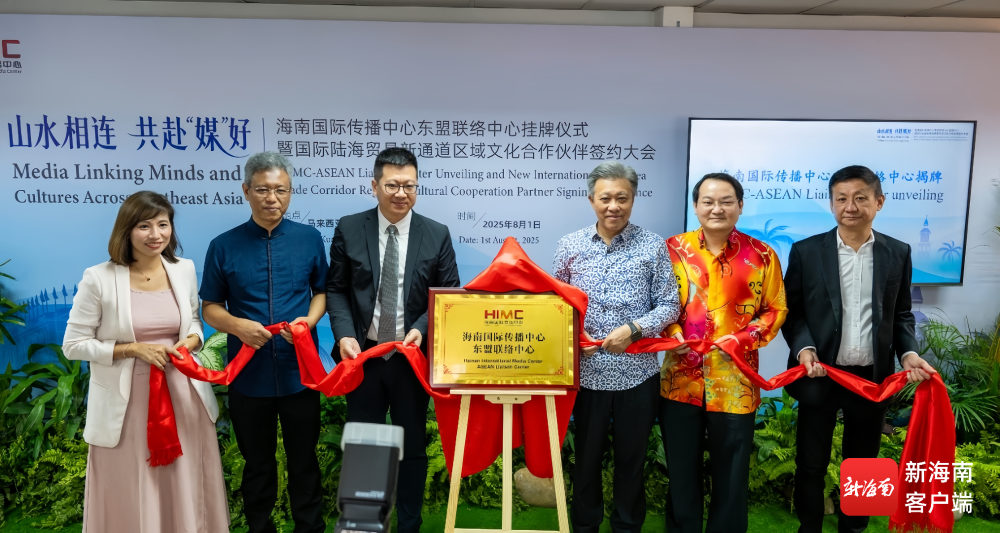
Hainan province, long China’s testing ground for economic and policy innovation, has emerged as a key experimental front in Beijing’s latest campaign — leveraging local and regional media to boost the country’s global “discourse power.” Earlier this summer, the Hainan International Media Center (HIMC), an office directly under the province’s propaganda office, unveiled a liaison center in Dubai, planting its flag in the Middle East. In Kuala Lumpur on Friday, it opened a new ASEAN Liaison Center (東盟聯絡中心), staking out Southeast Asia as a priority region for outreach.
Established in 2019, the HIMC was among China’s earliest provincial-level international communication centers (ICCs), following on the heels of the municipality of Chongqing, which launched its ICC in June 2018. The province’s unique position as a trade port experiment along what the CCP leadership has in recent years dubbed the “Maritime Silk Road” makes it a natural laboratory for President Xi Jinping’s “centralization+” approach to international messaging. It is also a key military region in the South China Sea from which China presses its territorial claims, a constant agitation for many ASEAN member states.
The launch ceremony for the HIMC liaison hub was attended by more than 60 guests under the theme “Media Linking Minds and Cultures Across Southeast Asia,” including Datuk Seri Wong Chun Wai (拿督斯里黃振威), chairman of the Malaysian National News Agency, Teh Hao Ran (鄭豪然), executive editor of Kwong Wah Yit Poh (光華日報), and Niu Xiaomin (牛曉民), deputy editor-in-chief of Hainan Daily Media Group (海南日報報業集團). The formation comes as Hainan prepares for the December 18 start of its free trade port’s closed-loop operation (封關運作), a development that officials say will dramatically increase connections with ASEAN countries. ASEAN has been Hainan’s largest trading partner since 2021.
The center, guided by Hainan’s provincial propaganda department and led by Hainan Daily Media Group, aims to serve as what officials described as a “comprehensive cooperation bridge” linking Hainan with ASEAN countries through international communication, economic cooperation, cultural exchange, and think tank collaboration.
The overseas expansion reflects Xi’s 2021 directive to “tell China’s story well” (講好中國故事) — terminology that has been core to the party’s international communication objectives since August 2013 — and make China “credible, lovable and respected” (可信、可愛、可敬), as Xi urged in a May 2021 speech to a collective study session of the CCP Politburo on “external propaganda” (外宣). Officials at the Kuala Lumpur ceremony invoked the same language, emphasizing the center’s mission to “tell good stories of China and Hainan” (講好中國故事、海南故事) to ASEAN audiences.
So the first Ministerial Meeting of China’s Global Civilization Initiative (GCI) didn’t top your news agenda? Despite the grandiose terms in which leaders have previously described this third initiative to signal the country’s global leadership in key areas — including also security (GSI) and development (GDI) — state media apparently made little effort to externally publicize what was meant to be its opening party of sorts. Just a smattering of English reports touted the gathering, which took place in Beijing on July 10 and 11. Serbia seemed the only nation to formally announce its participation as a diplomatic matter.
First introduced in March 2023, this initiative is built around a broader concept of “civilization” that Xi has trumpeted since the 20th National Congress of the CCP in October 2022 as a new grandiose concept to shore up his own domestic legitimacy [READ “China’s ‘Xivilizing’ Mission”]. So far, however, the GCI has been relatively understated as a foreign relations strategy. China’s leaders might have hoped to move it centerstage, but they seem not to have even preannounced the ministerial meeting.
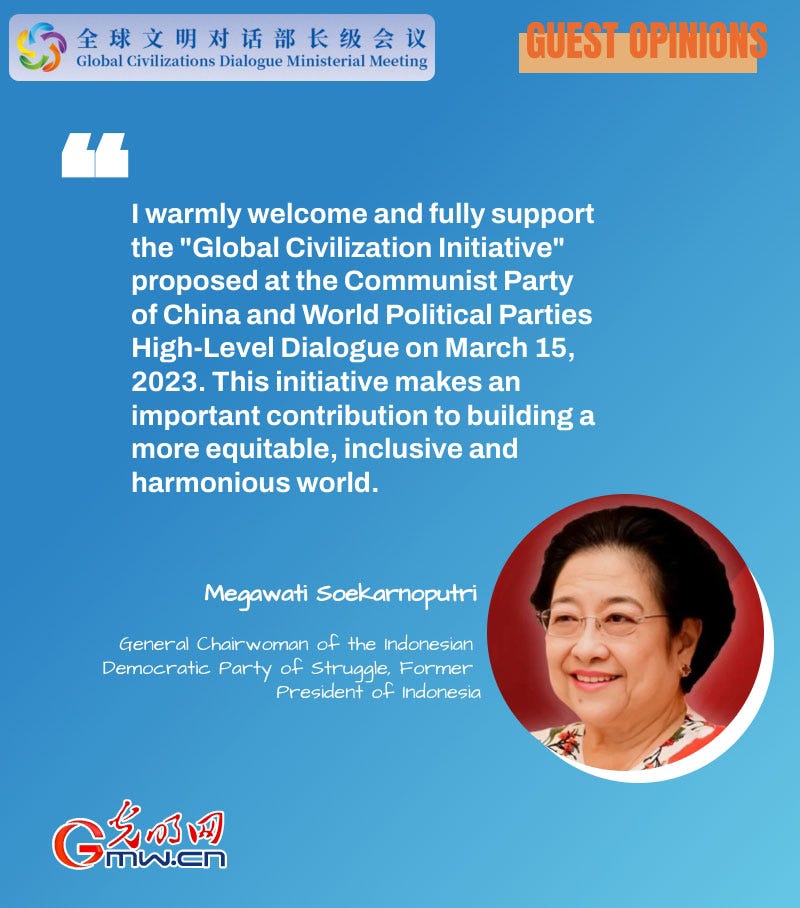
Remarks shared by the Central Propaganda Department-run Guangming Daily on the GCI meeting from former Indonesian president Megawati Saekarnoputri.
Naturally, there was a bit of fuss about the meeting in the pages of the People’s Daily, where a congratulatory letter from Xi Jinping made the front page on July 11. In his message, Xi stressed that at this critical juncture in international affairs, civilizational dialogue must transcend isolation and conflict. According to state media, the event attracted more than 600 political, cultural and educational leaders from approximately 140 countries and regions. Among the participants, featured in a CCTV+ video that received a paltry 247 views, was “American Tai Chi practitioner Jake Pinnick,” who called for dialogue and cooperation.
Also emerging from the event was a global“action plan” (行动计划) for civilization. The plan shows a strong focus on developing nations in the Global South. More on that in due course.
Responding to a push from the central leadership to supercharge international communication at the local level, China’s southern Guangdong province launched four new digital platforms this month. Going live on July 2 alongside the release of a glossy propaganda film called “Go Guangdong” (够广东), the platforms include IP Guangdong, INFO Guangdong, LIVE Guangdong, and GO Guangdong.
Provincial propaganda officials have lauded the online portals as new forms of “citizen-based external propaganda” (人人外宣), and state media have suggested they mark an innovative departure from previous top-down approaches to global communication. But the sites, and the plans announced alongside them, have the same underlying flaw as all external media communication conceived by China’s leadership in the name of “enhancing cultural soft power.” The point is power first, never culture. As for “soft,” these initiatives involve aspects of outright deceit that clearly mark them as classic iterations of sharp power.
Backyard Story Furnaces
In their basic concept, Guangdong’s new platforms are echoes of Xi Jinping’s top-down reconfiguration of external propaganda since around 2018, a process accelerating from 2021 onward. That reconfiguration enlists provinces, cities and even counties across the country in a more localized mobilization of messaging — including through a rapidly growing number of “international communication centers” (ICCs). The Chinese Communist Party’s objective is to augment past forms of large-scale and top-down global broadcasting — think CGTN and China Daily — with local voices and narratives.
As the new portals were brought online, propaganda officials in Guangdong hyped what they called an international communication ecosystem in which “everyone can participate and everyone can communicate” (人人可参与、人人能传播). Initially, that might sound like a loosening of state control over international communication, or even an empowerment of grassroots voices. It is not. In fact, it is something starkly familiar — the mobilization by central authorities of local energies, expanding outward and downward by fiat. It is, if you will, the backyard furnace (土法炼钢) approach to external propaganda in the 21st century.
This provincial initiative in Guangdong is premised on a two-fold strategy. First, it aims to make active storytellers of passive audiences, meaning that ordinary Chinese and international creators (such as artists and influencers) can become global communicators by using a built-for-purpose content portal. Second, services for foreign nationals in the province, such as planned cultural exchanges, are to be utilized as communication assets (“服务力”转化为“传播力”) — meaning that the provincial propaganda office has an active plan to exploit foreigners as propaganda resources in the name of service provision.
How exactly will this work?
IP Guangdong is the primary portal for the first of these two approaches. The bilingual creative platform actively solicits submissions from international content creators worldwide. The system aggregates visual materials including photographs, videos, and design elements around eight themes showcasing Guangdong’s economic vitality and cultural achievements. The platform has opened registration, submission, and collaboration functions to global creators, it says, seeking to activate and use creative forces internationally.
Like all four of these new platforms, IP Guangdong is under the direct control of Guangdong’s propaganda office and is operated through its existing state-run media structure. An ICP search for IP Guangdong shows that it is run by Today (Guangdong) International Communication Co., Ltd., a subsidiary of the Nanfang Media Group, the conglomerate under the provincial CCP committee that publishes the official Nanfang Daily newspaper.
A report from the official People’s Daily newspaper claimed earlier this month that IP Guangdong already hosts 712 individual creators and 76 institutional participants. The platform, which enables global registration — and says it offers opportunities for overseas distribution, copyright trading, and exhibition — clearly hopes to become something of an international gathering point for Guangdong-focused content creation. On its Facebook account earlier this month, The South, a rebranding of the former Guangdong Today website, urged its followers to “co-create the world’s next favorite Guangdong story.”
While the platform clearly wishes for international participation, the current contributor breakdown between domestic and foreign participants is not specified, and the draw for international content creators is difficult to imagine. What interest, short of direct payment from the Guangdong government, could content creators possibly have in using this portal over channels like Instagram or TikTok where a truly international reach is possible?
It only makes sense that propaganda authorities in Guangdong have not thought such questions through. Just as local officials in the 1950s fired up their backyard furnaces to please zealous central planners, they have responded not to the needs of audiences and content creators, but to the urgency of political will at the top. It is a recipe for inferior steel, but the slogans of course remain hopeful. “Your video clip is a montage of Guangdong,” read one for IP Guangdong this month. “Your creativity is the new power of Guangdong!” said another, unknowingly fixing the root of the contradiction.
As welcome as the recognition might be in propaganda-think since around 2021 that top-down state propaganda is not paying real dividends among global audiences, the push to mobilize individual voices from the bottom up to serve the larger narrative goals of the state is hardly cute and lovable. It fails, miserably, to understand the root forces that drive individual creativity.
Not to be deterred by a lack of understanding of both creators and audiences, IP Guangdong claims that its initial roster of Chinese contributors includes sculptor Xu Hongfei (许鸿飞), cartoonist Lin Dihuan (林帝浣), and photography association leaders from Guangdong, Hong Kong, and Macau, who have been appointed as “special creators” (特约创作者).
Global Ambassadors
While the first aspect of the Guangdong strategy shows a woeful lack of sensitivity toward creative acts and audiences, the second is outright deceptive.
Another of the new portals, INFO Guangdong, is meant to serve as a “service platform” (服务平台) for foreign nationals living in Guangdong. State media claim that the portal will offer multilingual support across government services, legal assistance, investment guidance, and advice on tourism, education, and healthcare. But another aspect of the INFO Guangdong plan is to establish “Foreign Clubs” (外国人俱乐部) within international communities that can be used to organize cultural exchange activities and attract foreign nationals for the purposes of promoting Guangdong and China.
In discussing these plans, the People’s Daily is shamelessly explicit, making clear that the platforms will “use events like ‘Foreigners Telling Stories’ to transform service recipients into communication partners” (将服务对象转化为传播伙伴). This will likely take shape much as media campaigns currently do, with unwitting foreign students or expats participating in events or junkets that allow state media to project chosen narratives with foreign faces onstage and on-screen.
In fact, according to state media coverage of the plans, five “international community service points” (国际社区信息服务点) have already been designated under INFO Guangdong, with foreign business leaders appointed as “Global Ambassadors” (全球推介官) to facilitate integration (融入) so that “all can tell the Guangdong story” (共同讲述广东故事).
This is not — it should go without saying — a role that foreign business leaders should be asked to play as they do business anywhere in China. Nor should city or provincial governments view their provision of basic information services to expatriates, tourists or other visitors as something transactional, to be cashed in for the broader narrative goals of the Party-state.
Ultimately, Guangdong’s latest approach to external propaganda, heeding Xi Jinping’s call to remake China’s global communication, reveals the same fundamental contradiction that has plagued Beijing’s pursuit of “discourse power” for years. Even as China’s leaders recognize the failure of top-down messaging and scramble to harness individual voices, they cannot find the soft spot in soft power because they refuse to loosen their stranglehold on expression itself.
The logic is circular and self-defeating: creativity must serve the leadership, and precisely because it must, it will not. Until China’s leaders can allow genuine individual expression to flourish without political instrumentalization, their myriad localized efforts at external communication will yield nothing more than inferior steel.