Cambodia’s media landscape has transformed dramatically over the past decade. What was once a competitive environment with independent outlets has become increasingly restricted. Beginning in 2017, the government launched a sustained crackdown on independent media ahead of the 2018 elections, forcing major outlets like the Cambodia Daily to close. According to Reporters Without Borders, this campaign has left most news outlets accessible to Cambodians under government control, with many topics now off-limits to journalists.
In this interview, Nop Vy, executive director of the Cambodia Journalists Alliance Association (CamboJA), discusses the state of press freedom since that pivotal 2017 crackdown. Today, only two or three truly independent local media outlets operate inside the country, even as approximately 2,000 registered outlets create an illusion of diversity.
Vy also examines China’s expanding influence over Cambodia’s information environment. Through joint ventures, journalist training programs, and media cooperation agreements, Chinese state narratives have become deeply embedded in Cambodian media, shaping what information ordinary Cambodians can access and limiting balanced reporting on sensitive issues.
Speaking with Dalia Parete, Vy offers an insider’s perspective on the dangers facing journalists who cover corruption, politics, and land conflicts, while highlighting how Cambodian citizens themselves have begun to fill the void left by the disappearing independent media.
Dalia Parete: For people who are not very familiar with Cambodia, what does the media landscape look like, and how has it changed in the past decade?
Nop Vy: The real turning point came in 2017. That’s when the Cambodian government forced several independent outlets to shut down. TheCambodia Daily, an English-language publication, was forced to close over what authorities called “taxation issues” — but this was widely seen as a pretext to silence independent journalism. ThePhnom Penh Post is still online today, but the print edition was shut down, and ownership transferred from an Australian to a Malaysian company with close ties to the prime minister’s family.
Around the same time, new outlets emerged that were closely aligned with the ruling party. Khmer Times, an English-language online publication, launched in 2014 and continues to operate today. Its owner has strong ties to the government. According to the Ministry of Information, there are around 2,000 media outlets operating in Cambodia. That sounds like a lot, but there is no real diversity in terms of editorial independence. Most outlets can’t freely cover political issues, social issues, or human rights. If you publish anything critical, you risk being forced to shut down.
DP: What happened to independent outlets?
NV: In 2023, we saw the only remaining local independent outlet,Voice of Democracy (VOD), forced to close its Phnom Penh operation. VOD was run by the Cambodian Center for Independent Media, an NGO, and now the former executive director operates it in exile from the United States.
So yes, there are many media outlets producing entertainment and breaking news. But there is nothing critical, nothing that gives people comprehensive information about what’s really happening.
Today, I’d say there are only two or three truly independent local media outlets still operating inside the country. Our association, the Cambodia Journalists Alliance Association (CamboJA), runs one. We operate cambojanews.com, and this year we received the Anthony Lewis Journalism Prize Award from the World Justice Project for our work exposing online scam operations and human trafficking, and for promoting social justice.
Cambojanews focuses on investigative stories, human rights, and freedom of expression — though it has shifted more toward social issues, economics, and technology. That’s partly about survival. Independent media need to generate income somehow, and those topics are less politically risky.
DP: So when you say most newspapers are tied to the government in some way — what does that actually look like?
NV: Many function essentially as government mouthpieces. They simply reproduce and promote whatever the government says and does. They’re not producing stories that serve the public interest or affect people’s daily lives — stories about deforestation, illegal land grabbing, social justice issues, things that actually matter to local communities.
DP: You’ve been working in journalism for more than twenty years — as a reporter, an editor, and now as the executive director of CamboJA. What are your takeaways from these twenty years working in the press?
NV: Press freedom in Cambodia has moved backward compared to where we were before 2017. Back then, Cambodians had access to quality content from both Khmer and English-language newspapers. The media market was competitive — not in the number of outlets, but in the quality of content and investigative reporting. Journalists working for those outlets were deeply committed to the issues they covered and the scope of their stories.
People valued it. Even our former prime minister would read the Cambodia Daily every morning. He’d sometimes respond publicly to what he read. But after 2017, that quality disappeared. We became concerned about how people could access independent information that serves their interests and promotes social justice. What we’ve also learned is that even as independent media declines, citizens themselves have stepped up. They’ve learned how to do citizen reporting from their communities — providing firsthand information from the grassroots to journalists reporting at the national level.
DP: So it’s not just that they’re a source of information. They’ve actually taken on an active role in journalism production. Is that right?
NV: Exactly. As the social and political environment has become more restricted and civic space has shrunk, educated citizens have begun looking for ways to keep voicing their opinions and demand responses from policymakers. With more and more citizens online, they’re using these platforms to speak out. At first, it was just social — posting photos, that kind of thing. But over time, they started highlighting issues from their communities.
In some cases, people have actually influenced their local governments through social media to respond to problems. We have several case studies where citizens successfully influenced policymakers through the content they published online.
DP: You mentioned that most outlets can’t freely cover certain issues. For the journalists who do try to report independently, what are the most dangerous topics to cover?
NV: Last year, one of our partners conducted a study that identified the subjects journalists are most concerned about — topics where covering them puts their safety at risk.
The first is corruption, which is exposed by international media that is deeply connected to some powerful people in the government.
The second is politics. In 2017, the Supreme Court dissolved the main opposition party, the Cambodian National Rescue Party. This created enormous political conflict. More than 100 former politicians now live in exile — in France, the US, Australia, and elsewhere. They continue to challenge the current government, which has made political reporting incredibly sensitive.
The third subject is land conflicts. The government had granted millions of hectares through economic land concessions, affecting hundreds of thousands of families across the country. This has sparked numerous protests against private companies and authorities.
When journalists report on these issues, they face real risks. Even today, environmental journalists reporting from remote areas face legal action from local authorities and private companies.
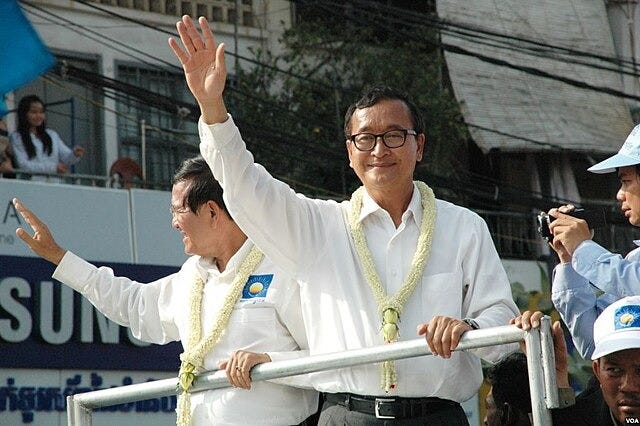
Sam Rainsy, Cambodia’s exiled opposition leader, waves to protesters in December 2013. Rainsy, a former Member of the Cambodian National Assembly, is now banned from reentering Cambodia. SOURCE: Wikimedia Commons.
Just last December, an environmental journalist reporting in Siem Reap province — where Angkor Wat is located — was shot dead by gangsters. Land issues, deforestation, and land grabbing are all dangerous issues. Some journalists have been threatened. Some have been physically attacked.
DP: Now, let’s shift toward China. Cambodia and China have had a long relationship that’s grown stronger over the years, with many cooperation agreements between Cambodian outlets and Chinese state media. What does this relationship look like in practice? Are you seeing Chinese content appearing in Cambodian media, or narratives from China being echoed?
NV: From my observation, the Chinese government plays an active role and extends its influence through different actors — not just through direct government channels, but through collaboration with Cambodian tycoons who, like Kith Meng, operate major media outlets. Meng operates three large television stations in Cambodia. These stations never amplified the voices of vulnerable people — especially those affected by the hydroelectric dam he operates with Chinese and Vietnamese companies. This is one way China extends its power and influence: through business sector collaboration.
NICE TV operates as a joint venture between Cambodia’s Ministry of Interior and Chinese investors. The station was initially announced in 2015 with backing from China Fujian Zhongya Culture Media Company (福建中次文化傳媒有限公司). However, by its 2017 launch, the Chinese partner was identified as NICE Culture Investment Group from Guangxi.
DP: With our platform, Lingua Sinica, we’ve tracked at least 33 partnerships between Chinese and Cambodian media — mostly Xinhua and other Chinese state outlets. But you’re describing something different: Chinese companies that do business in Cambodia but also push media content.
NV: Yes. And it goes even further. The government has also granted radio licenses to Chinese companies to operate local stations that broadcast in both Chinese and Khmer.
There’s also the Cambodia-China Journalists Association, which is co-chaired by Cambodian and Chinese journalists. Through this association and other channels, the Chinese government provides many opportunities to Cambodian journalists — training programs, conferences, and sponsored trips to China. Chinese government narratives get channeled into the region this way. Regional journalists are constantly invited to cover events in China and to speak at summits as prominent figures.
DP: We’ve traced a lot of Chinese-language media in Cambodia. Can you tell me about domestic Chinese-language media there? Do you think they’re serving the Chinese diaspora community?
NV: That’s a good question, but honestly, we have very little information about these Chinese-language media companies — especially their influence on the Chinese community in the country.
What I can tell you is that the Chinese and Cambodian governments have been working together on media capacity building. The Ministry of Information has partnered with China to train local journalists and provide technical assistance on digital infrastructure. This is another form of influence.
According to studies by Taiwan’s Doublethink Lab, Chinese influence in Cambodia operates through four channels: politics, foreign affairs, media, and economics. Media is a significant part of this influence. But regarding the Chinese-language outlets specifically, local organizations and researchers have been largely silent about their practices and impact.
DP: When you look at the Chinese presence in Cambodia, all the cooperation agreements and training programs, what does it mean for the information environment that ordinary Cambodians are getting? Is there any possibility for them to access balanced information on China?
NV: Because so many journalists are invited to attend and report on Chinese events — often through associations that promote Cambodia-China trade — that content dominates the information landscape.
The situation is made worse by the lack of independent media. Independent outlets play a critical role by producing content that offers different perspectives and analysis. Cambodian journalists used to scrutinize both the government and Chinese investment. They would point out that while China invests heavily in infrastructure, the quality often isn’t very good, whereas Japanese investment in Cambodia tends to be more sustained and higher quality.
Now there’s a lot of one-sided content favorable to China.
As for finding balanced information, this is a major challenge. The information landscape is dominated by narratives shaped by Chinese influence in Cambodian politics. Even academic institutions receive funding from China, which affects the research they conduct. When you try to find information about China’s influence in Cambodia or issues like Taiwan, it’s very difficult to find balanced reporting.
AllAboutMacau (論盡媒體), an independent news outlet that has been serving the Macau community since 2010, announced on October 30 that it would cease operations on December 20, following the government’s revocation of its publishing license.
The closure reflects Macau’s tightening press restrictions since the territory expanded its national security laws in 2023. The crackdown mirrors similar patterns in Hong Kong, where authorities have systematically dismantled independent media under national security provisions. The outlet said it would release its final print magazine, issue 150, this month, while its website and digital platforms will cease operations in December.
In their farewell message, the outlet revealed that since October 2024, authorities have barred its journalists from accessing the Legislative Assembly and official events for news coverage. In April 2025, three journalists were denied entry to the legislature and now face possible criminal charges related to that incident. The Press Bureau of Macau informed the outlet in October that its publication registration had been revoked, citing non-compliance with the legal requirements under the Publication Law.
“Farewell, take care,” reads the solemn message in AllAboutMacau’s announcement of its closure.
In the late 1990s, the media landscape in China was overtaken by a wave of commercialization and marketization as the Chinese government sought new ways to support otherwise expensive newspaper and broadcasting operations — and to encourage a “media industry” (an entirely new concept at the time) that was more suited to the country’s rapidly developing economy. One after another, media companies launched market-oriented reforms. And while media groups, most linked to provincial and city governance structures, pursued economic benefits, many working within these emerging outlets began embracing something less expected: journalistic professionalism.
The new generation of media outlets quickly distinguished themselves from their previous roles as propaganda outlets, serving growing, and increasingly affluent, audiences. Perhaps the most representative of these changes was the Nanfang Media Group (南方報業傳媒集團), which was known at the time for its suite of professional media outlets, including Southern Weekly (南方周末), was once praised by The New York Times as “China’s most influential liberal newspaper.” During this period, many liberal intellectuals used these media platforms to disseminate new ideas, and to speak more critically on social and political issues.
Veteran journalist Li Sipan (李思磐) joined the Nanfang Media Group in 2002, working there in various roles for a decade. But even in the space afforded by this relatively free and open environment, she keenly felt frustration at the systematic neglect of women’s rights. Later, inspired by Sun Yat-sen University Professor Ai Xiaoming (艾晓明), a women’s rights activist and filmmaker, Li Sipan and a group of female media professionals established the feminist platform Women Awakening Network (新媒體女性). They conducted advocacy on women’s issues, organized training workshops for female journalists, and hosted exhibitions and lectures — all while actively producing critical reporting on gender-related topics.
The period of relative openness proved to be short-lived. Following a cascade of events — including the 2013 controversy over the censoring of the New Year special issue at Southern Weekly (南方周末), and the 2015 “Feminist Five” incident — China’s market-oriented media experienced a rapidly shrinking public discourse space. Feminist voices came under severe suppression, and the Women Awakening Network also faced mounting pressure. Li Sipan was forced to leave the NGO in 2018 to take a university teaching job. On May 21, 2021, the Women Awakening Network Weibo account suspended regular updates. Its final post was a repost about the Zhu Jun (朱軍) sexual harassment case.
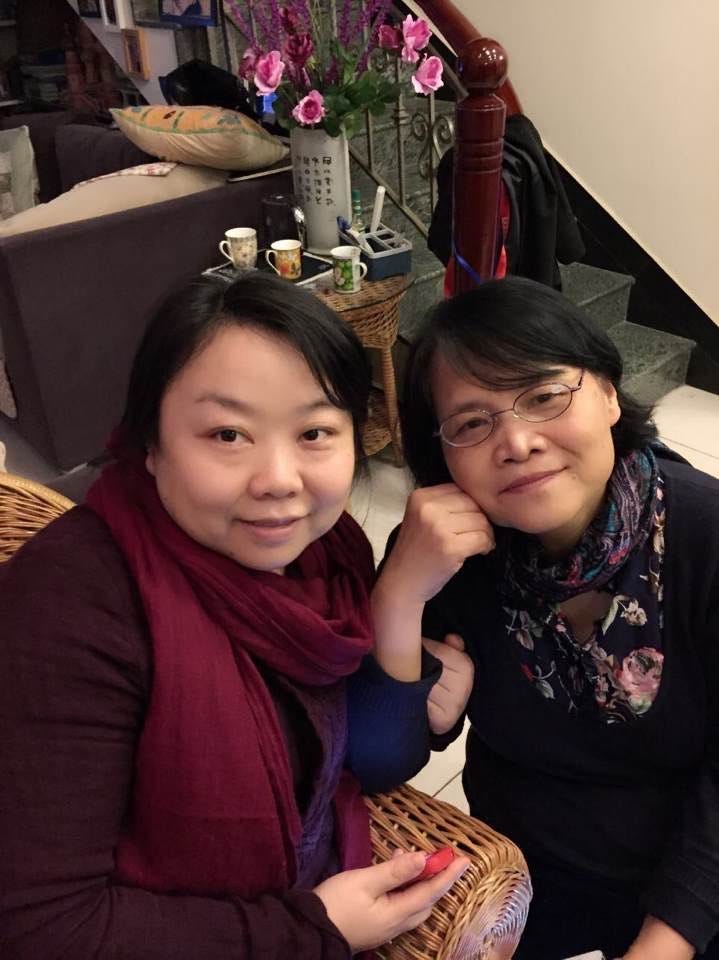
Li Sipan with feminist scholar and filmmaker Ai Xiaoming (艾晓明). Image provided by Li Sipan.
Li Sipan sat down with Tian Jian (田間), the China Media Project’s Chinese-language outlet on journalism and media, and CMP researcher Dalia Parete to discuss the absence of feminist consciousness in China’s liberal media. Speaking as both a feminist activist and an investigative journalist, she offered her observations and insights on China’s feminist movement and women’s journalism since the 2000s.
Tian Jian/CMP: Chinese media institutions were historically male-dominated. Did you face any challenges as a woman?
Li Sipan: I started working in the investigative department of Southern Metropolis Daily (南方都市報) in 2007. At that time, there were only two female reporters in the department — one in Guangzhou and another at a different bureau. The female reporter in Guangzhou was happy to have another woman join, noting that the constant presence of a large group of men in a smoke-filled room had made her feel very uncomfortable.
We didn’t have to work fixed office hours, and back then, every Monday, those of us who weren’t traveling for work would have dinner together. We were a really tight-knit group — everyone was good friends, and our work and personal lives overlapped quite a bit. But as a woman, I still felt a bit isolated. When we’d eat together, it was a male-dominated scene where the guys would drink heavily, competing to see who could drink more until they were making fools of themselves. Of course, the younger generation probably doesn’t do this anymore. But the way the men talked to each other often left us feeling awkward and quiet. They would casually toss around words like “beautiful” or “sexy” and other random, totally inappropriate words to refer to us.
This divide was also quite evident professionally. During the era of market-oriented journalism, social affairs and legal reporting were important beats that could easily enhance a journalist’s reputation. Since this type of reporting often involved cases of wrongful conviction and judicial injustice, it aligned with the traditional Chinese ideal that intellectuals shouldering moral responsibility and upholding justice, making it easier to capture readers’ attention and achieve notable results.
This type of reporting was typically easier for men to excel in. Public opinion supervision at that time was primarily conducted through cross-regional reporting, which required dealing with local officials. There was a common understanding that male reporters could drink with these officials until they became like sworn brothers — after some chest-thumping and shoulder-patting, they might receive news tips or key documents. I would also engage with officials, but honestly, many of these official drinking sessions were quite crude, with rampant sexual harassment, dirty jokes, and inappropriate physical contact.This made things really difficult for women, so I preferred to accept less-than-perfect results rather than drink with male officials.
i
Cross-Regional Reporting
异地监督
▼
Cross-regional reporting is a journalistic practice in China where reporters take advantage of regional gaps in jurisdiction to pursue sensitive stories outside their immediate area. While it would be risky for a Guangzhou-based newspaper to report on local corruption, they might safely cover similar cases in neighboring provinces like Hunan, as local propaganda offices typically only oversee media within their jurisdiction.
The kinds of stories we covered back then were completely different from today’s. A large proportion of coverage focused on rural issues, whereas now approximately 90 percent of topics center on the urban middle class.
What’s particularly interesting is that many of the male reporters in the investigative department back then were quite legendary figures. Some had previously sold fruit for a living, others had never formally attended university, but they excelled at breaking through barriers and “getting the scoop.” However, the female reporters had somewhat different backgrounds—the women around us typically had stronger educational credentials. Most of the men held bachelor’s degrees, while quite a few of the women had master’s degrees. I originally joined the investigative department at Southern Metropolis Daily because the department head wanted someone who could cover intellectual affairs, civil society issues, and Greater China stories. They liked that I knew Hong Kong, Macau, Taiwan, and Singapore, so I even spent some time reporting on Taiwan. As the Global Media Monitoring Project has observed, although I also covered politics as a female reporter, my assignments were still relatively “soft” — culture and society oriented — compared to the hard-hitting stories assigned to male reporters.
There was a common understanding that male reporters could drink with these officials until they became like sworn brothers — after some chest-thumping and shoulder-patting, they might receive news tips or key documents.
TJ/CMP: Why did you become so focused on women’s issues?
Li: It’s a long story. Feminism has appealed to me since middle school, probably. When I was in university and they held the World Conference on Women in Beijing in 1995, I wrote to the organizing committee asking for materials. My writing and studies were related to women’s issues, too. But what pushed me to take action was dealing with this male-dominated newsroom culture.
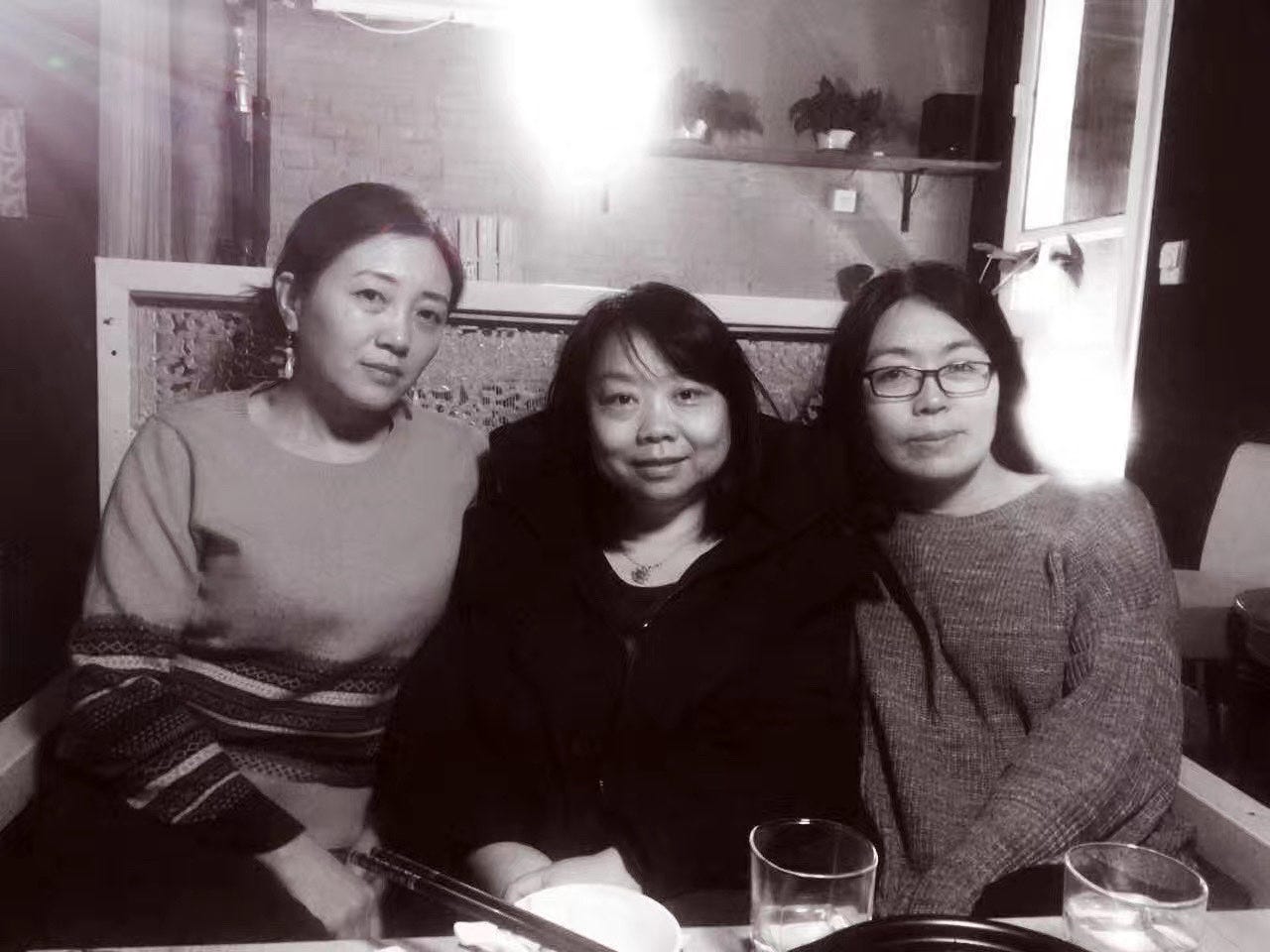
Li Sipan appears with investigative journalist Wang Heyan (王和岩), far left, and Jiang Xue (江雪). Image provided by Li Sipan.
Nanfang Media Group was considered the most progressive media organization at that time. What impressed me about them was this: when I was in Shanghai, local newspapers would refer to migrant workers as “blindly flowing outsiders” (外來盲流), which I found to be an extremely discriminatory term. But when I arrived in Guangzhou and began reading Southern Metropolis Daily, I noticed they didn’t treat migrant workers as a special or marginalized group. Their reporting would provide detailed portraits of individual migrant workers, including where they came from, what kind of work they did, which factory they worked at, and so on.
Later, I realized that even in Guangzhou’s press industry — which seemed to be the freest in China — there were many gender-related aspects that made me feel uncomfortable. For example, in 2005, one district implemented gender education where, during exercise breaks, girls were required to dance while boys practiced martial arts. Several reputable newspapers in Guangzhou reported this as a progressive development.
There was also the Peking University minority language program admissions controversy, where parents protested because female students needed admission scores dozens of points higher than male students. At the time, Southern Metropolis Daily‘s editorial department was extremely progressive — constantly discussing political reform — and yet they published a commentary arguing this wasn’t gender discrimination. Also in 2005, when China was amending theLaw on the Protection of Women’s Rights and Interests (婦女權利保障法), women’s organizations worked tremendously hard to include anti-sexual harassment clauses. But Southern Metropolis Daily basically said it was ridiculous —“wu li tou”— like something out of a Stephen Chow (周星馳) martial arts comedy.
I sincerely believed in the Nanfang Media Group philosophy. It provided journalists with tremendous freedom. I had a lot of personal growth there, and I formed some of the most important friendships of my life. But regarding gender issues, it was problematic in so many ways. Southern Metropolis Daily had several female editorial board members, but the journalistic culture remained very male-centered. Even the female leaders lacked sensitivity to gender issues. Like leaders in many mainstream institutions, while these women may have demonstrated more empathetic leadership styles compared to men, professionally they felt compelled to perform after the pattern of their male counterparts —perhaps even consciously or unconsciously distancing themselves from their female identities. In essence, everyone considered women’s rights unimportant, viewing gender equality as communist overreach — a failed ideological agenda.
Actually, I preferred being a reporter, but I started writing opinion pieces because of the Peking University minor languages program incident. I couldn’t sit still without writing about it, and that later became my standard response whenever I wrote commentaries. I wrote the piece, but Southern Metropolis Daily wouldn’t publish it, so I took it to Shanghai’s Oriental Morning Post (東方早報) instead. The editor there said I wrote well, but he also said [giving his sense of why it couldn’t be published]: “What you have there isn’t liberalism — it’s anti-communist.”
i
China’s “Minor Languages Incident”
(minor languages) 小语种
▼
The “minor languages incident” refers to a 2012 controversy when universities in China were found to have set different admission score requirements for male and female students applying to foreign language programs (excluding English). Female students needed higher scores than male students to gain admission. The rationale was that these language programs tend to attract overwhelmingly female students, with some programs reaching 83 percent female enrollment, creating what they saw as problematic gender imbalance that affected classroom dynamics and employment prospects.
TJ/CMP: How did Women Awakening Network come about?
Li: The turning point was getting to know Professor Ai Xiaoming. Professor Ai was working tirelessly to transform the media reporting culture at the time. She once organized a seminar specifically about Southern Weekly’s misogynistic advertisements and invited the then editor-in-chief Xiangxi (向熹) to participate. But in reality, no one in the media industry would actually endorse that kind of approach.
Later, Professor Ai collaborated with the British Council to bring in BBC experts for training on media and gender. The establishment of Women Awakening Network (新媒體女性) was a direct result of this training initiative. I wasn’t the sole founder. We were a group consisting of 12 media professionals from Guangzhou who had participated in the training.
Actually, that training had some issues. Because we needed interpreters for everything, the two-day workshop couldn’t cover much ground. Additionally, the BBC has these ethical guidelines, the kind that are necessary from both a legal standpoint and for social responsibility in places where there is actually freedom of speech.
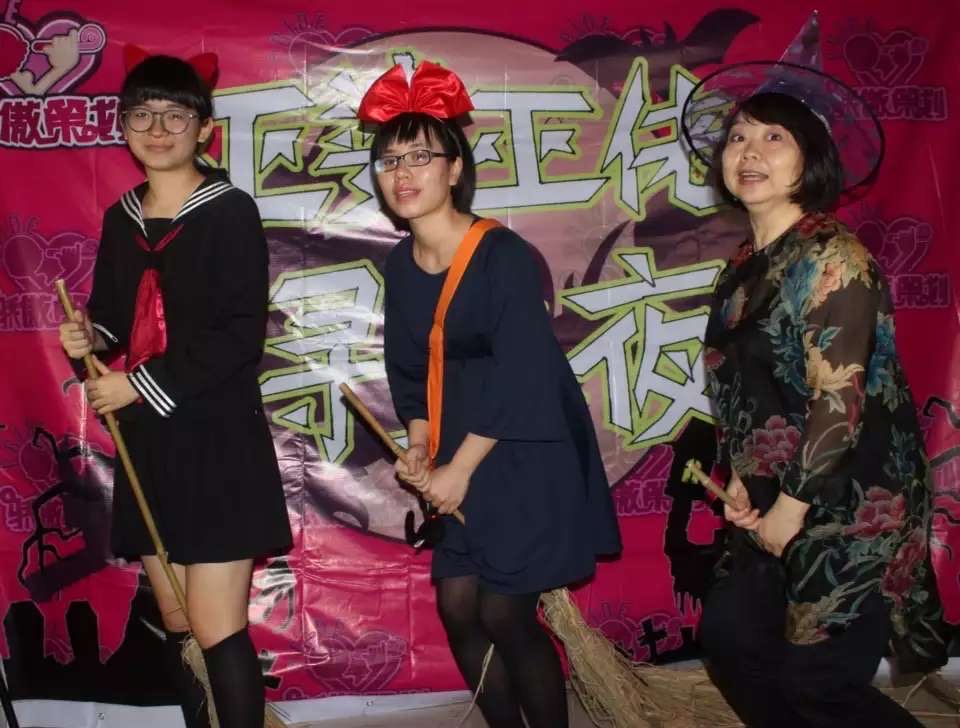
Li (at right) and fellow activists pose with brooms during a “Witches’ Night” event organized by Guangzhou’s feminist community. Image provided by Li Sipan.
But matters of journalistic ethics are hard to push in China. Chinese journalists really hate the whole journalism ethics thing, mainly because China is a place where it’s tough to get public information out there in the first place. Journalists face all kinds of obstacles and risks. If you can manage to get a story published — that’s already something.
So when we [at Women Awakening Network]advocated for gender mainstreaming, we didn’t position journalism ethics as our core training objective. We used the term “journalistic professionalism” (新聞專業主義) instead, focusing on providing journalists with more gender experts and activists as news sources — helping them develop their stories rather than telling them not to pursue certain types of coverage. We trained them on applying public service news values in their reporting, revealing truth, and promoting reform, based on the existing operating logic of market-oriented media.
Chinese women’s rights groups were unfamiliar with commercial media due to their operational methods. I noticed that the press avoided covering women’s issues because the two sides rarely interacted — in contrast to human rights lawyers and environmental groups at that time. So we wrote a few contact lists for women’s research and activism groups. We helped researchers, activists, and journalists connect. We provided organizations with lists of journalists they could contact, and journalists with lists of experts and groups they could call.
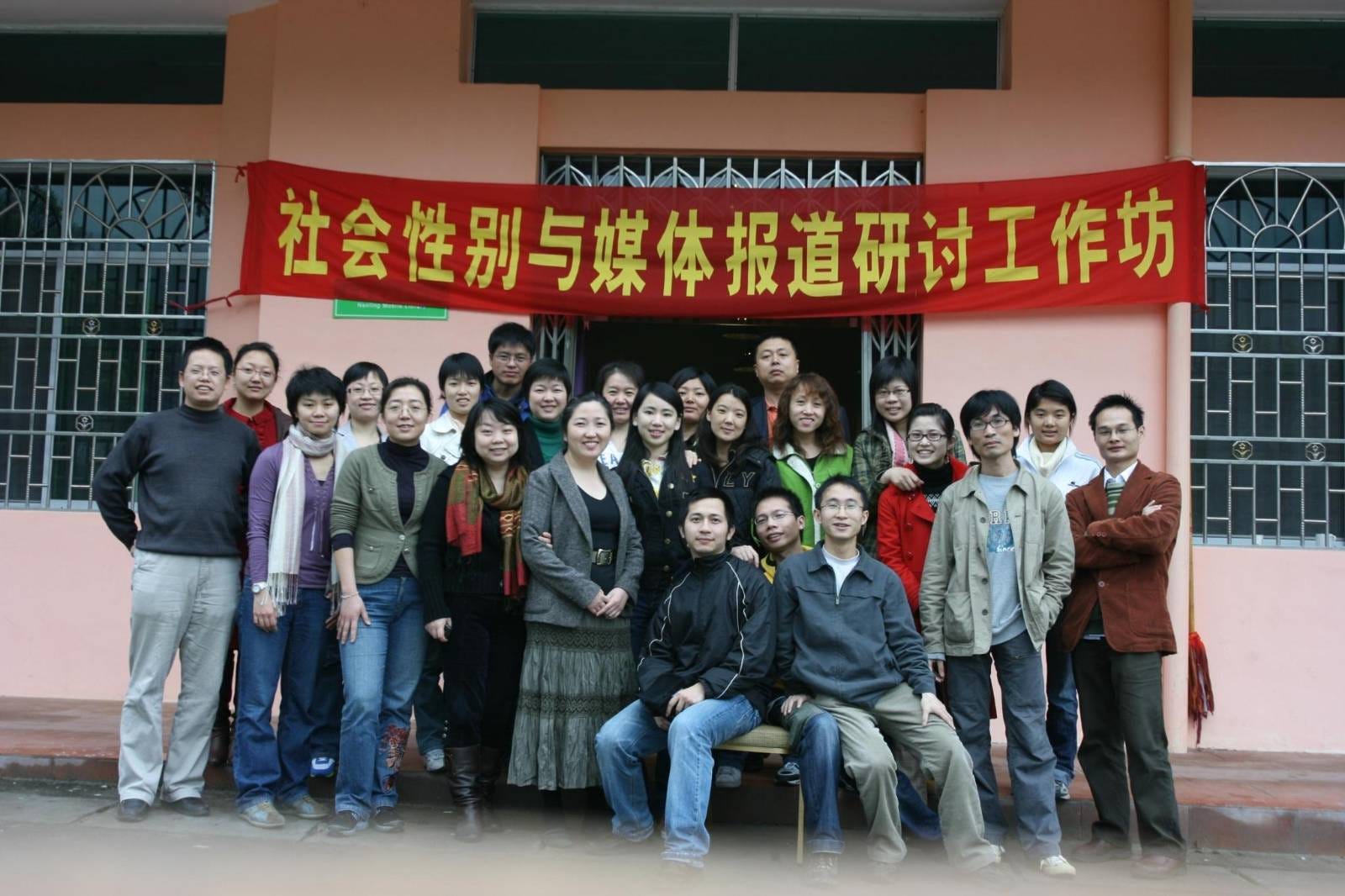
In 2007, the Women Awakening Network organized a Journalism and Gender Training Camp at Nanling National Forest Park in Guangdong. Image provided by Li Sipan.
TJ/CMP: What was unique about Women Awakening Network‘s feminist activities?
Li: Before 2003, Guangzhou had no feminist organizations. In the wake of the World Conference on Women, a lot of feminist organizations were established in Beijing, as well as in Zhengzhou and Xi’an, building on the groundwork laid by previous generations of feminists in those places. So when international funding became available, they naturally prioritized investing in and developing these existing networks first.
“What you have there isn’t liberalism—it’s anti-communist.”
At that time, feminists from northern China would often describe Guangzhou’s feminist activities as “very spirited.” Why did they say this? Because the leaders of women’s rights organizations in Beijing tended to come from official media outlets, or from the Women’s Federation (婦聯), or to be scholars from government think tanks. They were all people within the system. They not only needed to maintain good relationships with the government — they also had to consider the government’s operational logic, trying not to cause trouble. That is to say, rather than exposing social problems, they had to be helpful by promoting women’s rights concepts through publicizing the political achievements of local governments that were willing to support feminist projects.
But Guangzhou was different. We served as Women’s Federation experts for a period under Wang Yang’s (汪洋) governance of Guangdong, but our work wasn’t directly connected to the institutional Women’s Federation operations. Guangzhou is a media hub, so we used the media as our point of leverage. At that time, Guangzhou hosted all sorts of activities on remarkably progressive topics on a weekly basis. Public intellectuals were quite bold in the things they said, things that would be nearly impossible to hear publicly in other Chinese cities.
But there were hardly any female speakers back then. There were no talks about women’s issues — and definitely no feminist lectures. So we started organizing talks, exhibitions, seminars, and other events. We would invite journalists from the media to come. Commercial media journalists generally tend to resist being lectured to, or having ideas pushed on them. Instead, you need to let feminism exist in their city, and make feminist voices a real part of the conversation.
Support our work on journalism and media by becoming a paid subscriber.
By the time the young feminist activists emerged in 2012, Guangzhou media already had a group of journalists who were interested in feminist issues and had a basic understanding of women’s rights organizations. This was the result of our decade of work. Therefore, Guangzhou media was the most supportive of young feminist activism. Of course, at that time feminism wasn’t the only movement flourishing. Guangzhou’s civil society was vibrant on many fronts. Young people were engaged in a range of causes, from environmental protection to budget transparency, cultural preservation, and so on. Our work in women’s rights also influenced a certain cohort of young people.
TJ/CMP: Women Awakening Network also worked with online platforms like NetEase (網易) and Phoenix.com (鳳凰網), putting out some of the in-depth stories. Why did you decide to partner with new media?
Li: In 2014, when the Wu Chunming (吳春明) sexual harassment case happened at Xiamen University, we launched an eight months-long campaign around it. We supported the victims, provided them with legal advocacy, and ensured their voices were heard in the media. We published a series of investigative pieces and detailed commentaries about the case. We collaborated with Chinese university teachers and scholars from around the world to translate anti-sexual harassment policies from various countries and universities. We also drafted policy recommendations for the Ministry of Education and Xiamen University, and secured the signatures of scholars around the world on joint letters to the Ministry of Education. We also put together sexual harassment prevention handbooks for college freshmen, organized film screenings about sexual harassment in academia for lawyers, social workers, and people from all walks of life — that sort of thing.
By that time, the advertising market for newspapers was already collapsing. After the 2013 Southern Weekendincident, investigative reporting departments were shuttered and many veteran journalists were leaving the profession. As experienced professionals left traditional outlets, many simply lost their voice. Most of the resources had shifted to online platforms. As competition between news apps heated up, online portal sites like Sohu, NetEase, Tencent, and Phoenix all started doing original news content for their apps. And they were poaching a lot of talent from traditional media, offering much higher salaries.
i
The Southern Weekly Incident
《南方周末》新年特刊事件
▼
The 2013 Southern Weekly incident erupted when Guangdong’s Propaganda Department bypassed editors to alter the newspaper’s iconic New Year’s message, which for years had spoken idealistically about reform issues. Staff struck for four days and criticized censorship online, sparking public protests outside the Guangzhou headquarters. The liberal paper, known for testing free speech limits, eventually returned to work under increased government oversight, with the incident marking a turning point in China’s media control.
Internet companies had abundant resources, and they emphasized efficiency. They wanted to leverage their platforms to mobilize more resources. Therefore, they were very open and flexible. For example, when our grassroots advocacy group for legislation against domestic violence required media support, all the major portals provided us with resources to raise our public exposure — things like live streaming and expert interviews. During the Xiamen University incident, the departure of many veteran journalists left traditional media without the talent they needed to cover the story properly, leading to lots of mistakes. Internet companies were more flexible and could accommodate outside sources, such as people from NGOs, to collaborate on news content production. An outlet like Southern Weekly probably couldn’t publish an article by a women’s rights organization.
We worked with NetEase’s Plum News (真話頻道) to put out reports about the Xiamen University incident, which helped get the word out.
But relative to internet outlets, traditional news media still have a stronger watchdog role. This is because they are not purely commercial. In a way, they’re part of the propaganda system. Eventually, the Ministry of Education put out “Opinions on Establishing and Improving Long-term Mechanisms for University Teacher Ethics Construction.” This was the first Ministry of Education document that banned sexual harassment. At that point, Xiamen University was still dragging its feet on taking action against Wu Chunming (吳春明), the perpetrator in that case. So we arranged for two of the victims to appear on “Oriental Live Studio” (東方直播室), a program on Shanghai’s Dragon TV, where they could share their stories. The day after the program aired, Xiamen University finally announced they were stripping Wu Chunming of his Party membership and his teaching credentials. But the decline of traditional channels was about more than just money and changing technologies. Soon after that segment aired, “Oriental Live Studio” was shut down [for political reasons].
During a period when lectures were frequently disrupted, Women Awakening Network organized public discussions through film screenings (电影点映).
Internet platforms and traditional media each had their distinct roles. However, from 2015 to 2017, the traditional media space shrank rapidly, while social media also came under state control. For instance, in 2016, we organized a rather interesting campaign to resist March 7 — a feminist critique of the official “Girls Day” and its often sexist rituals. The “anti-March 7th” (反三七) opposed the official depoliticization of International Women’s Day, its detachment from women’s rights, and the support for or tolerance of “Girls’ Day” (女生节) — a campus tradition that reinforces gender stereotypes, discrimination, objectification, and the sexualization of women. In contrast, the call to “celebrate March 8th” (过三八) emphasized women’s civic identity and demanded gender equality, especially within the university context.
Internet platforms and traditional media each had their distinct roles.
Still, by 2017, we could no longer do it because I personally experienced quite severe online harassment. Of course, today this type of [online harassment] is directed at activists and journalists across the board. Later on, due to the passage of China’s NGO law, NGO work became very high-risk. I was “advised” by [government agencies] and gently urged to exit the Women Awakening Network organization. That turned me toward teaching.
TJ/CMP: Given the current situation with such strict government control, how can feminist issues and movements be promoted and spread?
Li: I personally focus on women’s rights and journalism, and both areas have become extremely challenging since the pandemic.
At the beginning of the pandemic, many journalists were still actively doing reporting. Some were citizen journalists who weren’t affiliated with any news organization, but when they went to Wuhan, many of them were detained and arrested. Back then, we still felt journalists could still manage to do meaningful work through non-fiction platforms and other alternative institutional media (机构媒体). But today, journalists from established media outlets are facing the same fate as those citizen journalists back at that time. Everyone has become extremely cautious, and it has become very common for journalists to face both state violence and online violence.
And don’t even get me started on women’s rights. The feminist movement has actually been systematically suppressed step by step, from the 2015 “Feminist Five” incident right up to now. At this point, it’s basically impossible to have any registered women’s rights organizations or advocacy groups. New Media Women held out for a long time, but they were also forced to shut down between 2020 and 2022.
The [authorities] invest a lot of energy in controlling the spread of feminism. They will say to individuals and organizations: “Look, there are some things you can do, but don’t talk about them online.”
They control the dissemination of public and feminist-related information. What is meant here by “public”? It’s often connected to government authority, but it may also relate to the breadth of information transmission (傳播範圍擴大). Suppose you discuss domestic violence, bride prices, or marriage and family issues that generate significant controversy. In that case, they might say you’re inciting gender antagonism. This is what ordinary bloggers encounter. But you can still engage in these discussions. However, anything related to ideology or state institutions is strictly guarded against. For instance, the Liu Qiangdong (劉強東) sexual harassment case can still be discussed, but the Zhu Jun (朱軍) case [involving a prominent state media figure] cannot.
And don’t even get me started on women’s rights.
I once made a social media post discussing how many women had been killed in the war in Ukraine, and then the police contacted me. Initially, I thought it was because of the Ukraine war, but it wasn’t. Their reasoning was that it involved women, because that article had garnered hundreds of thousands of views. Given how vigilant they are about the spread of feminism-related information, launching feminist advocacy campaigns as previously defined has become extremely difficult. For example, during the chained woman incident, some female netizens took personal action to visit that village.
But the undeniable fact is that today, after years of advocacy and awareness-raising, feminism has become common knowledge. It no longer requires organized feminist groups to drive its influence. It’s more like individual water droplets converging into an ocean, with many different forces now working to spread feminist ideas. However, we no longer have the conditions for the kind of organized activism we had before, nor are we likely to see mainstream media rallying together to cover and support a centralized feminist movement.
Sina Weibo came under much greater scrutiny in 2012, and the citizen activism accelerated by Weibo, especially liberal citizen activism, became the primary target. Of course, the marginalization of public intellectuals that came with the crackdown brought the feminist movement two or three years of relative visibility on social media. But while feminist discourse still appears quite “mainstream” on social media today, the reality is that the current feminist discourse is a result of the feminist movement being systematically eliminated from the communication sphere. Therefore, I believe we can no longer rely on a digital space that is heavily subject to censorship and algorithmic control.
Feminism serves as a very important binding force. For building alternative cultural spaces and non-mainstream communities, the critical perspective of feminist theory is extremely valuable.
If we view only these algorithm-influenced platforms, the feminist thought on them is extremely uniform. To use an academic term, it could be said to have very strong neoliberal characteristics. Due to the absence of face-to-face connections, feminism has become a popular catchword used by women of relatively higher social status to legitimize their self-worth and advantaged positions. It is no longer based on public participation and accountability as starting points.
Algorithms and commercial interests might not eliminate your connection to the public. For example, when we organized our “Resist March 7, Celebrate March 8” campaign, the platform later gave me a “Weibo Big V Award.” But censorship breaks the connection. It systematically dismantles trust between people and undermines our capacity for collective action. So if the feminist movement wants to accomplish anything today, we need to step away from social media platforms and connect with real people again. Like in the early days, we should organize small in-person gatherings that foster genuine face-to-face human connections.
We no longer have the conditions for the kind of organized activism we had before, nor are we likely to see mainstream media rallying together to cover and support a centralized feminist movement.
TJ/CMP: From your point of view, how does China’s current media environment differ from that of before?
Li: It’s clear now that there are more female journalists doing in-depth reporting, around the same age as my students. But they haven’t experienced the hardcore news-reporting environment of the “golden age of journalism,” so I also feel that the way young journalists approach reporting has become quite different.
This has to do with the influence of political censorship, business models, and other factors. You’ll also notice that rural topics have become less common. Many young journalists grew up reading in-depth reporting that was primarily in a creative nonfiction style, and the in-depth pieces they write also lean toward that creative nonfiction approach. Of course, creative nonfiction is itself a way of pushing back against the censorship environment. But for example, when someone asks me to look over a draft, I’ll say that back when we worked at newspapers, this article would have been 5,000 words at most —how did you end up writing 12,000? They tend to focus on literary writing and include a lot of details that we used to think were unimportant in journalism. But sometimes, parts of the fundamental news elements — the 5Ws and 1H — are missing, creating this kind of suspended state where time and place feel disconnected.
As for what’s possible, even media outlets with editorial rights (採編權) — [meaning they are authorized to conduct reporting] — in many cases no longer do investigative reporting or engage in watchdog journalism. Some long-form nonfiction or feature-oriented media outlets are perhaps still trying to find ways to carry out such work, but they cannot provide journalists with the necessary conditions to do it properly, including, in some cases, even the legitimate press credentials required to report.
Li: I think journalists all grow up with the company and competition of their peers. Actually, there’s more cooperation than competition, so it’s very good for female journalists to have a network. In the past, there might have been more media reports, and everyone’s cooperation was like scattered flowers — different provinces all had media reporting and publishing reports. But now only a few individual media outlets can publish much of anything — even if everyone’s level of cooperation remains the same.
TJ/CMP: After 2017, you went into teaching. What advice would you give to students or young Chinese people who want to become journalists?
Li: I previously taught domestically at Shantou University in Guangdong. Shantou University’s Cheung Kong School of Journalism and Communication was greatly influenced by its founding dean, Ying Chan [NOTE: Chan was also the founder of the China Media Project]. So it emphasized journalism practice and valued teachers’ newspaper industry backgrounds. But later it became much like other journalism schools in China, where teachers must have doctoral degrees [over practical experience]. I felt at the time that this was problematic.
On the other hand, some of my students were intimidated or interrogated by the police while still serving as interns. For all sorts of reasons, journalism has become extremely high-risk. The risks they face are completely different from what we faced back then. At that time, we had institutional protection. Now, even with institutional protection, it’s not really possible to do real journalism.
But I still believe in journalism. The skills you develop as a journalist—learning to explore and understand the world on your own terms—will serve you no matter what path you take later. And for young people willing to pursue this work even in today’s harsh environment, driven by idealism and a desire for justice, that persistence will pay off. They will find ways to make a difference.
Liu I-lo remained buried in journalism work, even on the eve of being informed of the layoffs at WHYNOT, or Wainao (歪脑), the Chinese-language platform launched in 2017 under the US-run Radio Free Asia (RFA) news service.
“In our final breath, we rushed to get a lot of articles out, publishing what we could. In the last two weeks, we hurried to process all contributor payments, kept phone numbers active so writers could continue receiving payments — and we made our best effort to ensure we compensated for unpublished pieces,” he recalls. “We self-funded our SOPA submissions to completion,” he added, referring to the prizes for journalism excellence given each year by the Society of Publishers in Asia.”Even in the worst-case scenario that we were completely destroyed in the end, there were awards to win. What’s more, we did our job well, whether keeping pace or speeding things along.”
Liu was not alone. For many journalists at RFA and Voice of America (VOA), the last few months have been particularly difficult. It hasn’t just been about losing journalism jobs, but about the journalistic values they were able to practice at these outlets — and facing the possibility of having no real place to exercise those values again, or even lacking the capacity altogether.
Beginning in March 2025, the funding for multiple media outlets under the US Agency for Global Media (USAGM) – the independent U.S. agency that has funded media broadcasters like RFA and Voice of America (VOA) — was abruptly frozen. VOA, which primarily broadcast to East Asia, laid off nearly 100 people, while RFA underwent massive layoffs, with most staff placed on unpaid leave without work authorization. As of August, only 81 employees worldwide remained employed, with most programs suspended.
For this article, we spoke with multiple journalists who worked in various departments and positions at RFA. They discussed how they faced the sudden news of dismissal and how they have contemplated concerns about the future since, from the perspective of their personal lives as well as their journalistic values. Given ongoing professional considerations, the three sources agreed with Tian Jian to speak anonymously. They are identified here as Chen Mai, Jhou Sin, and Liu I-lo.
Project Layoff
In late November 2024, just after Donald Trump was elected to the presidency, USAGM internal staff were all discussing “Project 2025,” a policy blueprint prepared by the Heritage Foundation, a conservative American think tank. An entire chapter in this 900-plus-page document discussed the “reform” of public media, including USAGM’s overseas broadcasting.
Jhou Sin, a former employee of RFA’s Cantonese service, said in an interview that employees knew as early as late 2024 that there would be personnel reform after the election. No one expected mass layoffs.
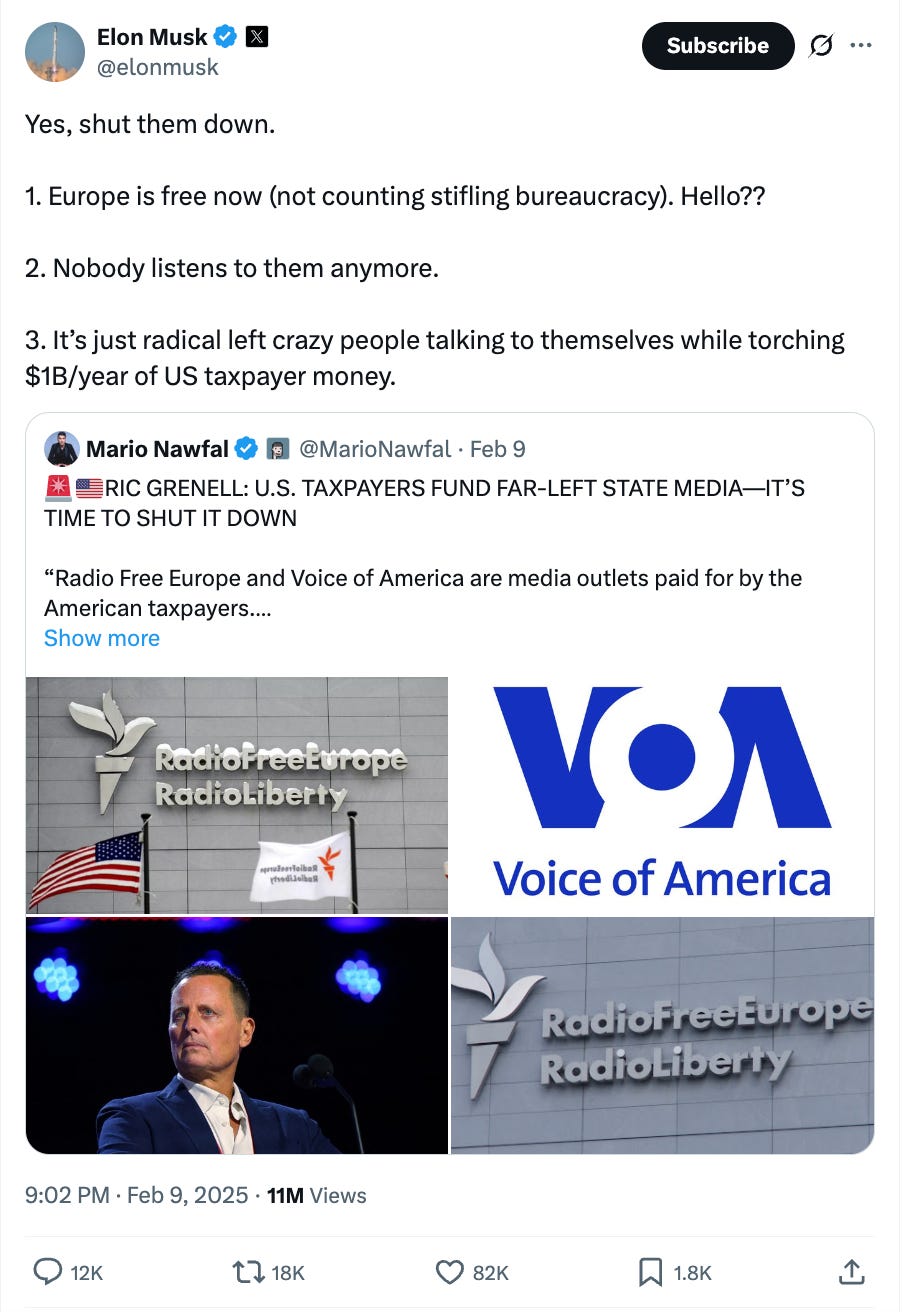
“We vaguely knew Trump would ‘reform’ us after taking office, but we didn’t know what methods would be used. Everyone could only guess, thinking that VOA and RFA might merge, or that the Mandarin and Cantonese services might combine,” said Jhou. But soon after, Elon Musk, then head of the Department of Government Efficiency (DOGE), criticized USAGM on X. Shortly after, DOGE took over USAGM, and waves of budget freezes, unpaid leave, and batch layoffs followed.
Layoffs at USAGM organizations came days after Elon Musk, then head of DOGE, criticized RFA and VOA on X.
Liu I-lo’s recollection is similar to Jhou Sin’s. At the time, the company made employee retention decisions based on various labor laws and visa statuses in different locations and bureaus, trying to maximize protection of employee interests. Each individual’s situation was different, but with operating funds shrinking by the day, there was no other choice but to make increasingly poor decisions.
“Most DC colleagues were furloughed, overseas staff at the time didn’t know what would happen, contractors had their contracts immediately terminated, our part-time colleagues were suspended one after another, colleagues in the UK and Canada were also laid off, followed by major layoffs at the Taipei office,” Liu recalls.
“This is what being a journalist is. Even if the sky falls, you have to do reporting.”
During those months, Liu said, although RFA was still operating, management became increasingly sensitive about certain types of content.
“When we saw news about USAID being heavily targeted, everyone already knew we shared the same vulnerabilities,” said Liu. “Those non-profits funded by USAID — we initially tried to report on them. But these pitches were rejected by upper management. Because you knew you would be next. So actually many ideas in the editorial department were rejected by upper management.”
Other topics of concern to target audiences, including human rights, gender, and geopolitics, were also often softly rejected by senior management. As ideological lines became clear, many articles and videos already published were “temporarily removed,” as management explained. For other topics in planning or already in progress the phrase was “publication postponed.” Liu recalls that during that time almost every weekly editorial meeting involved trying different approaches to softly resist — this being a tactic generally associated with more repressive environments like that in Hong Kong.
“You have to think, USAID has humanitarian crisis-level funding under it. If [the U.S. government] doesn’t even care about that, why would it care about small-scale matters like ours?” Liu said.
Subsequently, waves of unpaid leave and batch layoffs began. Liu I-lo recalls that after colleagues were informed of layoffs, they were constantly busy with various forms of administrative cleanup. “This is also what being a journalist is,” he said. “Even if the sky falls, you still have to do reporting. Suppose the Earth is going to explode tomorrow, would you do a report today?”
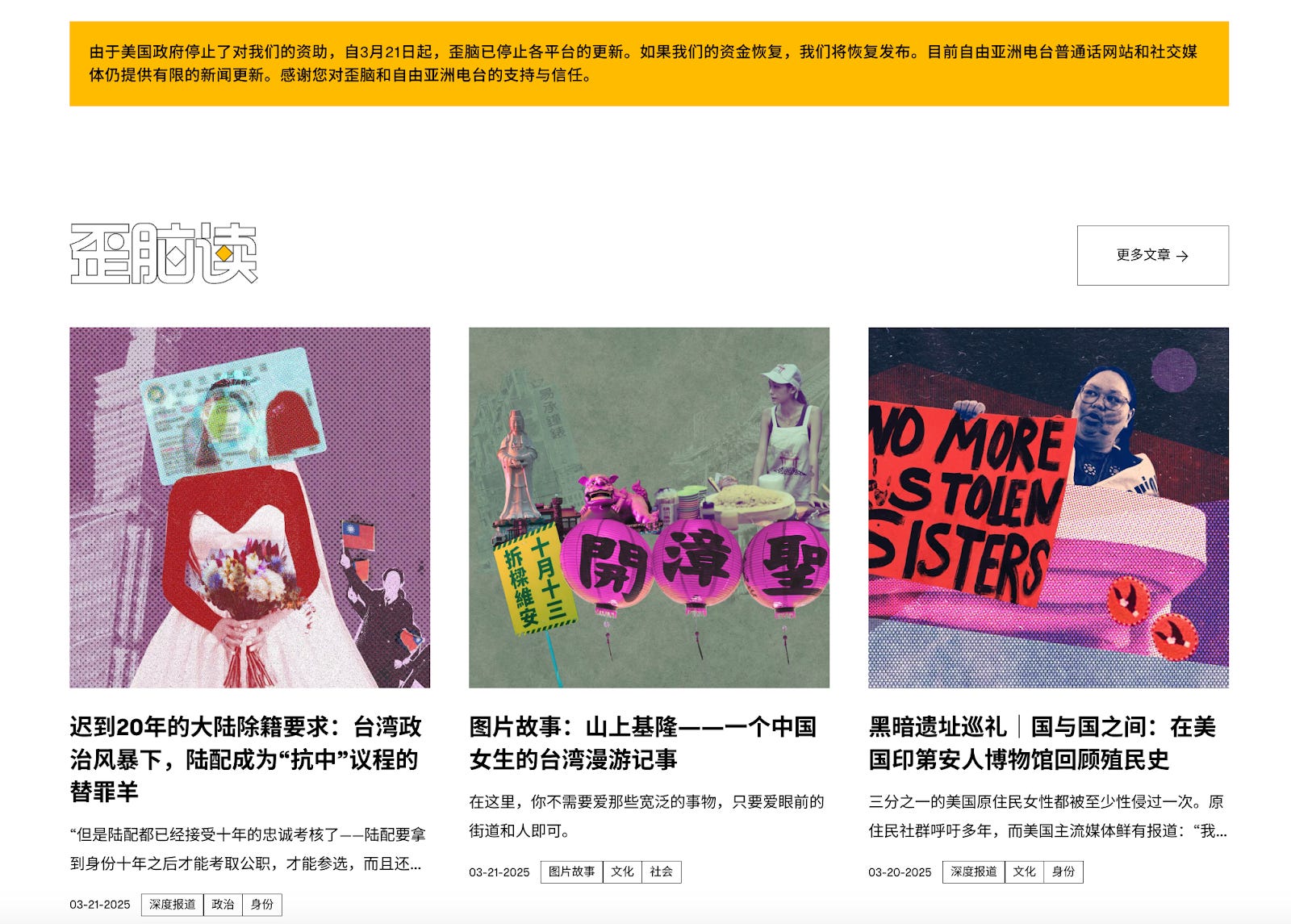
On March 22, WHYNOT was the first outlet within the agency to shut down. On social media, they published a farewell message: “WHYNOT’s website and social media will stop updating on March 22 and 24, respectively; the website and social media can continue to be viewed normally until further notice. We look forward to reuniting with all WHYNOT readers when the skies clear after the rain.”
A message on WHYNOT’s website states that it has “stopped updating on all platforms due to the suspension of US government funding.”
The Cantonese service, where Jhou worked, announced its closure on June 30 and stopped updating on July 1.
“I feel I have already earned three months more than others, not earning money, but earning time,” Jhou said. “Being pessimistic, I knew I would definitely be laid off; it was just a matter of time. At first, I felt confused, but later I gradually adjusted to doing whatever I could. We wanted to be the last group to close the door, and if it really had to end, then we wanted to end it decently.”
RFA was formally established in March 1996, its mission to “broadcast news and information to listeners in Asia who are otherwise denied access to full and free information.” This was nearly seven years after the Tiananmen Square massacre, which had ushered in a period of renewed press control in China — even as the economy was expanding and the Internet revolution just around the corner.
The Cantonese service of RFA was established two years later, in 1998, soon after the transfer of Hong Kong’s sovereignty to the PRC under the “one country, two systems” formula. Protections for press freedom in the territory continued to make it an ideal space for local language journalism that could be broadcast across the region, even reaching audiences across the border in Guangdong.
The situation changed dramatically with the passage of Hong Kong’s National Security Law in 2020. As many local journalists from such media as Apple Daily and Ming Pao were purged by the Hong Kong authorities, RFA’s Cantonese service became an increasingly popular source of news for Hong Kong people.
“With the anti-extradition movement, the National Security Law, and the departure of [journalism] colleagues from Hong Kong, the Cantonese service has experienced a lot of turbulence in recent years,” said Jhou. “But even under so much turbulence, everyone still produced strong reports.”
Yielding to China
Chen Mai worked as a designer at RFA and was also laid off in May 2025. Born in Hong Kong and currently living in Washington, D.C., he has already started looking for a new job.
Chen joined RFA in 2019 and contributed to many major digital feature productions, including several award-winning reports.
“Coming to RFA was quite important for me at the time. The feeling then was, ‘we can make something important,’ which somewhat alleviated my political depression,” said Chen, referring to his emotions around the direction of Hong Kong.
Having come to America just a few years ago and now facing layoffs, he still believes he ultimately had to leave Hong Kong. What is more difficult is seeing other colleagues who are stuck due to issues with their immigration status.
Chen added that RFA has multiple language services, including Cantonese, Tibetan, and Uyghur services, and that “those in the most difficult situations are employees who have worked for years in these small language services.” Not only do they face issues with their visa status, but it is also difficult for them to find new jobs in the short term, with some still hoping the outlet might restart operations.
There has been no sign that will happen — even as many argue that the loss of the services is to the detriment of press freedom globally.
After RFA stopped receiving funding in March, CEO Bay Fang said: “The termination of RFA’s grant is a reward to dictators and despots, including the Chinese Communist Party, who would like nothing better than to have their influence go unchecked in the information space.”
Former US Ambassador to Russia Michael McFaul, a former MSNBC commentator and Washington Post columnist, similarly described the cuts as “giant gifts to China,” with people in Hong Kong, Tibet, Xinjiang, and elsewhere now receiving a diminishing volume of information about human rights from outside sources.
Jhou Sin believes the US government certainly has its own considerations in terms of RFA and VOA content and its goals, but at the very least, USAGM regulations guaranteed editorial independence and editorial oversight, which meant substantial resources going to media that had a duty to professional reporting. “In comparison, other diaspora media don’t have such resources,” said Jhou. “Thirty minutes of daily programming, lots of features and commentary, and a high-frequency of updates on social media.” These had an appreciable impact on the news environment in Hong Kong, he believes, and he said he could foresee that after the end of RFA, the flow of news in Hong Kong could decrease significantly.
“Bay [Fang] was right, this is the biggest gift to the CCP. With the end of the Cantonese service, I also believe Hong Kong’s pro-government media may increase their propaganda efforts,” Jhou said.
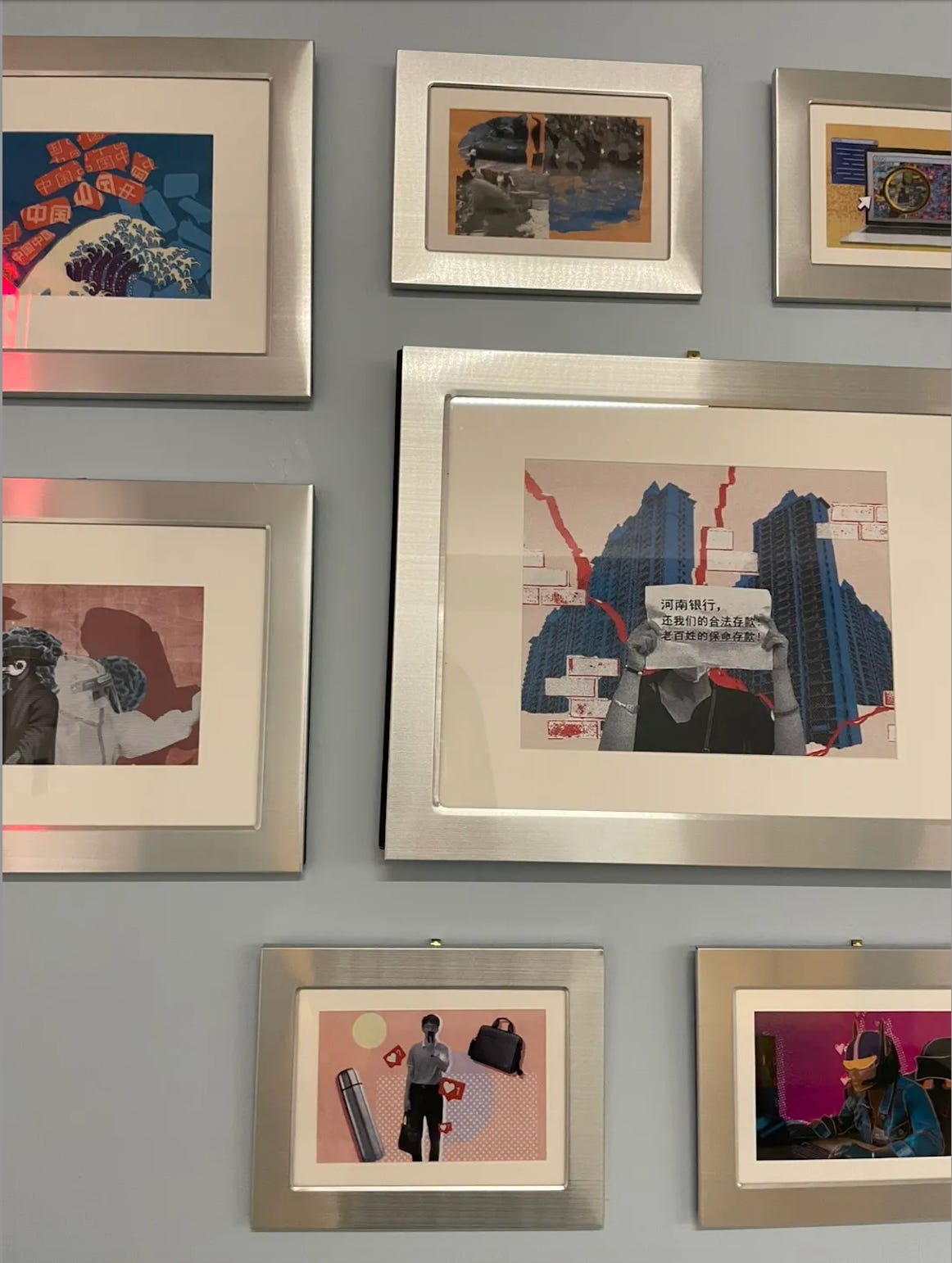
The WHYNOT office contains several framed images from past stories. Photo by Xu Jiaqi.
Of course, many in the region have also criticized journalists working at RFA and VOA for taking US government money and producing what they deem to be propaganda for “foreign hostile forces” — a phrase China has long used to broadbrush critics as conspirators.
“This matter itself is quite strange,” Liu said in response to those criticisms. “If I could write my reports without constraint in China and Hong Kong today, would I still need to go [to RFA]?”
“Critics will say that everyone is just issuing American meal tickets, thinking they’re doing good deeds, but under the entire world system as led to date by America, these articles are nothing more than cups of water trying to put out a burning cart of firewood,” said Liu, referring to efforts by Western-funded Chinese-language media organizations to fill the void left by the collapse of independent journalism in China. “For me, there’s nothing particularly special about this so-called [criticism]. It’s just whether a piece of reporting can be done well, whether there’s sufficient space to do it. Because Chinese-language media is now in a state of collapse, but if it can stir up even a small ripple, then it’s worth doing.”
Continuing Resistance
After his work at RFA ended, Liu interviewed everywhere — mainly for visa reasons. He didn’t limit himself to journalism, applying for jobs at convenience stores, sushi restaurants, and retail shops, and for restaurant server and sales representative positions.
No more journalism? He admitted that a senior Chinese-language journalist and editor’s resume is completely useless where he currently lives.
“I was targeted by the government before; now I’m being targeted by the government again.”
“When I looked for work, asking where they needed servers, saying I could speak Chinese and English, and Cantonese too, they said ‘very good, very good,’ but they didn’t have time to train me and needed someone with experience. This is a vicious cycle — how can I gain experience if I need it to land a job in the first place?”
He started by calling a local Chinese-owned sushi restaurant. “The boss was from Fuzhou and immediately said a lot of discouraging things — babbling on about how the hours here are long, no one will teach you — and then had me start helping in the kitchen. The boss was indeed willing to teach me: cutting avocados, cutting mangoes, peeling the thin skin off imitation crab. I worked this job for a few days. Then one day, I got the time wrong and was fired immediately.”
Following this experience, Liu edited his resume, removing the content about his past roles as a “senior journalist” and replacing it with restaurant kitchen experience.
“The funniest thing was, I used my previous journalist resume to apply for a staff position at a store, asking if it could be passed to the manager. There was no reply. Later, after editing a new resume, I saw that store again, applied again, and this time got an immediate reply.”
For now, Jhou Sin doesn’t need to worry about visa issues. But his life has descended into a state of confusion — as he finds it difficult to engage with issues around him.
Jhou Sin has felt uncertain about the future since his layoff from RFA. Photo by Jhou Sin.
“Before, I spent so much time every day desperately thinking of story ideas, proactively reading different news sources,” he said. “Now I have no motivation left. I wake up and barely read the news, just casually browse, because there’s no goal to aspire to. Why come up with story ideas anymore? So instead I feel somewhat empty.”
This is not the first time Jhou has experienced unemployment. The first time was when he was working for local media in Hong Kong.
“I was targeted by the government before; now I’m being targeted by the government again,” Jhou said. “The first time I lost my job, I thought I didn’t want to work in this profession anymore. That sense of powerlessness was strong. But at that time, my current supervisor used his silver tongue to convince me to come work here [at RFA]. It wasn’t easy then to pick up my enthusiasm for journalism again, and now once again it has to end. That old sense of powerlessness has returned.”
Chen Mai is job hunting now, too. Compared to other American cities, Washington, D.C. has more severe unemployment issues due to massive layoffs across government agencies. He is contemplating whether he should change fields or continue to work in the media.
The experience has served as a reminder not to self-censor due to political pressure.
“My point is that we absolutely cannot censor ourselves, cannot modify content according to readers’ preferences or interviewees’ partiality, and cannot self-censor because of pressure from above,” Chen said. “I experienced all of this at RFA, but even if you are subject to political censorship, you cannot rationalize this. You need to resist. You need at least to debate.”
“Once we become submissive, thinking that [accomodation] can protect us, we still get targeted in the end,” Chen added. “And being targeted has nothing to do with content actually having an issue. All these compromises are irrational and will only make you less like a news organization.”
Regarding journalism work, Liu I-lo stands by his professional record. “I’m confident that everything that came from my hands was professional work. I never considered RFA to be American propaganda. Even if that was the goal, we would make an effort to resist.”
At the Society of Publishers in Asia (SOPA) awards ceremony in June, WHYNOT won two awards, adding to its count. A report about detained Chinese journalists Wang Jianbing (王建兵) and Huang Xueqin (黃雪琴) won the award for excellence in human rights reporting, while a series on the 35th anniversary of the June 4th Incident won first prize in news innovation. Because the editorial department had long since ceased operations, however, no one appeared that day to accept the awards in person.
Hsu Chia-Chi is a journalist focusing on political, cultural, and human rights issues in Taiwan, Hong Kong, and China. She previously worked for WHYNOT.
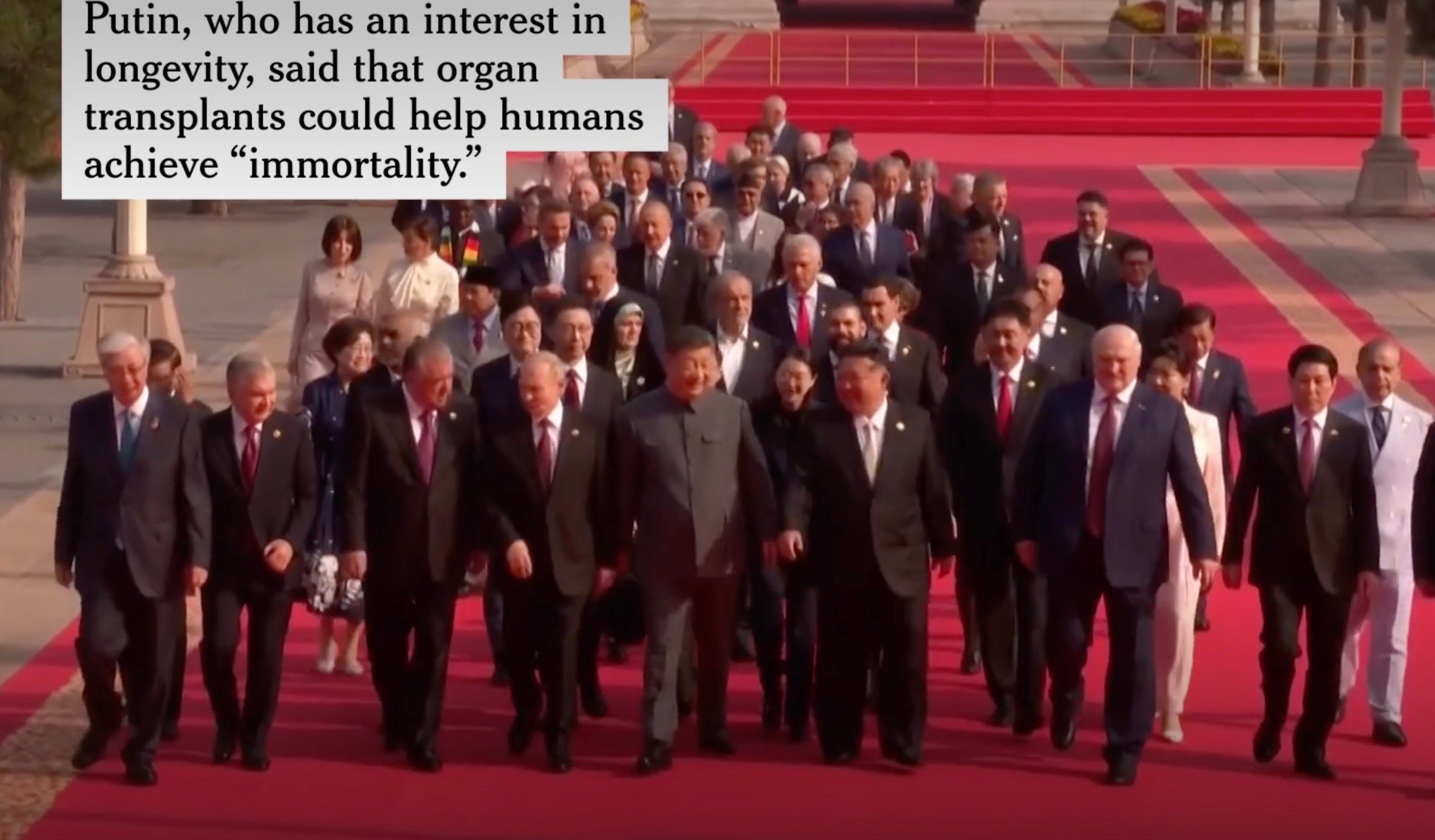
Last Friday, the Reuters news agency withdrew from global circulation a four-minute hot-mic video that had shown Chinese President Xi Jinping and Russian President Vladimir Putin leaning close and exchanging odd small talk about human longevity and organ transplantation.
A screenshot of New York Times coverage of the hot-mic discussion, which made thousands of media worldwide.
Captured during Beijing’s military parade on September 3, the open-mic exchange was initially distributed by China Central Television (CCTV), the country’s state-run broadcaster, which had exclusive broadcasting access to visiting leaders. CCTV apparently had not considered that off-the-cuff conversations — including Putin and Xi discussing the possibility of humans living to 150 years through biotechnology and organ transplants — might be captured and become news. Within 24 hours of the release of the Reuters version of the video, the exchange had been picked up by more than 1,000 global media clients and had gone viral on social media.
On Friday, the legal team at CCTV accused Reuters of “misrepresenting facts” in its editorial treatment of the footage, and withdrew permission to distribute the video. Reuters responded by defending its accuracy, but nevertheless complied with the state-run broadcaster’s demands. The incident highlights China’s ability to control access to official events and to restrain global media narratives around topics it regards as sensitive — even retroactively removing content from international news organizations.
Last month several figures in Hong Kong’s media spoke out about an apparent new tactic being used to curtail the activities of independent media and journalists. Since November 2023, at least six outlets and around twenty journalists have faced tax audits spanning seven years, with demands totaling over HK$1.7 million, or more than 200,000 dollars. The targeted outlets include InMedia (獨立媒體), The Witness (法庭線), ReNews, Boomhead, Hong Kong Peanuts (香港花生), and the Hong Kong Free Press.
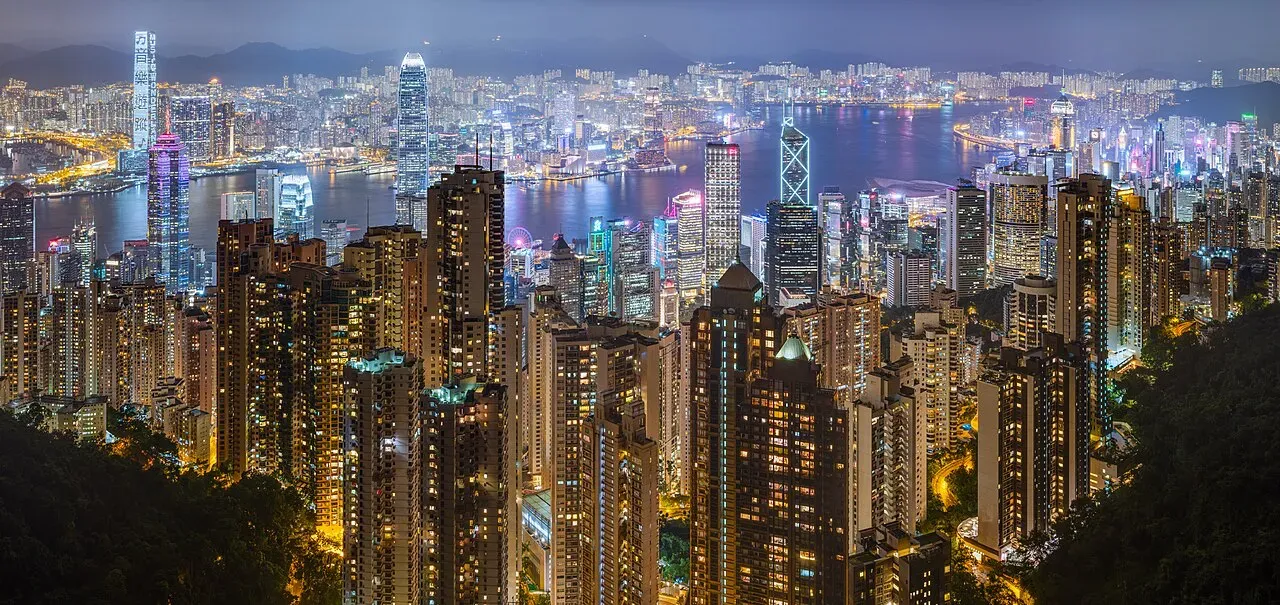
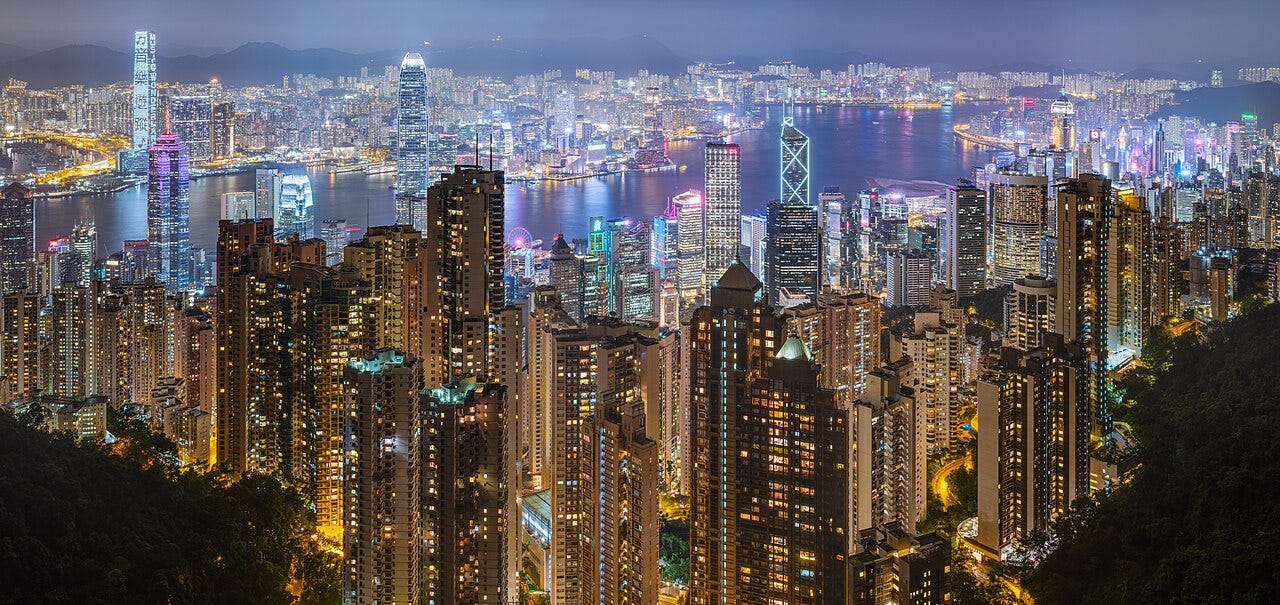
The Hong Kong skyline from Victoria Peak. SOURCE: Wikimedia Commons.
Tax authorities made errors and “strange, unreasonable claims,” including auditing one outlet for a year before it was established and asking a journalist to pay profits tax for a nonexistent company registration number. Inspections also extend to family members, including both parents of journalists’ association chief Selina Cheng (鄭嘉如). Hong Kong Peanuts host To Kwan-hang (陶君行) revealed that virtually all hosts, including Wong Ho-ming (黃浩銘) and Chow Ka-fat (周嘉發), received audit demands.
While the Inland Revenue Department (IRD), the territory’s tax collection authority, maintains that the “industry or background of a taxpayer has no bearing on such reviews,” the unified actions appear to be a form of bureaucratic censorship designed to exhaust the operations of independent media. Similar tactics have been used by authoritarian governments in Russia and Turkey, where punitive tax audits and financial sanctions have sought to control press activities. The approach would mark a new development in Hong Kong’s media landscape.
For many in the Hong Kong indie media space, the IRD’s insistence that they were “randomly selected” for a probe is difficult to swallow. “I can count all of Hong Kong’s non-government aligned digital media outlets on two hands,” Hong Kong Free Press founder Tom Grundy told Lingua Sinica. “Most are under tax audit simultaneously.” Grundy emphasizes that his outlet has insisted throughout its ten-year history on “meticulous record-keeping,” but notes that handling the audit “has diverted resources, manpower and funds away from journalism.”
The IRD audit of the Hong Kong Free Press comes one year after the outlet was selected — “randomly,” it was told — for a rare inspection from the Companies Registry, the city’s official business registration and company records authority. “We’re so lucky, perhaps we should put some numbers on the lottery,” Grundy said.
Chinese state-run outlets in Hong Kong have launched a coordinated response against Reporters Without Borders after it ranked Hong Kong at 140 on its 2025 World Press Freedom Index — downgrading the city to its “very serious” category for the first time. The Ta Kung Pao (大公報) criticized RSF for “distorting facts” and “misrepresenting the truth,” while the Wen Wei Po (文匯報) claimed RSF views Hong Kong through an “ideological lens” that deliberately magnifies isolated cases. Meanwhile, pro-establishment lawmaker Elizabeth Quat (葛珮帆) accused RSF of “double standards,” citing a survey by the Bauhinia Institute (紫荊研究院) claiming 62.5 percent of Hong Kong residents believe the Basic Law (基本法) effectively protects press freedom.
Citing this source may actually support RSF’s basic concerns, however. The Bauhinia Institute, founded in 2016, is closely associated with the central government’s Liaison Office in Hong Kong. The company’s director and 100 percent shareholder is Zhang Chunsheng (張春生), a former Xinhua News Agency journalist who later joined Wen Wei Po and for many years was a top executive at the central government-runBauhinia magazine.
RSF defended its methodology, noting that at least 28 journalists have been prosecuted and 10 remain detained since the implementation of national security legislation in 2020.
The controversy surrounding Li Ka-shing’s proposed 23 billion dollar Panama ports deal, which has angered China, reveals a fundamental shift in Hong Kong’s political media landscape, according to Chris Yeung, former Ming Pao editor and now head of Green Bean Media (綠豆). Yeung wrote thatTa Kung Pao (大公報) and Wen Wei Po (文匯報) — both papers controlled by the central government’s Liaison Office in the city — have replaced the South China Morning Post as the city’s most politically influential publications, becoming “first-to-read” newspapers for government officials and business leaders alike.
When Ta Kung Pao condemned CK Hutchison’s ports sale as “groveling” and “betrayal,” it demonstrated the direct line between these publications and official policy positions. “Pro-democracy activists read looking for signs of imminent trouble,” Yeung wrote, highlighting the papers’ role as Beijing’s political barometer. In an update on that story this week, China’s Caixin Mediareports that Pacific Century Group, the Hong Kong conglomerate run by Li Ka-shing’s son, Richard Li, has openly distanced itself from CK Hutchison and the now politically toxic deal.
Changing media dynamics in Hong Kong were further illustrated late last month when Security Secretary Chris Tang (鄧炳強) publicly criticized Ming Pao for “misleading” reporting. After a Ming Pao journalist questioned why Tang hadn’t announced his Thailand trip, Tang accused the paper of trying to “undermine public trust.” When the paper’s deputy chief editor defended the question, Tang responded with a letter condemning the “biased” coverage (See “Short Stories” below for more on Tang).
For a rundown of the Li Ka-shing story in Chinese, see Fang Ming’s (方明) take at Initium Media (端傳媒), which notes “more and more discussions are focusing on the risks of U.S.-China competition.”