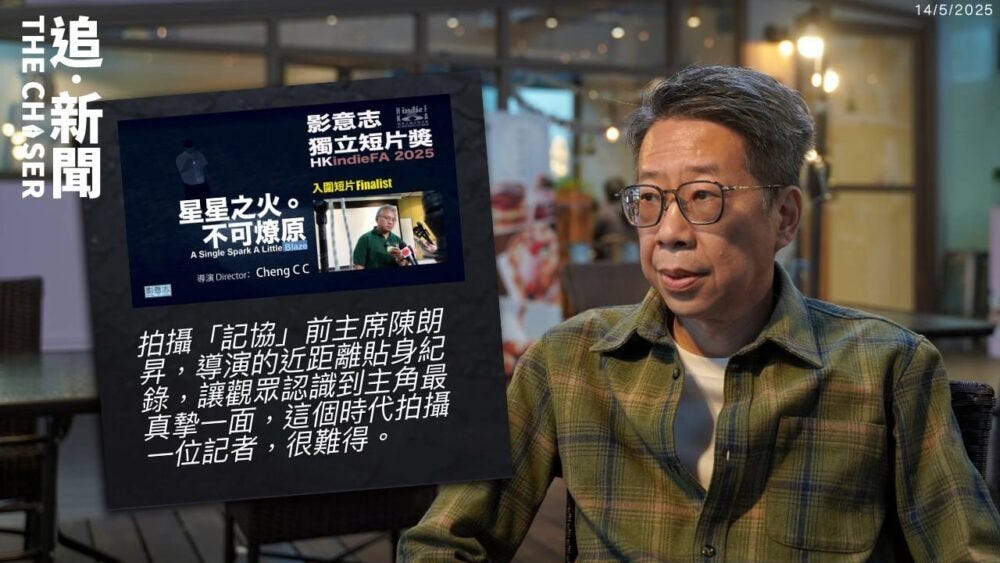
A documentary about a prominent Hong Kong journalist has been pulled from an international film festival, offering a stark reminder of the territory’s constricting space for artistic expression. “A Single Spark A Little Blaze” (星星之火・不可燎原), featuring former Journalists Association chairman Ronson Chan (陳朗昇), was withdrawn from all screenings of the inaugural Ying E Chi Independent Short Film Award after “interviewees faced pressure,” organizers announced Tuesday.
“We remain in Hong Kong. If trouble comes, it could destroy families and separate loved ones,” Mr. Chan told Photon Media (光傳媒), a Hong Kong exile media outlet, explaining his reluctance to detail specific threats. The film was among 12 finalists selected from 165 global submissions by Hong Kong filmmakers. Vincent Chui (崔允信), former artistic director of Ying E Chi (影意志), expressed deep disappointment but maintained optimism that the work would eventually be shown in Hong Kong. “I’ve always believed that day will come,” he was quoted as saying in Chaser News, another exile outlet.
Chui’s organization, which relocated to Taiwan after disbanding in Hong Kong last October, still plans to hold screenings in Taiwan, the United States, Canada and Britain next month.
Screenshot of coverage of the film story by The Chaser.
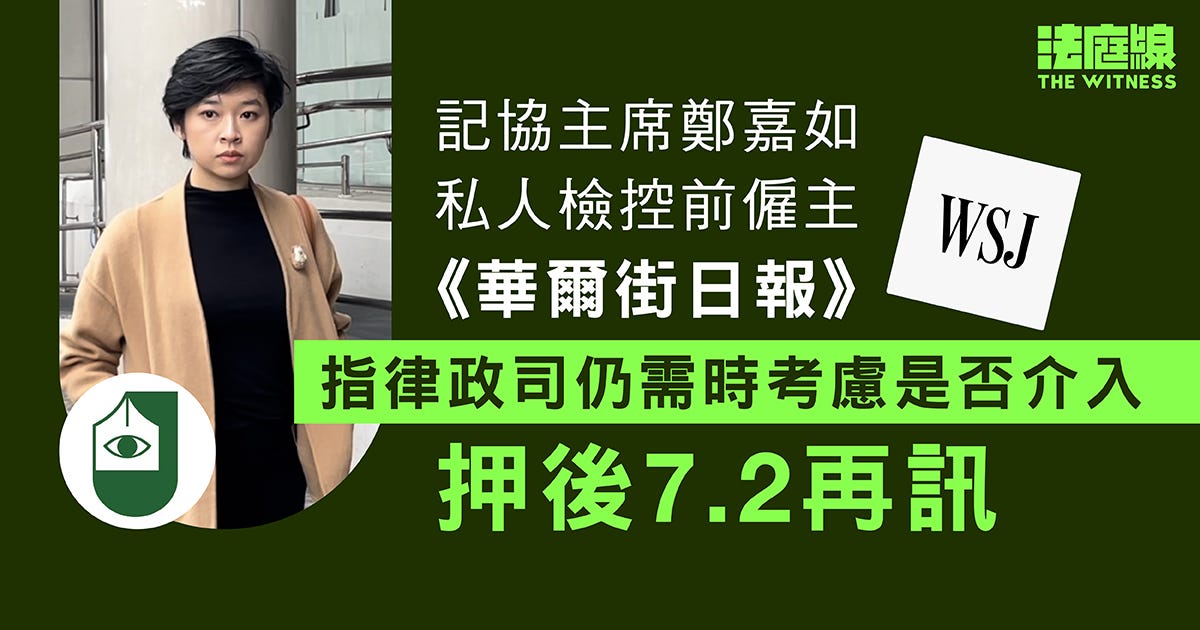
Hong Kong journalist Selina Cheng (鄭嘉如), the chairperson of the Hong Kong Journalists Association (HKJA) who contends that she was illegally dismissed in July last year by the Wall Street Journal after her election to her HKJA position, appeared in Eastern Magistrates’ Court Tuesday through legal representatives in her private prosecution against her former employer. According to the court reporting outletThe Witness (法庭線), Cheng’s case involves two charges claiming her employer demanded she withdraw from the HKJA election and later terminated her employment for holding the position. Barrister Ma Ah-shan (馬亞山) represented Cheng in the proceedings, which were adjourned until July 2 by Principal Magistrate So Man-lung (蘇文隆). Hong Kong’s Department of Justice reportedly has requested additional time to consider intervention in the case — possibly considering its unwanted visibility on the question of deteriorating press freedoms in Hong Kong.
Report on the Selina Cheng case. SOURCE: The Witness.
CMP’s Dalia Parete reached out to freelance journalist Will Yang (楊智強), the founder of the independent outlet Border Eyes (邊境之眼), which focuses on Myanmar and Southeast Asia, to discuss the near-impossible challenge facing the press as they try to cover Myanmar’s devastating 7.7-magnitude earthquake under military junta restrictions. Yang recently wrote a piece on this issue for Taiwan’s United Daily News (UDN).
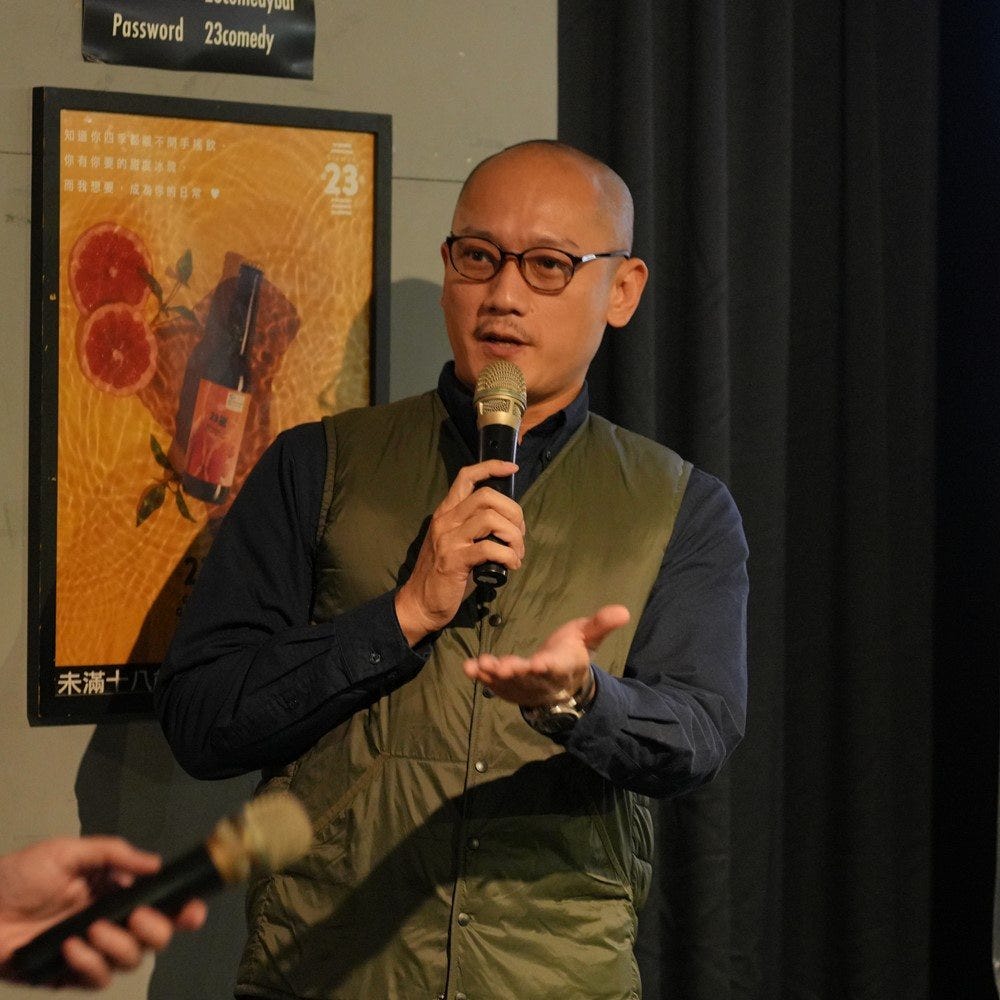
Border Eyes (邊境之眼) founder Will Yang.
Lingua Sinica: Is it possible for foreign journalists to enter Myanmar right now to cover the earthquake? What are the challenges and potential ways to get in?
William Yang: The military spokesperson announced that they don’t accept foreign media. Major media from the West, Taiwan, Japan, and Korea probably cannot enter. But NHK and AFP still have some personnel inside Myanmar who can assist. The obstacle is that you’d need to sneak in without a press visa. They won’t issue press visas, so maybe you get in on a tourist visa, which for them is illegal. This is already dangerous for you.
If you’re a TV reporter with big equipment or a microphone, it’s almost impossible. You could do it with a small gear or a cell phone, but it’s very dangerous. People will fear being interviewed because they know it’s unsafe, especially if they’re illegally doing news activity.
Lingua Sinica: How has the military government’s approach to press freedom since the 2021 coup created a particularly challenging environment for disaster coverage?
William Yang: The damage is too devastating. The government doesn’t have enough manpower, equipment, or resources to help its people. They don’t want the press reporting on these shortcomings. It’s all about the government fearing bad press that would expose their lack of infrastructure to respond effectively. Even in Sagaing City, I heard 80 percent of buildings are damaged—the disaster is simply too massive. They probably don’t want international society to know they’re incapable of handling this. They seem to care more about their image than their people. After the past four years, this is sadly credible.
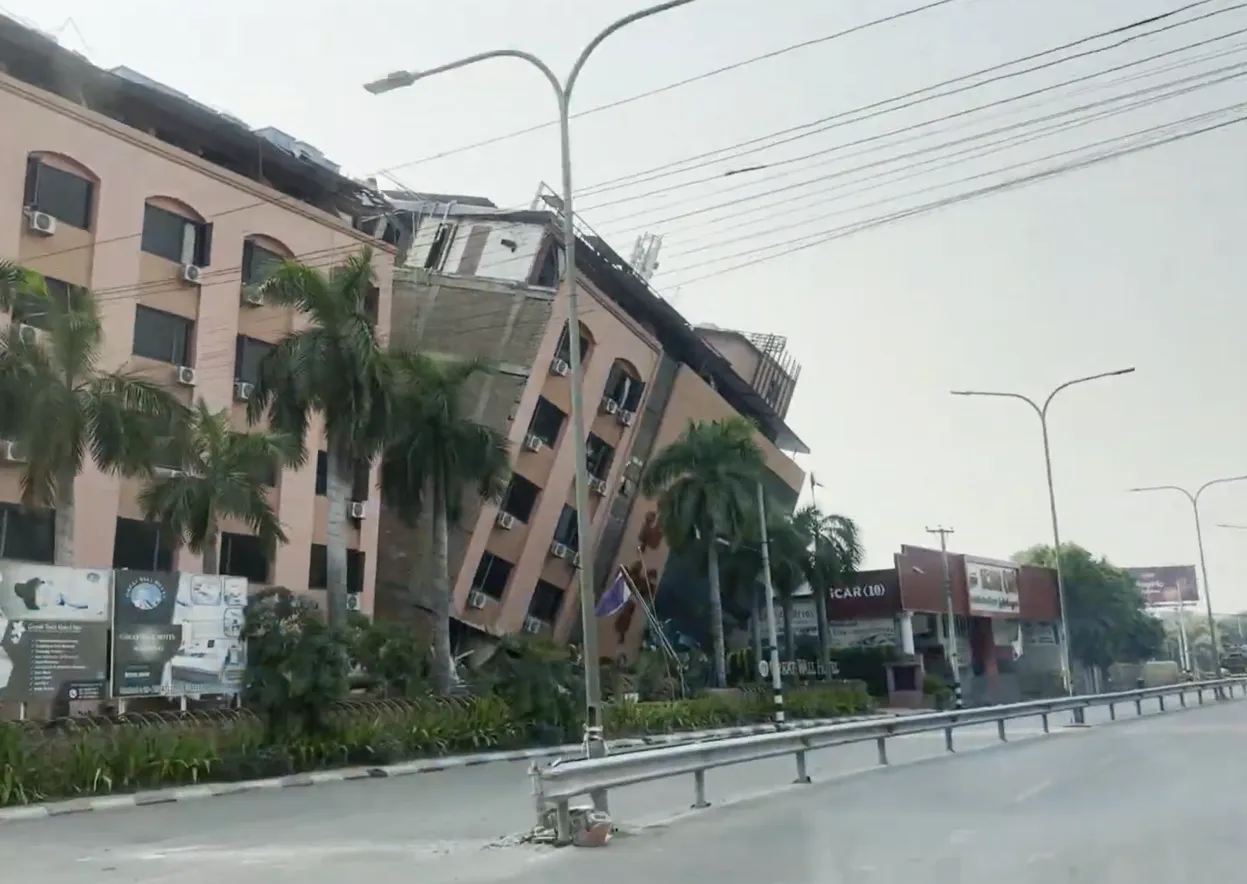
Screenshot of a video from China News Service that shows the aftermath of the Myanmar earthquake. SOURCE: Wikimedia Commons.
By blocking press access, they’re deliberately controlling information. Additionally, the civil war has worsened the disaster response, as ordinary people now view anyone in military uniform as an enemy or threat. The government has lost public trust. Even if officials genuinely try to help now, citizens remain skeptical, creating a significant obstacle to effective disaster relief.
Lingua Sinica: Reporters from what countries can enter Myanmar?
William Yang: Russian, Belarusian, and Chinese reporters are there because they’re allied with the junta. They trust each other and won’t allow the situation to spiral out of their control. Their primary goal is to protect their interests with all parties involved. The junta trusts Chinese state journalists, who can enter to report on what their rescue teams are accomplishing, creating a mutually beneficial arrangement.
Lingua Sinica: Are you seeing any strategies that local or international journalists are developing to continue reporting on this crisis despite the restrictions?
William Yang: Even today, I’m trying to connect with people inside Mandalay. There are independent journalists who had contacts in the city before the earthquake. I asked them to film hospitals and the airport, which has shut down, to understand why. They’ve captured footage but can’t transmit it.
The internet connection is too poor. We can communicate by text, but sending large video files has been impossible all day. Everyone is trying. Everyone wants news from inside Myanmar. However, broken internet remains a major obstacle to getting information out, and VPNs don’t help with speed issues.
The controversy surrounding Li Ka-shing’s proposed 23 billion dollar Panama ports deal, which has angered China, reveals a fundamental shift in Hong Kong’s political media landscape, according to Chris Yeung, former Ming Pao editor and now head of Green Bean Media (綠豆). Yeung wrote thatTa Kung Pao (大公報) and Wen Wei Po (文匯報) — both papers controlled by the central government’s Liaison Office in the city — have replaced the South China Morning Post as the city’s most politically influential publications, becoming “first-to-read” newspapers for government officials and business leaders alike.
When Ta Kung Pao condemned CK Hutchison’s ports sale as “groveling” and “betrayal,” it demonstrated the direct line between these publications and official policy positions. “Pro-democracy activists read looking for signs of imminent trouble,” Yeung wrote, highlighting the papers’ role as Beijing’s political barometer. In an update on that story this week, China’s Caixin Mediareports that Pacific Century Group, the Hong Kong conglomerate run by Li Ka-shing’s son, Richard Li, has openly distanced itself from CK Hutchison and the now politically toxic deal.
Changing media dynamics in Hong Kong were further illustrated late last month when Security Secretary Chris Tang (鄧炳強) publicly criticized Ming Pao for “misleading” reporting. After a Ming Pao journalist questioned why Tang hadn’t announced his Thailand trip, Tang accused the paper of trying to “undermine public trust.” When the paper’s deputy chief editor defended the question, Tang responded with a letter condemning the “biased” coverage (See “Short Stories” below for more on Tang).
For a rundown of the Li Ka-shing story in Chinese, see Fang Ming’s (方明) take at Initium Media (端傳媒), which notes “more and more discussions are focusing on the risks of U.S.-China competition.”