Activity Type: Promotional or Propaganda Media Event

Brazil’s National Journalists Federation Joins Chinese Network

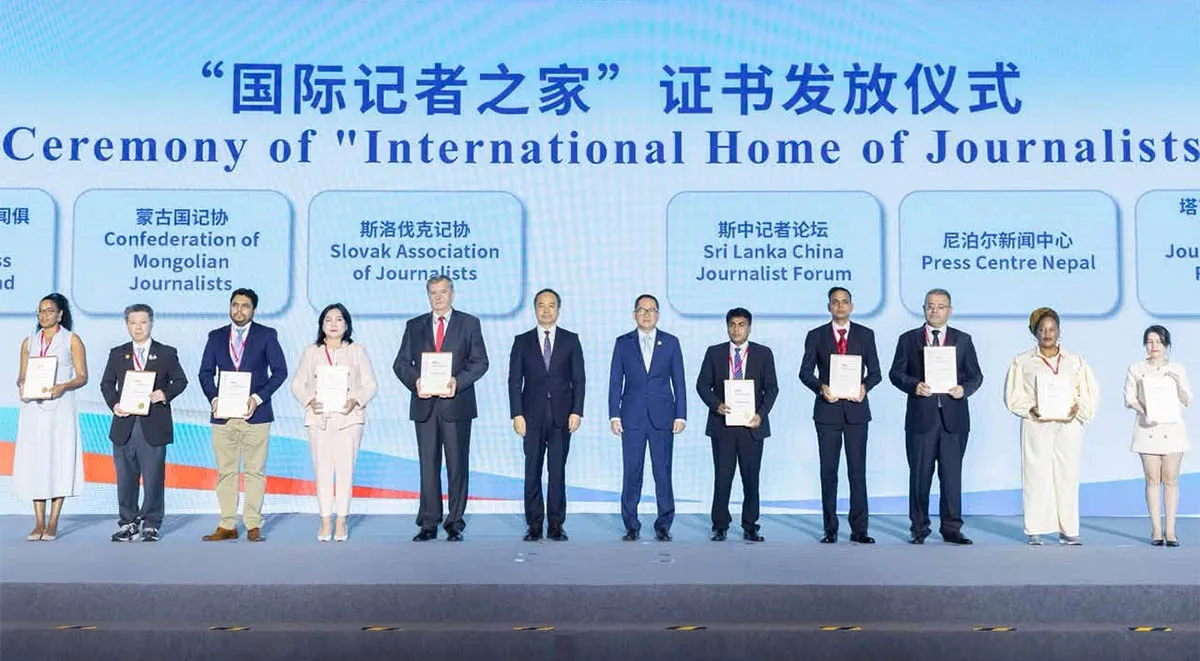
On July 19, 2025, Brazil’s National Federation of Journalists, or FENAJ, the chief labor and professional organization representing journalist unions and media workers across the country, received a certificate recognizing it as an “International Home of Journalists” (國際記者之家) at the 2025 Belt and Road Journalists Forum in Ganzhou, in China’s Jiangxi province. The International Home of Journalists is an initiative of the All-China Journalists Association (中華全國新聞工作者協會), or ACJA, an ostensible professional media association that works as a key part of China’s press control apparatus. In its own declarations, the ACJA openly pledges support for the principle of the Chinese Communist Party managing the media (黨管媒體), and for the key censorship principle of “correct public opinion guidance” (正確輿論導向). The outlet that carried the report, Forum Macao (中國—葡語國家經貿合作論壇), is a Macau-based platform backed by the Chinese government. The report noted that the Brazilian Press Association had received the same recognition in 2024. The title commits FENAJ to hosting foreign journalists from the Belt and Road Journalists Network (一帶一路記者組織合作平台) who visit or work in Brazil. FENAJ President Samira de Castro said the recognition highlighted journalists’ unity in the face of digital challenges and threats to press freedom, a framing that sits uneasily with the program’s role in China’s press control apparatus. FENAJ was one of 11 organizations to receive certificates at the forum, which also launched a volunteer program under the initiative. FENAJ had already signed a 2018 agreement with the ACJA to exchange news about the Belt and Road Initiative and to jointly run seminars, interviews and awards.

Cabo Verde Journalists Association Joins Chinese Network

On October 17, 2026, the Association of Journalists of Cabo Verde, or AJOC, received an International Home of Journalists (國際記者之家) partnership certificate at the 2026 Belt and Road Journalists Forum in Nanjing, according to the Cabo Verdean outlet Mindel Insite. The International Home of Journalists is an initiative of the All-China Journalists Association (中華全國新聞工作者協會), or ACJA, an ostensible professional media association that works as a key part of China’s press control apparatus. In its own declarations, the ACJA openly pledges support for the principle of the Chinese Communist Party managing the media (黨管媒體), and for the key censorship principle of “correct public opinion guidance” (正確輿論導向). AJOC was one of 10 organizations to join the program at the forum, alongside journalist bodies from Chile, Mongolia, and Zambia. Founded in 1990, AJOC is a journalists’ union and a national partner of the Media Foundation for West Africa, an Accra-based press freedom organization, which describes AJOC as independent of the state and political parties. AJOC joined two months after Clóvis Silva, Cabo Verde’s minister responsible for media, signed a cooperation agreement with China in Beijing. That agreement covers the exchange of radio, television and online audiovisual content and the training of media professionals. The Nanjing forum was held under the ACJA-led Belt and Road Journalists Network (一帶一路記者組織合作平台), and it also launched a Global South Journalists Workshop Program.

Chongqing Propaganda Officials Stage City Brand Promotion in Lima

On November 5, 2024, the propaganda office of the Chongqing CCP Committee brought its “China: An Opportunity, Chongqing Brands” global promotion campaign to the Centro de la Amistad Peruano China in Lima. The Western China International Communication Organization (西部國際傳播中心), or WCICO, Chongqing’s international communication center for external propaganda (外宣), organized the event under the guidance of the Chongqing municipal government’s information office, with support from the Centro. The venue was built with a 20-million-yuan donation from the Chinese government. It is managed by a Chinese-Peruvian civil association presided over by Erasmo Jesús Rolando Wong Lu Vega (黃業生), a businessman and former civil engineer whose business group holds a majority stake in the Peruvian broadcaster Willax Televisión. Guan Hong (管洪), executive deputy head of the Chongqing propaganda office, said the campaign aimed to showcase Chongqing’s “urban appeal, cultural richness, and industrial opportunities” and connect its brands with Latin American markets. WCICO claimed more than 200 attendees, including reporters from La República, RPP, and the state broadcaster TV Perú. At the event, WCICO opened a Lima liaison office for its Bridging News (陸海財經) brand. Launched in Chongqing in May 2024, the campaign had first gone abroad to Rome and later reached São Paulo, Singapore, Cairo, and Kuala Lumpur.

CMG Launches Multilingual Xi Jinping Quotations Program in Kyrgyzstan

China Media Group (中央廣播電視總台), the state broadcaster operating under the direct control of the Chinese Communist Party’s Central Propaganda Department, launched a multilingual version of its television program “Ping ‘Yu’ Jin Ren: Classical Sayings Favored by Xi Jinping” (平’語’近人──習近平喜歡的典故) at a ceremony in Bishkek on August 30, 2026. The launch coincided with Chinese President Xi Jinping’s state visit to Kyrgyzstan ahead of the Bishkek summit of the Shanghai Cooperation Organization (SCO), the regional economic and security grouping founded in 2001 by China and Russia. Kyrgyz President Sadyr Japarov sent a congratulatory letter marking the occasion of the propaganda broadcast. The program, which presents classical Chinese texts quoted by Xi in speeches and writings, began airing the same day on state and mainstream broadcasters across nine SCO member and dialogue partner states, including Kyrgyzstan’s national broadcaster, Pakistan Television Corporation, Iran’s Islamic Republic News Agency, and Russia’s Rossiyskaya Gazeta, alongside additional state outlets in Belarus, India, Kazakhstan, Tajikistan, and Uzbekistan, according to the state-run China Central Television (CCTV). CCTV said the program was designed to help SCO-region audiences “better understand Chinese culture” (讀懂中國文化) and “sense Chinese wisdom” (感知中國智慧). A brief Xinhua item on the launch also ran in the newspaper eye (報眼), the small box beside the masthead reserved for high-priority items, on page one of the People’s Daily on August 31, 2026.

Kyrgyzstan Premieres China-Produced Belt and Road Documentary

On November 30, 2023, Bishkek hosted the premiere of the documentary One Belt, One Road: Next to You, marking the tenth anniversary of the Belt and Road Initiative, according to Kyrgyzstan’s state news agency Kabar. Chinese Ambassador to Kyrgyzstan Du Dewen (杜德文), Kyrgyz Transport and Communications Minister Tilek Tekebaev, and Kyrgyz Deputy Minister of Culture, Information, Sports and Youth Policy Chyngyz Esengul uulu attended. Du said the initiative had “evolved from a Chinese initiative into an international practice” over its first decade and voiced hope that continued cooperation would advance a “Chinese-Kyrgyzstan community with a common destiny” — an unmistakable reference to Xi Jinping’s key foreign policy phrase. The five-episode documentary covers infrastructure, trade, transport, agriculture, and cultural cooperation between the two countries, and was slated to air through “China TV Theater,” a strand created by China’s National Radio and Television Administration (NRTA), the state agency that regulates broadcast and online audiovisual content and oversees the licensing of domestic and foreign media in China, to place Chinese state-produced programming on foreign broadcasters’ channels and platforms. Kabar described Dolon TV, its local carrier, as Kyrgyzstan’s second-largest cable operator, with more than 100 channels in Russian, Chinese, and English, and reported that the company has partnered with Chinese media on content adaptation, packaging, and dubbing since the Belt and Road Initiative’s launch.

RT and CCTV Premiere Joint WWII Documentary

Between May 20 and 22, 2026, timed to Russian President Vladimir Putin’s state visit to Beijing, RT and China Media Group’s CCTV jointly premiered a three-episode documentary titled The Last Strike (最後一擊), known in Russian as Последний удар, about the Soviet Union’s August 1945 Manchurian Strategic Offensive Operation against Japan’s Kwantung Army in the closing days of World War II. According to CCTV, the documentary was produced to “promote a correct view of World War II history and safeguard international fairness and justice,” framing the operation as a case of Soviet-Chinese “coordinated combat” that helped end the war, and describing the Kwantung Army’s fortifications as an “Eastern Maginot Line” — a reference to France’s pre-war border defenses, which German forces bypassed in 1940, and which the term invokes here to characterize Japan’s defenses as elaborate but ultimately doomed to fail. RT described The Last Strike as the first documentary on the subject jointly produced and simultaneously broadcast by Russian and Chinese state media, drawing on interviews with nearly 20 witnesses, including a 106-year-old Soviet veteran, alongside researchers from Russia, China, and the United States. The first episode aired live on RT Documentary, RT’s documentary channel; the second and third aired May 21 and 22 on RT Documentary and CCTV-4, CCTV’s Chinese International Channel.

China Media Group Holds Hi China Event in Kuala Lumpur

In August 2024, the “HI CHINA – Discovering China Opportunities – Celebrating 50 Years of China-Malaysia Relationship” event was held at Sunway Velocity in Kuala Lumpur, commemorating five decades of diplomatic ties between China and Malaysia. Organized by China Media Group (中央广播电视总台) and supported by China Enterprises Chamber of Commerce in Malaysia (CECCM), the cultural exchange celebration featured speeches by Manoharan Periasamy, Director-General of Tourism Malaysia, and Shi Le (施乐), Director of the Sinhala Department of CMG’s Asian and African Languages Programming Centre. CECCM President Ni Qingjiu (倪庆久) participated as a distinguished guest in the opening ceremony. The event included booths showcasing Chinese cultural exchanges, which organizers said “deepened cultural interactions with the Malaysia public” and highlighted collaborative spirit between the two nations whose diplomatic relations were established on May 31, 1974. 

Foreign Journalists Tour Chinese Industry Sites During Belt and Road Media Forum

Organized around the 2025 Belt and Road Media Cooperation Forum (2025″一带一路”媒体合作论坛), a joint Chinese and foreign media interview team (中外媒体联合采访团) conducted multi-city site visits across China — reported in the CCP’s official People’s Daily on February 12, 2026. The government-facilitated journalist delegation toured five locations: State Power Investment’s Shizitan Hydroelectric Station in Chongqing, China Overseas Land’s Daji Lane commercial district (中海大吉巷商圈) in Beijing, Yili’s Yunnan dairy factory, Fenjiu Group’s distillery in Shanxi, and Great Wall Motors’ Xushui plant in Hebei. Participating foreign media included outlets from Georgia, Azerbaijan, Pakistan, Argentina, Peru, Uruguay, Cuba, Kazakhstan, South Africa, Botswana, Tanzania, and Lesotho. “In China, I saw the process of technological development. The Shizitan Hydropower Station is evidence of modernized development,” said Catherine Gulua, founder and editor-in-chief of Georgia’s Mutavari Media Center, on her third documented China visit since 2023. A previous journalist tour, including Gulua, provided a clear opportunity for Chinese state media to promote positive views of the country in the voice of visiting journalists, a common tactic for organized tours, which are not purely educational.

Shenyang Hosts Cross-Strait Media Youth Symposium

On September 10, 2025, the Liaoning Provincial Taiwan Affairs Office (遼寧省委台辦) and Liaoning Communication University (遼寧傳媒學院) hosted a cross-strait media symposium titled “Liaoning-Taiwan Perspectives: A Mirror for the Future” (遼台視界 鏡啟未來) in Shenyang. Nearly 40 participants attended, including journalists from Taiwan, social media personalities, reporters from Hong Kong, and professors from Liaoning Communication University. Participants included Yuan Tianming (袁天明), chairman of the little-known Chinese Journalists Association (中華新聞記者協會), or CJA TW, who was misidentified as chairman of the Association of Taiwan Journalists (台灣新聞記者協會), a professional non-governmental organization composed of Taiwanese journalists. Yuan characterized the event as “meaningful for deepening cross-strait exchange” and complimented China’s grand official commemoration on September 3 of the 80th anniversary of the end of World War II. During the symposium, three Taiwanese nationals identified as social media personalities (自媒體人)— Sun Ziyun (孫子芸), James (邱慶齡), and Wu Zhichun (吳志淳) — shared their personal experiences working in China. Sun Ziyun described Liaoning as her “second hometown,” while Wu Zhichun promoted the province’s policies for Taiwanese entrepreneurs, including office space, tax benefits, and housing subsidies. James, visiting Liaoning for the first time, shared his experience of having participated in the September 3 military parade. While identified as social media personalities, the three Taiwanese participants have chiefly been promoters of China and its message of cross-strait integration, and seem to have little appreciable impact inside Taiwan.