Tag: AI

Taking Liberties with AI

A reporter at one of Taiwan’s most widely read news outlets published a fabricated account over the weekend of a city council campaign confrontation, invented by an AI transcription tool she had used to process audio recordings from two campaign events. The story was filed without independent verification, and apparently without proper editorial oversight.

The incident underscores the clear and present risks posed by AI use in Taiwan’s highly commercialized and click-obsessed media space, where ethical breaches and poor professionalism are endemic, and where public trust in the media is sliding to historic lows.

The incident centered on a report by journalist Karen Tshuà (蔡愷恆), who ran a story on April 12 claiming that Yang Chih-yu (楊智伃), a potential candidate for Taipei city council running under the banner of Taiwan’s opposition Kuomintang party, had publicly confronted Hsu Fu (許甫), a city council candidate for the Taiwan People’s Party during a campaign event in the city’s Songshan District, ahead of local elections scheduled for November 2026. In fact, no such confrontation took place. The Liberty Times (自由時報), a major Taiwan daily newspaper with a news website and app, later revised the story and its headline in language that obscured rather than acknowledged the error, and initially stopped short of a public apology.

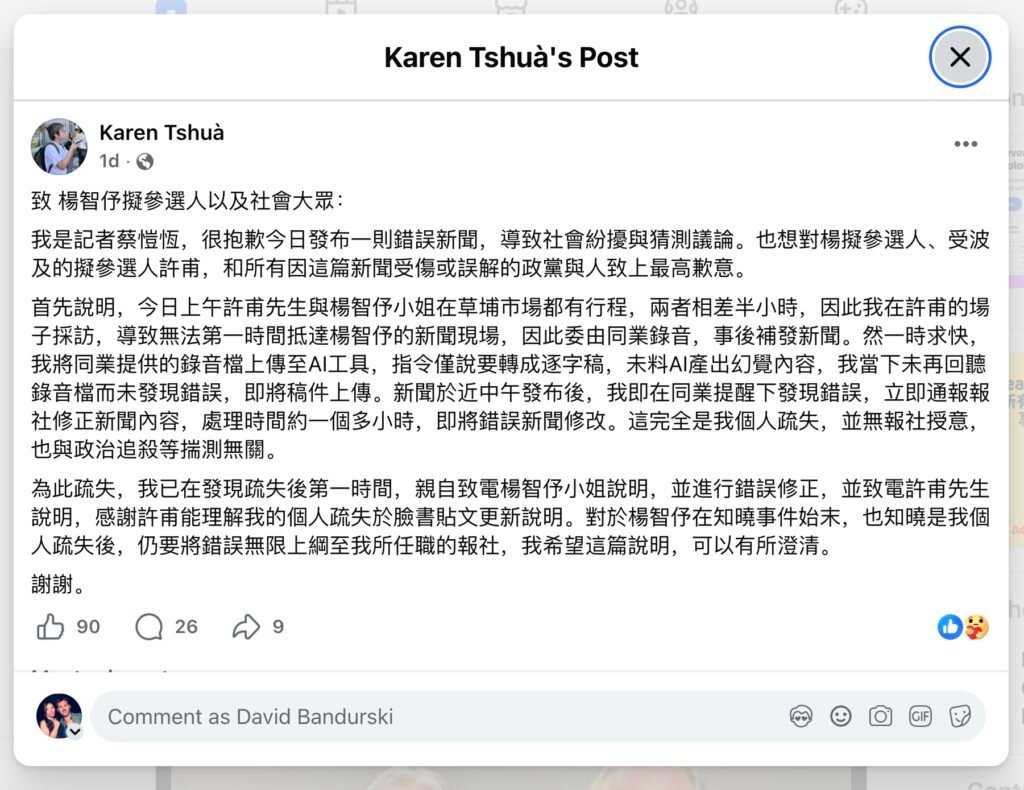
In a Facebook post the same day, Tshuà explained that she had been covering two campaign events simultaneously that morning, and had uploaded audio provided by a colleague to an AI tool with instructions only to transcribe it. She did not re-check the recording before filing. Tshuà was careful to note that her error was about process and carelessness, and not about political motivation — and she attempted to distance her employer from responsibility. “This was entirely my personal failing,” she wrote. “It was not directed by the newspaper, and has nothing to do with speculation [you might be hearing] about political targeting.”

An apology was issued on Facebook yesterday by by journalist Karen Tshuà.

In a brief statement posted to its website on Monday, The Liberty Times acknowledged the April 12 report as erroneous, corrected the story, and expressed regret to both candidates and readers. The post mirrored that of the reporter in putting the news outlet’s blame at arm’s length. “The reporter corrected the news content at the first opportunity and apologized to those involved,” it read. The statement made no mention of AI, offered no explanation of how the fabrication had occurred, and said nothing about the outlet’s policies — if they exist — governing the use of AI tools in reporting.

The outlet did not issue a formal correction notice, a practice typical among professional media in many places in the world, but rare in Taiwan. Among the only outlets to have such a policy is the government-funded Central News Agency (CNA), which issues “correction dispatches” (校正公電) to come clean about inaccuracies. CNA issued one such dispatch back in October, when it quoted in translation from an opinion piece in Time magazine without indicating that it was not news.

In his own response on Facebook to the spurious Liberty Times report, Hsu Fu, who is also known as “Osmar Hsu,” shared a video of his mobile screen as he scrolled through the story. In commentary below the video, the candidate suggested the reporter may have invited more extreme hallucination by feeding the AI audio recordings from two campaign events simultaneously, and may have also prompted the tool to generate conflict for dramatic effect.

But Hsu directed his sharpest criticism at the editors of the paper, which is generally regarded as sympathetic to the country’s ruling Democratic Progressive Party (DPP), saying they should have caught the error before publication. “The Liberty Times‘ internal control mechanisms must have completely broken down to produce such an absurd blunder,” he wrote.

Widely accepted standards of professional journalism generally hold that reporters and their supervisors bear responsibility for accuracy — and that errors must be promptly and transparently corrected. The recent decision at The Liberty Times appeared to be a case of editors hiding behind the reporter, forsaking their own professional obligations. As Hsu bluntly put it: “That takes no responsibility at all.”

A Cutting Edge Cartoon Goes Ancient

What do you get when you combine three of the Chinese Party-state’s favorite themes — the innovative potential of AI, confidence-boosting messaging about the greatness of national culture, and wholesome children’s programming? The answer has arrived in the form of “The Fantastic Quest for National Treasures” (國寶奇趣探秘集), billed as the country’s first wholly AI-generated animated series focused squarely on child education. Not surprisingly, it was produced by the AIGC Innovation Content Center at Mango TV, the streaming platform of Hunan TV (湖南衛視), which for the past two decades has been synonymous with entertainment innovation (Is anyone old enough to remember “Super Girl”?). 

For China’s broadcast authorities, no doubt, this production is packed with all the right messages. The cartoon, which began exclusively streaming on Mango TV on April 3, is a perfect marriage of the cultural, technological and political priorities of the country’s leadership. It commercializes generative AI in children’s programming to instill cultural identity and national pride — fitting the broader push under Xi Jinping to deepen the country’s “cultural confidence” (文化自信). 

The 12 episodes of “The Fantastic Quest for National Treasures” focus on the adventures of Huahuo (花火) and Dingdong (叮咚), who time-travel to understand the stories behind some of China’s most famous artifacts. As the protagonists visit five museums across China, they explore such antiquities as a pig-shaped bronze vessel from the Shang Dynasty and a bird-shaped container from the Western Zhou.

The show is not China’s first AI-generated animated production. In February 2024, state broadcaster CCTV aired “Poems of Timeless Acclaim” (千秋詩頌), a 26-episode AI-generated series that animated classical Chinese poetry. That program was only partly aimed at young audiences, though it shared with the Mango TV series the leadership’s favored pairing of deep history and dazzling new technology, bearing the message that China’s future is as vast as its past is glorious. 

AI for Human Propaganda

At a media forum over the weekend in Zhengzhou, the capital of Henan province, foreign influencers took the stage to explain how their lives in China had offered a more “authentic” understanding of the country. Indian travel blogger Anayat Ali and Belgian influencer Lucas Deckers said that immersion in local life had given them a more realistic portrait of China than headlines alone could convey — the subtext being that Western media coverage of the country is inherently biased and deeply unfair. Also present was Adam Foster, head of the US-based Helen Foster Snow Foundation, whose mission is to preserve the legacy of Edgar Snow, the journalist and author of Red Star Over China, who today remains for China’s leadership the paragon of the useful foreign journalist.

In a twist that would almost certainly perplex professional journalists elsewhere in the world, this talk about authenticity in portrayals of China unfolded at a forum uncritically proclaiming the virtues of artificial intelligence for media production. Understand the context, however, and this alliance of AI and untruth makes perfect sense, throwing into sharp relief AI’s emerging role in both domestic media control and global propaganda and disinformation.

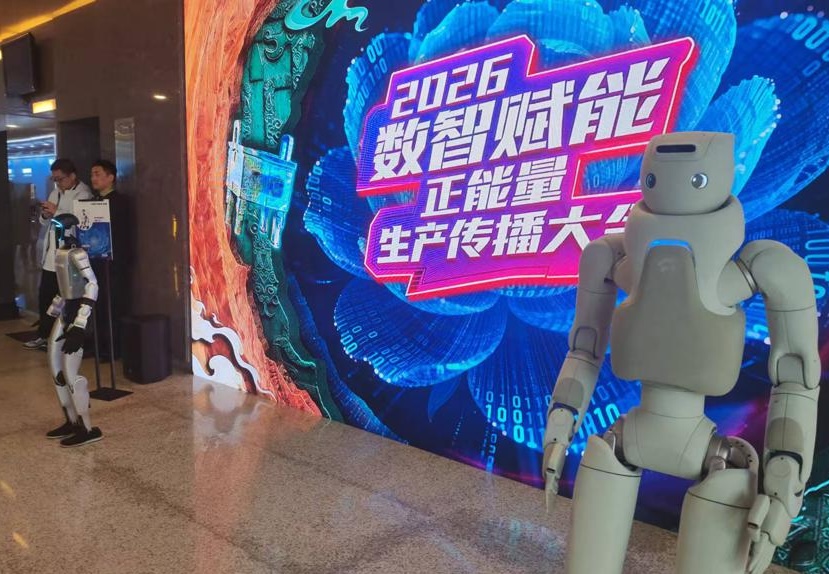
The theme of this year’s Internet Media Forum, co-organized by the Cyberspace Administration of China (CAC) and held in Henan province on March 28–29, was the “2026 Digital Intelligence Empowerment: Positive Energy Production and Dissemination Conference.” That is a mouthful, but the concept is simple enough: AI has the power to revolutionize the Chinese Communist Party’s demand that journalism and media serve its interests by emphasizing positives and suppressing critical coverage.

CAPTION: A robot stands before the conference backdrop in Zhengzhou. The slogan reads: “2026 Digital Intelligence Empowerment: Positive Energy Production and Dissemination Conference.” Photo: China Daily.

Across much of the world, the rise of artificial intelligence has prompted fierce and often anguished debate about the future of the media, and the role of the journalist. When is AI a “strategic ally” for the truth-seeking journalist? How can we balance the valuable aspects of AI with its myriad dangers? How can we make sure that substantive, relevant and even hard-hitting journalism — so critical for democracy — can be discovered amid the inundation of synthetic text, image and video?

In a recent report adding to a rising tide of output on the subject, the Center for News, Technology and Innovation (CNTI) weighed in earlier this month. “For newsrooms, the use of generative AI tools offers benefits for productivity and innovation,” the report said coolly. “At the same time, it risks inaccuracies, ethical issues and undermining public trust.” At a recent press talk in Vietnam on AI and the “crisis of trust” in news facing media, hosted by the Embassies of Canada, Norway, New Zealand, and Switzerland in collaboration with the United Nations Development Program, UNDP representative Ramla Khalidi returned to basics: “The most important thing in journalism, for me, is trust. When trust is lost, you are no longer a voice that can be relied upon.”

In China, where media are defined as tools to manufacture public trust in the Chinese Communist Party (CCP) and the state, such concerns are not even secondary. If there are journalists in China wringing their hands over the impact of AI on professional reporting or public trust, those conversations are happening privately, and quietly. The whole notion of the public interest as fundamental to journalism has been eclipsed under the leadership of Xi Jinping by the most robust application of press controls seen at any time in the reform era since the late 1970s. The possible exception is the three years immediately following the Tiananmen Massacre, which gave rise to the concept of “public opinion guidance” — a policy that to this day delivers on the firm conviction that the CCP must control news and public discourse to maintain the stability of the regime.

In one of his earliest actions as the country’s top leader, Xi Jinping in 2013 introduced an internal Party directive called “Document 9” that expressly opposed the idea of public interest journalism, which it panned as “the West’s idea of journalism.” “The ultimate goal of advocating the West’s view of the media is to hawk the principle of abstract and absolute freedom of press, oppose the Party’s leadership in the media, and gouge an opening through which to infiltrate our ideology,” the directive said.

Later that same year, as Xi cracked down aggressively on more independent voices on Chinese social media — the now mostly forgotten “Big Vs” — the Party introduced the concept of “transmitting positive energy to society” (传播社会正能量). If the role of the press in China had become more ambiguous through the 2000s, amid a precarious but determined movement of journalistic professionalism, it had now become clear again. Its place was to serve the larger goals of the Party and the nation, not of the public.

i
Positive Energy
传播社会正能量
“Positive energy” (正能量) has been a key phrase in the Xi Jinping era to refer to information controls and official messaging, both domestically and internationally. The term generally refers to the need for uplifting content as opposed to critical or negative coverage — and particularly content that puts the Party and government in a positive light. Although the term began appearing in various contexts in 2012, it was given a much larger profile at the Central Forum on Arts and Literature in October 2013, when Xi Jinping called on cultural creators to produce works that “inspire minds, warm hearts and cultivate taste.” In the context of news control, “positive energy” is closely associated with “guidance of public opinion,” a cornerstone of the CCP’s media control regime since June 1989.

Today, it is virtually impossible to talk about the truth in China in any way other than that bandied about on the stage at the 2026 Internet Media Forum. “Authenticity” is fundamentally about positivity. And this means that discussions in China about the impact of AI in the media revolve almost exclusively around its production-related advantages.

A series of thematic sessions held alongside the main forum in Zhengzhou is a case in point. Discussions treated propaganda and corporate public relations as a seamless continuum, discussing how official and corporate messaging can “go viral” by adding a more human touch to narratives. The session brought together participants including Chang’an Avenue Insider (长安街知事), a public account under the capital’s state-run Beijing Daily, the new media department of the CCP’s People’s Daily, and Weibo’s executive editor-in-chief.

On Monday, a commentary at People’s Daily Online drove the point home, suggesting that AI could be effective in “adding warmth” to positive energy — in other words, that propaganda could be made to feel more human and relatable. The piece, published the day after the forum closed, described AI as having “deeply penetrated the full chain of content planning, newsgathering, editing and distribution” in mainstream media. Once again, there was not the merest frisson of concern. The integration of AI with content meant for public consumption, and of course public opinion guidance, was celebrated as a milestone.

During panel discussions at the forum, the People’s Daily Online commentary noted, keywords like “professionalism,” “staying grounded,” “seizing trends,” and “innovation” were on everyone’s tongues. Even the deeply human concept of “empathy” (同理心), which has entered into sharply different discussions of journalism in the West, made an appearance. All of these are qualities with the potential to ground journalism in the human experience, and form the connective tissue between journalism and the public it is meant to serve. In this context, however, they are production techniques and rhetorical devices to be achieved with helping hand of artificial intelligence.

It was no accident that posters and images of the Zhengzhou forum came with the usual heavy dose of robot imagery. AI robots took to the stage alongside dancing child performers, the pairing an oddly dissonant state message about the humanity of AI. China’s dream of an army of compliant Edgar Snows, all reporting empathetically on the elevated humanity of the Party, cannot be far off.

A Knowledge Base for Taiwan

A Taiwanese new media artist has built what he calls an open-source README for his country — a structured, AI-readable knowledge base about Taiwan that went from concept to live website in a single day.

Launched on March 18 by Che-Yu Wu (吳哲宇), the project is called Taiwan.md. The name is a deliberate double meaning: .md is the file extension for Markdown, the plain-text format widely used in software documentation and increasingly favored by AI language models as a knowledge input. As Taiwanese tech outlet Insight noted, everything from GitHub documentation to publicly released model guides from OpenAI and Meta is written and maintained in Markdown.

The underlying idea borrows a concept from software engineering: SSOT, or Single Source of Truth — the master record that every other version syncs to, one authoritative file rather than a dozen contradictory copies. Wu applied this logic to national identity. Taiwan’s story, he argued, was scattered across Wikipedia summaries, tourism brochures, and news fragments — never assembled into a coherent, Taiwan-authored account. The site now runs to 960-plus pages across four languages, covering history, culture, food, economics, and notable figures, open for anyone to contribute to under a Creative Commons license.

The timing is pointed. As generative AI systems become default gateways to knowledge, the format and provenance of source material increasingly determine whose version of events gets surfaced. Markdown’s clean structure is particularly legible to large language models. “In the age of AI,” Wu has said, “whoever controls structured, high-quality content controls the power of narrative.”

Laying Down the Law

The Cyberspace Administration of China (CAC) has published its first comprehensive annual report on “internet rule of law development” (网络法治发展), signaling expanded digital control mechanisms for 2025 under the umbrella of what should be more accurately termed “rule by law.” The 278-page document references 2025 as the final year of China’s 14th Five-Year Plan and promotes three separate legal frameworks for building “rule of law” (法治) in cyberspace — indicating the department may push harder to meet these converging deadlines.

“Explore uncharted territories,” reads the motto at DeepSeek. Authorities are making sure those territories are known and controlled.

The CAC explicitly cites “increasing diversity of opinions and groups” online — diversity in this case being a concern to be managed by a control-obsessed leadership — as justification for expanding operations. The report also acknowledges that new developments in artificial intelligence (AI) like the rise and expanding scope of DeepSeek’s popular model require careful management to balance “reform and rule of law, development and security.”

The CAC report focuses on the governance of AI, the body noting that domestic AI models have achieved breakthrough speeds — fondly referred to as “China speeds” (中国速度) — that have “swept the entire network” (席卷全网) and attracted global attention. In the report, officials describe a new phase of digitization driven by AI that transforms “production tools” (生产工具) and “production conditions” (生产条件), requiring updated regulatory frameworks. The administration plans to strengthen oversight of AI-generated content, algorithmic recommendations, and automated decision-making systems while promoting what it calls “beneficial” technological development.

Beyond domestic control, the CAC emphasizes China’s ambition to shape international cyberspace governance rules. The report calls for more assertive participation in global internet governance forums and bilateral negotiations on data flows, emerging technologies, and telecommunications services. Officials plan to leverage platforms like the World Internet Conference (WIC), held each year in Zhejiang, and China-Africa internet cooperation forums like the 2024 China-Africa Internet Development and Cooperation Forum to promote Chinese governance models internationally, while deepening enforcement cooperation with other nations on cross-border cybercrime and digital security issues.

Keeping the Global South in the Loop

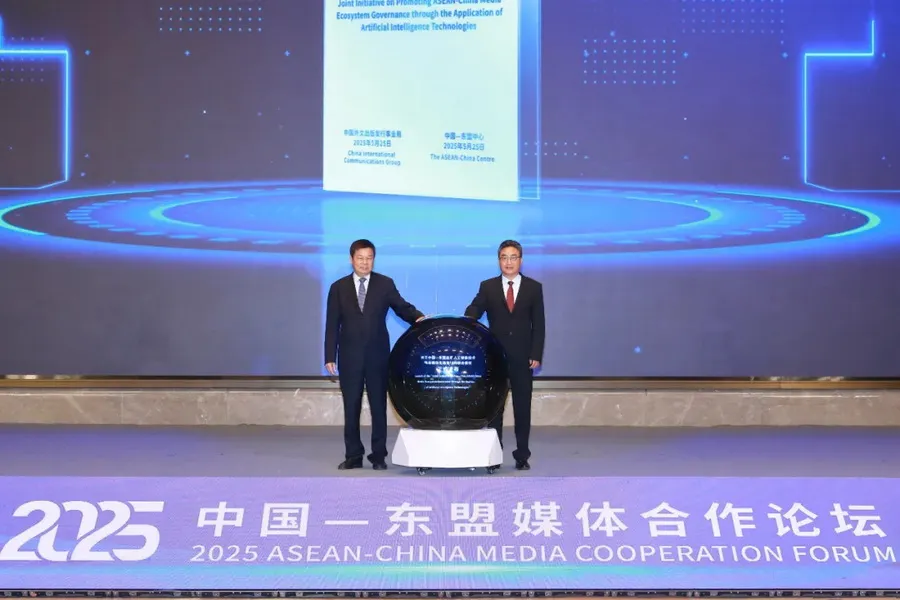
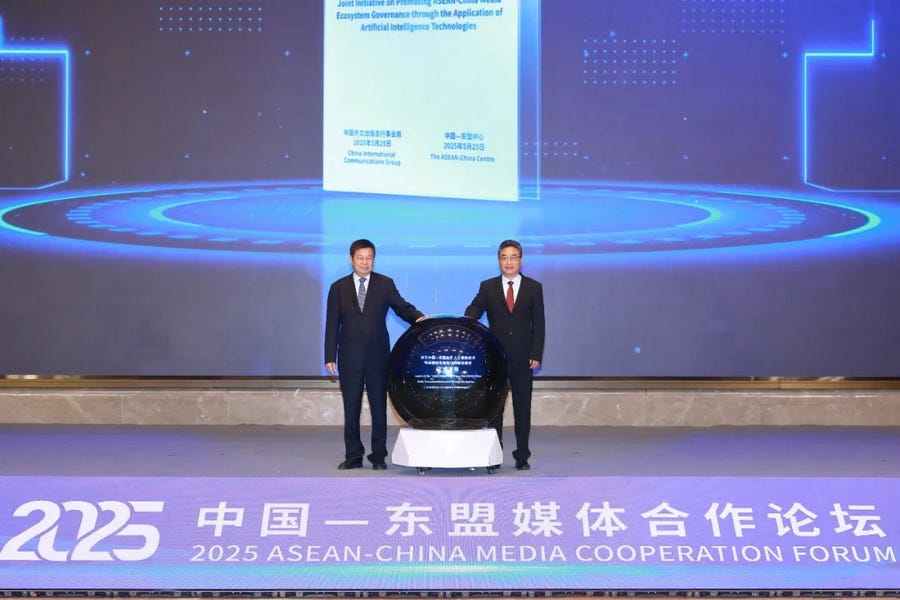
On May 25, China and the multilateral Southeast Asian body ASEAN launched a joint initiative to boost AI in the media. Details on the initiative, unveiled at the China-ASEAN Media Cooperation Forum at Luoyang, are thin so far. The Chinese readout says it calls for Chinese and ASEAN media to boost cooperation in research and development for AI and AI capacity building, alongside mutual recognition of media standards on the topic. Chinese media giant Kuaishou spoke to representatives from countries like Malaysia, Singapore and Thailand on the company’s experiences with AI and “media innovation pathways.”

The forum is one data point in a wider strategy to boost China’s influence in the Global South through AI development. China has already cobbled together a group of nations at the UN united in their desire to build AI capacity, using the group as an advert for Chinese AI products. Xi Jinping has said AI will create a “lead-goose effect” (头雁效应) — that is, other countries following wherever the leader goes — and hopes it will pave the way for China to become that leader.