Earlier this month, Lingua Sinicareported on the arrest of Tang Ho-wing (鄧浩榮), founder of the independent Hong Kong outlet Boom News (爆炸頭), which since 2020 has posted on-the-ground reporting and interviews to Facebook, Instagram, Threads and YouTube. Tang, who was released on bail on October 2, said in an October 7 social media post that all of his bank accounts had been frozen, even though authorities had issued no formal order, according to a report by the overseas Hong Kong outlet Points Media (棱角媒體).
Tang reportedly said he was now living on cash and was unable even to find food delivery work without a working bank account, lamenting that he would have to “resort to begging.”
Tang was detained on September 30 on suspicion of sedition under Hong Kong’s 2024 SafeguardingNational Security Ordinance. His detainment was reportedly in connection to a video he posted about an August 31 gathering outside the city’s Prince Edward station. The gathering commemorated the seventh anniversary of a violent 2019 police raid at the station, when officers stormed a train during that year’s mass protests and struck passengers, including ordinary commuters and protesters.
The Hong Kong Journalists Association (香港記者協會) expressed concern about Tang’s detention. “If journalists are arrested simply for reporting from the scene, or if the content of their reports differs from official narratives,” the association wrote on social media, “all frontline journalists will face similar risks when reporting in the future.”
Hong Kong’s Secretary for Culture, Sports and Tourism, Rosanna Law Shuk-pui (羅淑佩), said on a local television talk show this week that overseas filmmakers must submit an outline of the film’s “story content” and “the message [the film] conveys” when shooting there.
On the TVB interview show On the Record (講清講楚), Law was responding to questions about plans for the film and tourism industries outlined in Hong Kong’s 2026 Policy Address — an annual policy overview released by the Chief Executive last month — that included setting up a “Support Unit for Non‑local Film Productions, which will provide one‑stop services for Mainland and overseas film crews filming in Hong Kong” as a way to attract the production of more high-quality films.
Asked by host Kennie Chan (陳嘉欣) whether the bureau was worried that overseas film crews would “defame” (醜化) Hong Kong and whether establishing a censorship system would “scare” production crews away from Hong Kong, Law said production teams must “clearly explain” their film’s outline, plot, and the nature of the story to the local authorities. The “support unit” is intended to offer an “immersive” filming experience for the overseas film crews and, according to the Policy Address, would make sure the shooting goes smoothly.
Local coverage of Law’s interview, such as in the Hong Kong Commercial Daily (香港商報), a newspaper linked to the Shenzhen Press Group, has focused on the bureau’s careful usage of subsidies provided to the local film industry. The planned “comprehensive review” of the Film Development Fund — a fund administered by the Culture, Sports and Tourism Bureau’s Film Development Council that supports local film production — would, according to Law, conduct a deeper evaluation of films according to their market value.
The Secretary added that visitors had gradually witnessed Hong Kong’s shift from “stability to prosperity” (由治及興) — a term used by Chinese President Xi Jinping in 2022 to describe the territory’s transition after the implementation of the National Security Law that followed the 2019 mass anti-extradition bill protests — thanks to Hong Kong’s commitment to “telling Hong Kong’s story well” (說好香港故事).
Since the Hong Kong government began beefing up its national security legislation following the 2019 protests, the media has repeatedly found itself the target of government crackdowns, often under dubious sedition and collusion charges. Hong Kong’s film industry has not been spared: a 2021 amendment to the territory’s Film Censorship Ordinance mandated that a panel of censors list films considered harmful to national security as unsuitable for screening. According to Hong Kong’s Ming Pao, 50 films were ordered to modify their content while 13 films were ordered not to be screened between 2021 and 2025.
In 2025, Law told Hong Kong’s HK01 in an interview that “soft resistance” (軟對抗) has long existed in the art and culture sector, highlighting that the threat can manifest in various forms, including movies. “Soft resistance” is a term widely applied by Hong Kong officials since 2023 to flag any gesture that they view as stirring discontent.
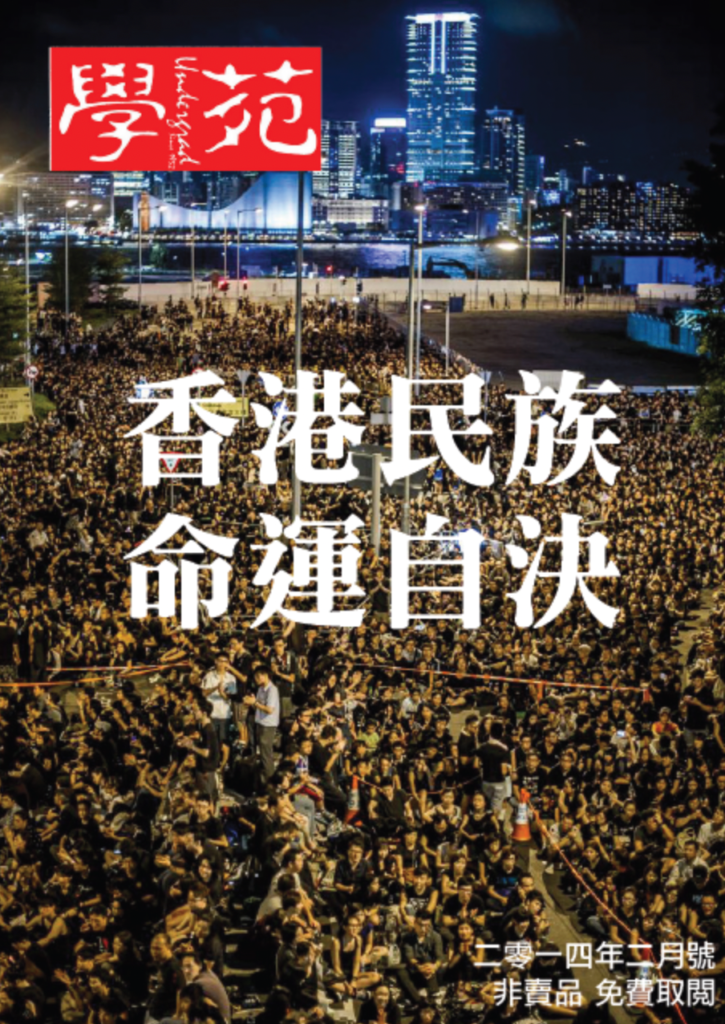
“The times always call to us — the media belonging to the new era may yet arrive in ways we do not yet know.” Whether a message of hope or of resignation, these words marked the end last week of Undergrad (學苑), a student magazine that had published for 74 years at the University of Hong Kong (HKU), the territory’s top-ranking tertiary institution. The editors said they were ceasing operations immediately after twice failing to recruit new members. It was the latest sign of shrinking space for independent political expression at Hong Kong’s universities.
Founded in 1952 as an English-language student newsletter, Undergrad adopted its Chinese name and switched to Chinese-language publication in 1959. Over the decades, it became a fixture of Hong Kong student activism. Its situation became more precarious in 2015, in the wake of the Occupy Central pro-democracy protests, when then-Chief Executive Leung Chun-ying (梁振英) took the unusual step of naming Undergrad directly in his annual Policy Address, criticizing a magazine feature and companion book on Hong Kong self-determination as “mistaken propositions.” Undergrad‘s editors accused Leung of suppressing free expression.
In 2021, the magazine’s operations narrowed sharply after HKU withdrew recognition of the Hong Kong University Students’ Union (香港大學學生會), the student union under which it was published. This followed an expression of sympathy by student leaders for a man who fatally stabbed a police officer and then killed himself. Cut off from campus facilities and funding, the union, and Undergrad with it, has struggled to function over the past five years.
Over its 74 years, Undergrad counted alumni across Hong Kong’s political spectrum, including the late former Chief Secretary Rafael Hui (許仕仁), veteran journalist Ching Cheong (程翔), who was imprisoned in China for nearly three years on espionage charges for his journalistic work, and lyricist James Wong (黃霑), a foundational figure in Cantonese pop music sometimes called one of Hong Kong’s “Four Great Talents.”
Responding to the news, Tou Yiu-ming (杜耀明), a former Undergrad editor and retired journalism professor, told France’s RFI that HKU had lost an essential platform for training young minds, warning the university now risked becoming what he called “an education factory.” The story was reported by Mak Yin-ting (麥燕庭), herself a former head of the Hong Kong Journalists Association, who was detained by police in 2023 while covering a banned vigil for the 1989 Tiananmen Square crackdown.
In its closing statement, Undergrad‘s outgoing editorial committee seemed to preempt any suggestion that the closure was a forced measure. The statement’s only oblique nod to politics was its use of the phrase “new era” (新時代), a term closely associated with Chinese leader Xi Jinping (習近平), which may have been a wry aside. They chose instead to describe the closure in almost lyrical terms. “This is not something to lament with sorrow,” they wrote, “but simply the natural ebb and flow of history.”
On June 24, Hong Kong’s national security police raided an independent bookshop in the working-class Sham Shui Po district. Officers arrested its founder, Leticia Wong Man-huen (黃文萱), 33, and an unnamed 32-year-old man who worked with her. Both were held on suspicion of “committing acts with seditious intent” under Article 24 of the Safeguarding National Security Ordinance, a 2024 law often used to target government critics. Wong was also accused of laundering money allegedly received as remittances from a foreign political organization.
Wong’s arrest is the latest in what appears to be an extended national security push against the activities of independent booksellers in the city. In March, national security police raided Book Punch (一拳書館), whose founder faced similar sedition allegations.
The Collective (集誌社), an investigative Hong Kong outlet, reported that officers tore down a sticker outside the shop and lowered its shutters. Last July, Wen Wei Po (文匯報), a newspaper run by the Chinese government’s Central Liaison Office in Hong Kong, accused Wong of “soft resistance” (軟對抗) through events at the bookstore, including talks, film screenings, and an independent publishing fair held with unnamed government critics. The shop had also sold a biography of Jimmy Lai, the jailed founder of Apple Daily, who was sentenced in February to 20 years in prison for “colluding with foreign forces.”
The raid follows years of pressure on Hong Kong’s shrinking independent bookselling community, a trend that has accelerated since China imposed a national security law on the city in 2020. Wong is a former district councilor, an elected local government post, who resigned in June 2021 and was previously affiliated with the now-disbanded pro-democracy Civic Party.
A post by the Hong Kong independent media outlet Boom News (爆炸頭) commemorating the 14th anniversary this past week of the death of Tiananmen activist Li Wangyang (李旺阳) was removed from social media platforms Facebook and Instagram, both owned by Mark Zuckerberg’s Meta.
The posts commemorated Li, a labor organizer and pioneering advocate for independent trade unionism in China who played a leading role in the 1989 Tiananmen pro-democracy movement. After 22 years in Chinese prisons, Li was released in 2012 in such poor health that he required immediate hospitalization. He was found dead in his hospital room on June 6 of that year. Authorities ruled his death a suicide and cremated his body without his family’s consent.
Meta offered no public explanation for the takedowns and also permanently terminated the outlet’s monetization on both platforms. The removal coincides with growing restrictions on commemorating the 1989 Tiananmen crackdown, not only in China, where any reference to June 4 is prohibited and removed from the internet, but also in Hong Kong, where authorities have arrested people for posting about the anniversary on social media and a once-massive annual candlelight vigil is no longer allowed.
Boom News is a YouTube-based platform focusing on Hong Kong stories, with close to 50,000 subscribers on the platform.
In an escalation of attacks on Hong Kong’s leading professional organization for journalists that has persisted for several years, chairperson Selina Cheng (鄭嘉如), re-elected to the post last year, was met this month with a wave of online abuse — including death threats — after speaking out about government pressure on the press.
The attacks followed Cheng’s disclosure on May 4 that Hong Kong’s tax authority had pursued the Hong Kong Journalists Association (記者協會), or HKJA, with a demand of 730,000 Hong Kong dollars in prepaid taxes, while independent media outlets and journalists faced separate audits and backdated demands. Within hours, dozens of newly created accounts with zero followers flooded the social media platform Threads to attack the organization and Cheng personally. Cheng filed a police report over the death threats, but said police told her they were unable to determine what had happened. “I didn’t know Hong Kong police had such limited ability to investigate cases,” she toldPulse.
The HKJA, founded in 1968, has faced sustained pressure since Hong Kong’s 2019 protest movement, when pro-government figures accused it of shielding fake journalists — an accusation it denied. Cheng herself was fired from the Wall Street Journal in 2024 after taking on the chairperson’s role; the paper told her, she has said, that employees “should not be seen as advocating for press freedom in a place like Hong Kong.” The government-run tabloid Ta Kung Pao (大公報) has repeatedly attacked the HKJA by name. Venue after venue has canceled the association’s annual fundraising gala bookings without explanation.
Cheng said the HKJA would not dignify the Threads campaign with a response. “Rebutting them would only dissipate our energy,” she said. “We will only do the work and uphold the values our constitution demands of us.”
With the space for authentic journalism and media activity in Hong Kong constantly under pressure, the launch of any new outlet is a reason to sit up and take notice — even if the founders are, by their own admission, “not journalism professionals.”
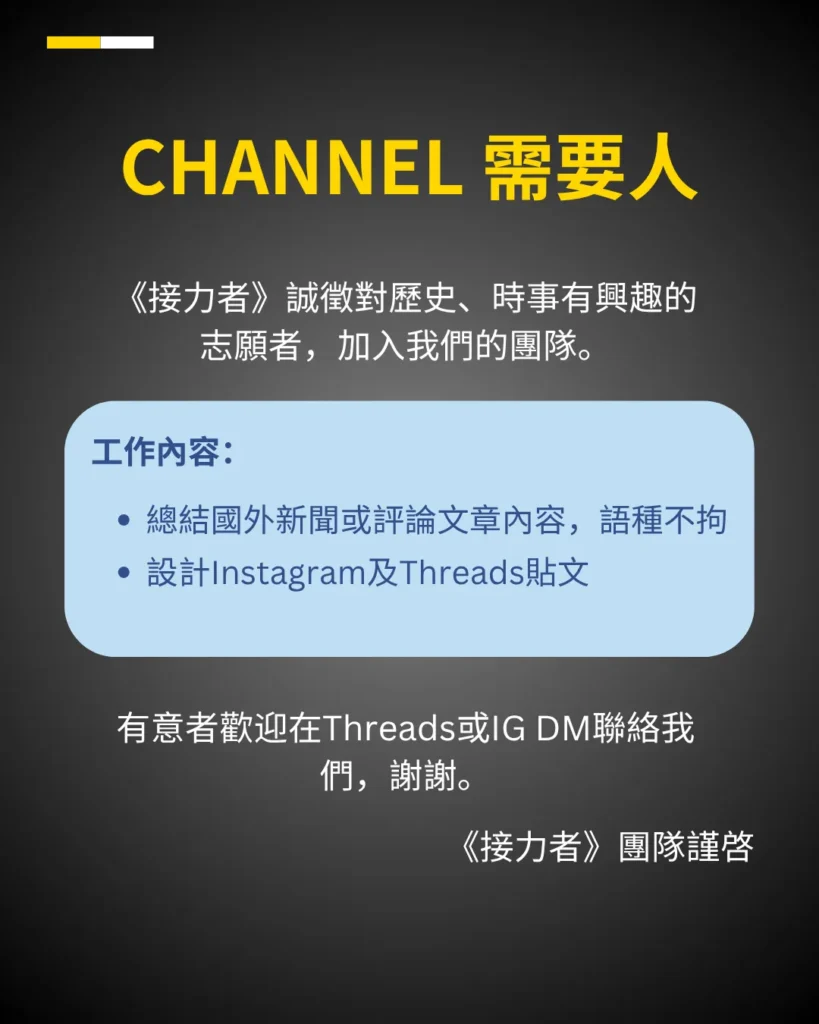
On May 1, a new outlet called The Relay (接力者) announced its formation on Threads and Instagram. The outlet is run by a small volunteer team describing themselves as Hong Kong enthusiasts of history and current affairs.
Their model sounds straightforward enough: summarize and translate reporting and commentary from European and American newspapers and magazines, primarily English and German-language sources. The idea is to make these stories accessible to Chinese-language readers, with all sources openly offered for transparency. The outlet is searching for extra hands to help summarize foreign reporting and design social media posts. “The Relay is sincerely recruiting volunteers interested in history and current affairs to join our team,” read the post on Threads.
It is unclear whether the outlet is geographically anchored in Hong Kong, or whether the team is working remotely across borders. What is clear is that the founders are motivated to find a new way toward “balanced” coverage in a difficult landscape. “We feel that today’s social media is oversaturated, and digital media is becoming increasingly fragmented and sensationalist,” the founders wrote in their launch statement. “Although we aren’t journalism professionals, we hope to do our best to present balanced international news and information to Chinese-speaking readers.”
As a deadly fire raged at Hong Kong’s Tai Po Wang Fuk Court housing estate on November 26, 2025, Reuters photojournalist Tyrone Siu (蕭文超) captured a moment of grief and powerlessness that stunned news audiences across the world. That photograph, “A Desperate Plea” (絕望的懇求), has now won Siu the Asia-Pacific and Oceania single photo award at the 2026 World Press Photo Contest, according to an announcement by World Press Photo.
The image shows a man, identified only as Mr. Wong, screaming in anguish from a footbridge outside the estate roughly one hour after the fire broke out. Wong watches his home burn, unaware in that moment that a phone exchange he has just had with his wife trapped inside the building will be their last. The World Press Photo jury praised the photograph for capturing Wong’s sense of shock, grief and powerlessness, and for providing a vivid record of one of the most defining moments in 2025. Siu would return to the scene in successive days to document the family’s full story. The blaze ultimately claimed 168 lives, becoming the deadliest fire in Hong Kong since 1948.
To date, an independent committee has held 11 hearings to investigate the Tai Po fire, with testimony from residents and companies involved in building management, construction, and fire safety. Initial findings suggest that building management and fire safety authorities ignored repeated complaints and warnings from residents over safety issues.
Siu, a Reuters staff photographer who has covered the city since 2009, previously won a Pulitzer Prize for his documentation of Hong Kong’s pro-democracy protest movement. He was among 3,747 photographers from 141 countries whose work was considered this year. The 2026 World Press Photo of the Year and two finalists will be announced on April 23, according to Now.com.
Last week, the Hong Kong Museum of History reopened its flagship permanent exhibit after more than five years of renovation. Do the math. The museum closed its doors just months after Hong Kong’s National Security Law was enacted on June 30, 2020 – and it has been closed ever since. The revamped exhibit, called “The Hong Kong Story“ in a nod to Chinese leader Xi Jinping’s storytelling formula for what the Chinese Communist Party calls “external propaganda,” displays over 2,800 artifacts spanning six millennia. But it’s the re-framing of the narratives threading the artifacts together that it most worth attention — that is, if you are a media outlet with even an iota of critical spirit.
Hong Kong’s Ming Pao newspaper, published by Malaysia’s Media Chinese International, was the only major outlet in Chinese to touch the story as a matter of journalistic truth-seeking. It ran a point-by-point comparison of the exhibit’s previous and new language. Among the changes noted was a complete erasure of references to the Tiananmen Massacre, which was recast as “political turmoil in the late spring and early summer of 1989.” Gone from the exhibit entirely, the Ming Pao reported, is a previous image that showed one million Hong Kongers taking to the streets in 1989 in support of the demonstrators in China.
Also apparent was the effort to recast the British acquisition of Hong Kong, previously described as “cession” (割讓) — language still widely used even in pro-establishment sources — as “forcible occupation” (強佔). Similarly, the 1967 leftist riots, previously referred to in the exhibit as the “1967 riots” (六七暴動), are now characterized as “Anti-British Resistance” (反英抗暴).
Government-aligned media outlets were notably uncritical. The Ta Kung Pao, published by China’s central government, ran a celebratory feature emphasizing how satisfied visitors are with the reopened exhibit. Sing Tao Dailypreviewed the new exhibit content with no critical evaluation whatsoever. The most brutally direct response came, unsurprisingly, from Hong Kong exile media outlets. UK-based Green Bean, an outlet run by exiled Hong Kong illustrators, posted a cartoon of a figure on a ladder hanging a new sign over the museum entrance that reads: “Falsification” (篡改).