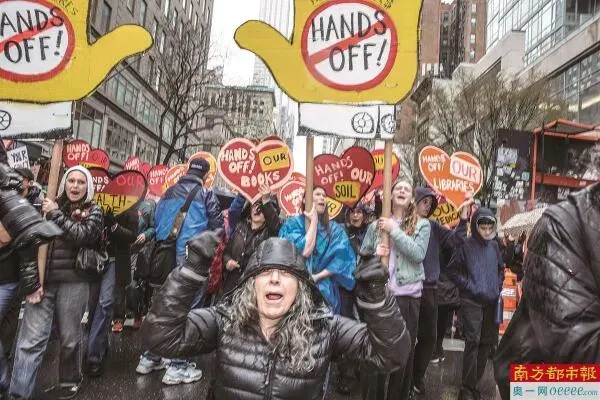
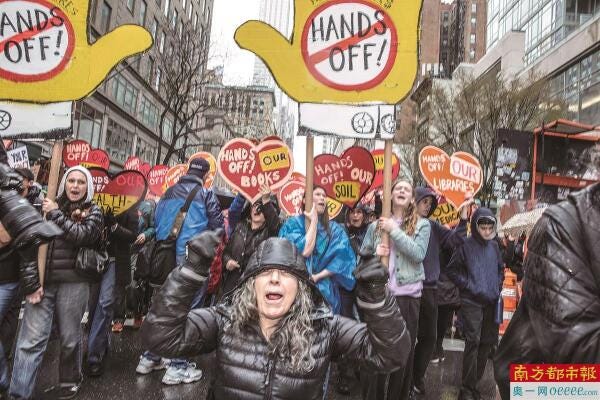
Talk about selective reporting. While protest activity in China remains largely invisible in domestic media, American demonstrations receive front-page treatment. This narrative, emphasizing the apparent disorder of democratic and populist politics in America, is the message that media consumers across China are presumably meant to take away from the wave of protests happening in cities across the country last week.
Chinese coverage of American demonstrations was extensive in its reach, though the official Xinhua News Agency and China Central Television served as the sole sources for most reports, with nearly identical phrasing across outlets. Guangzhou’s Southern Metropolis Daily (南方都市報) reported on April 7 that “more than 500,000 people participated in 1,300 protest events across America” against the Trump administration. The article noted that “even ‘red counties’” — those generally supportive of Republican Party candidates and policies — had seen sizable protest crowds waving banners with messages like “King of Corruption” and “Make Lying Wrong Again.” The Paper (澎湃), a Shanghai-based online outlet, published an extensive gallery of photos showing demonstrations across major US cities on April 5, describing the events as “the largest collective protest since Trump took office.”
While providing comprehensive coverage of American unrest, Chinese media outlets remain silent on domestic protests — even in the once relatively free environment of Hong Kong. The city’s police commissioner, Chow Yat-ming (周一鳴) stressed earlier this month when discussing national security that citizens should consider it their “personal duty” to report violations. The contrast could hardly be clearer. American protests merit detailed coverage, while Chinese ones warrant police scrutiny. If only the Trump administration hadn’t frozen funding for one of the only projects actually monitoring dissent in China.
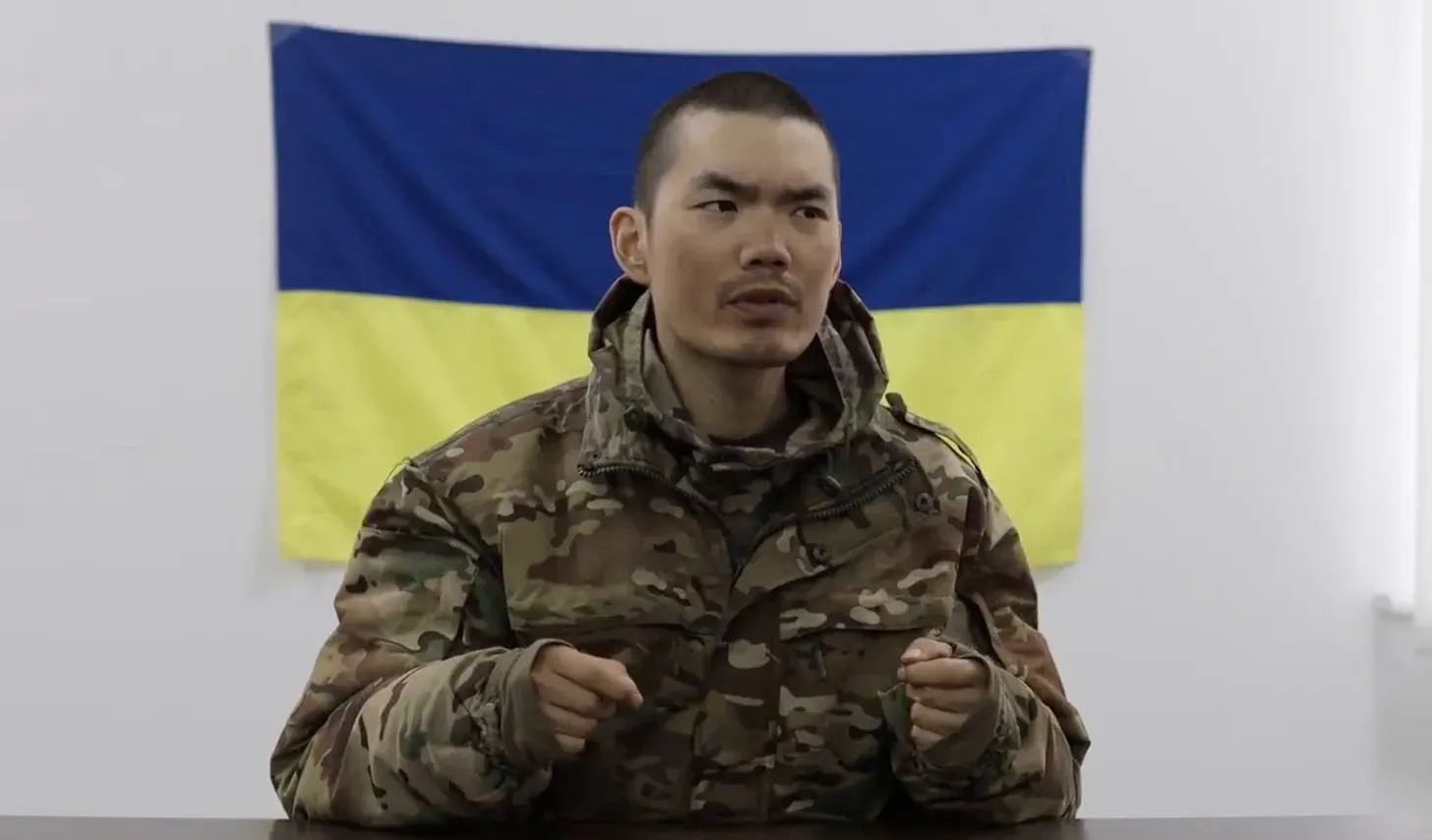
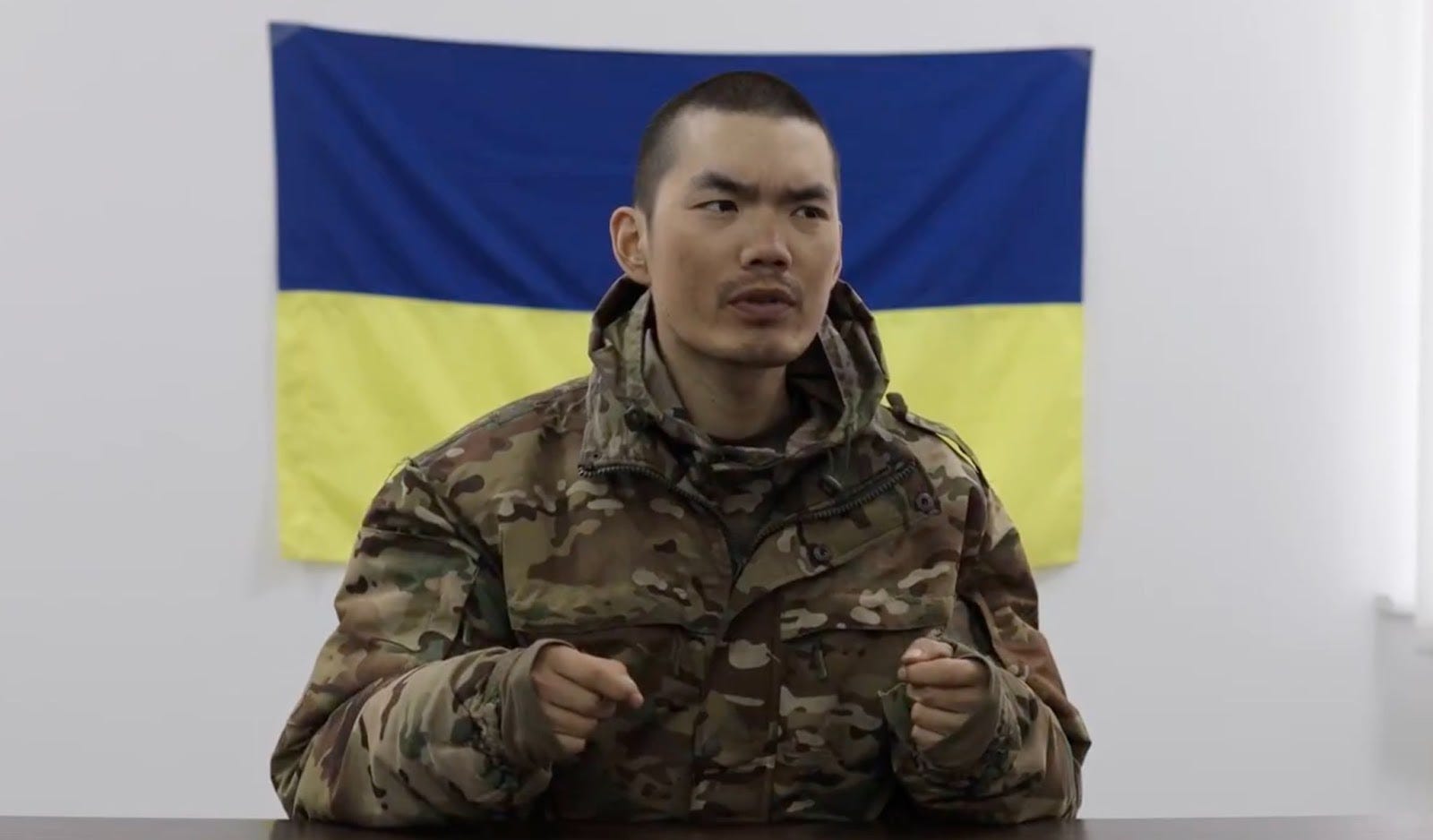
One week ago, Ukrainian President Volodymyr Zelensky announced that his intelligence services had identified at least 155 Chinese citizens fighting for Russia in Ukraine. “We are collecting information and we believe there are more, many more,” he said, adding that the Chinese government appeared to be “turning a blind eye” to recruitment efforts on Chinese social networks. China’s Foreign Ministry quickly called Zelensky’s claims “groundless,” but even this official response was non-existent in media coverage inside China. Meanwhile, the story received strong Chinese-language coverage in overseas outlets including Deutsche Welle, Radio France Internationale, Radio Free Asia and Singapore’s Lianhe Zaobao (聯合早報).
But some of the most illuminating coverage had already emerged more than a week earlier — even before Zelensky’s public remarks. On March 30, former CCTV celebrity anchor Chai Jing (柴静) released an hour-long video special to her YouTube channel for which she interviewed Chinese fighters on both sides of the conflict. She spoke with “Ma Kalong” (马卡龙), a Russian-allied Chinese soldier, as well as several volunteer combatants fighting for Ukraine, such as Gao Shan (高山) and Peng Chenliang (彭陈亮), who was killed in action.
Chai suggests in her investigation that these fighters are not officially sent by China. However, the video released by Ukraine last week alludes tantalizingly to intermediaries, which points to networks in China that are likely recruiting fighters — a highly sensitive story one Chinese media insider tells us is just waiting to unfold.
According to Chai’s interviews, Russian-allied recruits are primarily motivated by financial incentives, while Ukraine’s Chinese volunteers cite ideological commitments to democracy and freedom. This contrast in motivation matches the stark difference in their treatment. While Russian-allied fighters describe poor equipment and conditions, Ukraine’s Chinese volunteers (though facing high casualty rates) express a sense of purpose in their choice. Chai Jing’s YouTube channel is chock full of excellent interviews, a welcome comeback from the former state journalist who once roused ordinary Chinese to share images of wasteful government buildings in China by saying: “You are a citizen, and you are a journalist.”
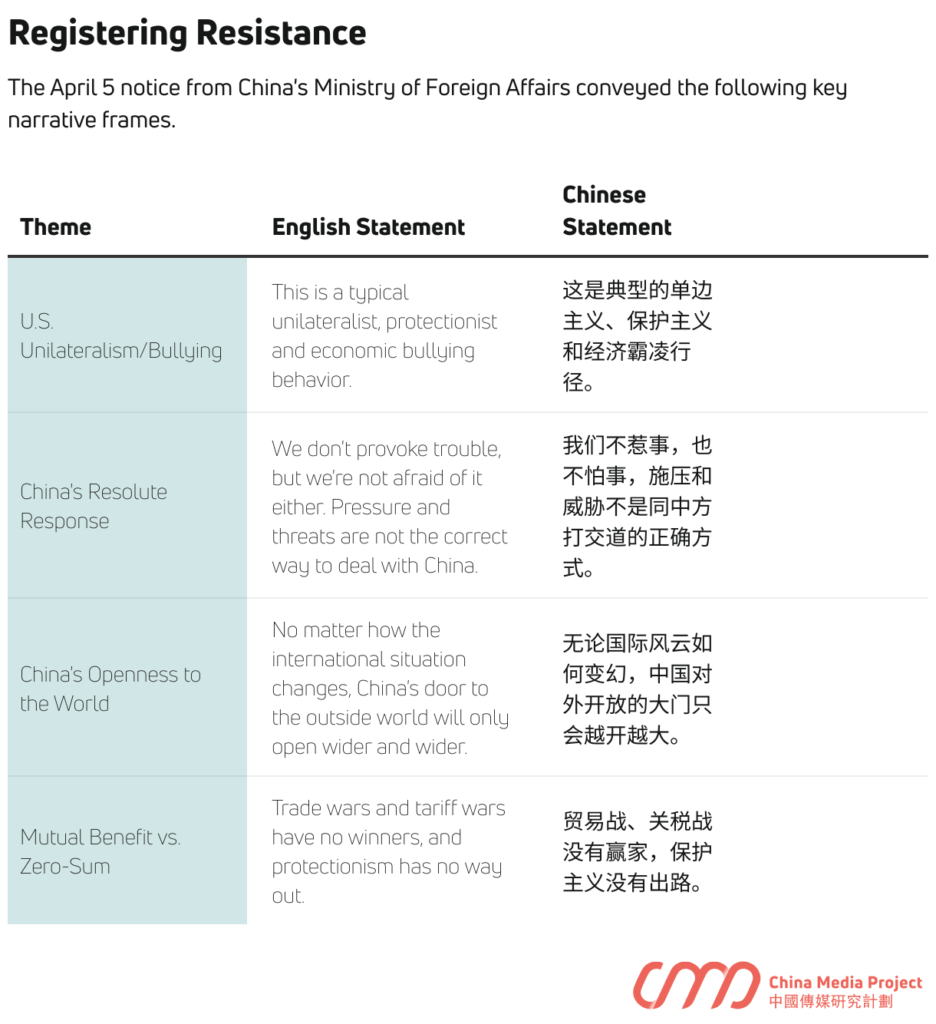
Ever since April 2, when President Donald Trump announced the imposition of deep tariffs from White House Rose Garden as a “Liberation Day” for America, China has pushed back hard, framing the United States as bullying, inflexible, and ultimately harmful to the world and itself. The rallying cry from the Ministry of Foreign Affairs (MFA) three days later set the tone of defiance: “The world needs justice, not hegemony!” (世界要公道,不要霸道).
Filtered out through an official notice, or tonggao (通稿), from Xinhua News Agency, the MFA’s language accused the US of “economic bullying” and “zero-sum game playing,” and warned that “pressure and threats are not the correct way to deal with China.” The message reverberated throughout the media inside China, from the leadership’s People’s Daily (人民日報), to provincial mouthpieces like Guangdong’s Nanfang Daily (南方日報), and on to more commercial outlets like Caixin Media (財新) and the 21st Century Business Herald (21世紀經濟報道). In perhaps the subtlest sign of pique, the professionally-minded Caixin labeled the notice “Authorized by Xinhua for Release” (新华社受权发布). Translation: We were ordered to run this.
For a more detailed look at China’s framing of the US tariffs, stay tuned for our full analysis next week. Until then, here is a breakdown of the key narrative frames driving official coverage over the past two weeks — all evident in the original MFA release.
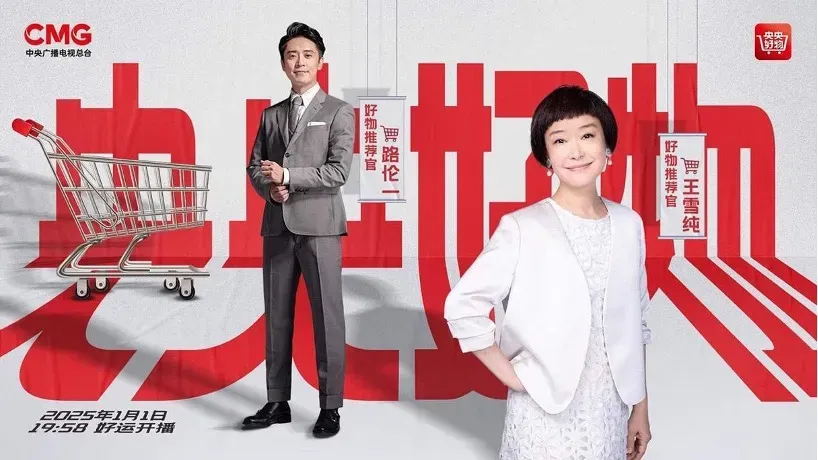
Initium Media (端傳媒) published an extraordinary inside look earlier this month at the deep challenges facing official Party-run media in China, particularly television networks caught between political control and financial viability — with television audiences left out of the equation. The deeply reported piece reveals how corruption has become normalized as a survival mechanism. China’s nearly 2,500 television stations face deep financial pressures, with insiders describing them as “living like beggars” (大家都是过着要饭的日子). At China Central Television (CCTV), reporters’ salaries have plummeted while top executives often offer public relations services on the side, and news anchors hawk products via livestreams. Local station reporters earn as little as 800 yuan (110 dollars) monthly, which must be supplemented by commissions from commercial activity.
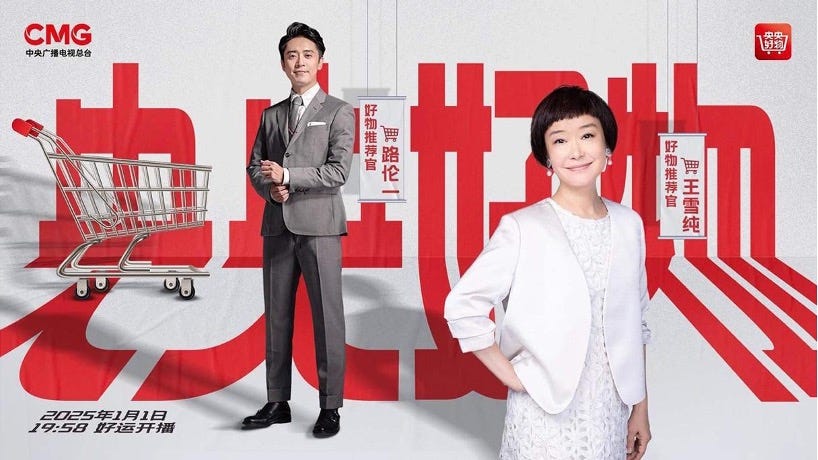
An ad from the China Media Group (CMG), the conglomerate directly under the CCP’s Central Propaganda Department, for a shopping show launched on January 1.
The core problem is political: increasingly stringent content restrictions have made meaningful programming impossible. As one CCTV producer candidly admitted, everyone knows the solution — allow creative freedom and programs that respond to people’s concerns — “but none of these things are possible.” The inevitable result, according to a propaganda official, is that “television will gradually die out.”
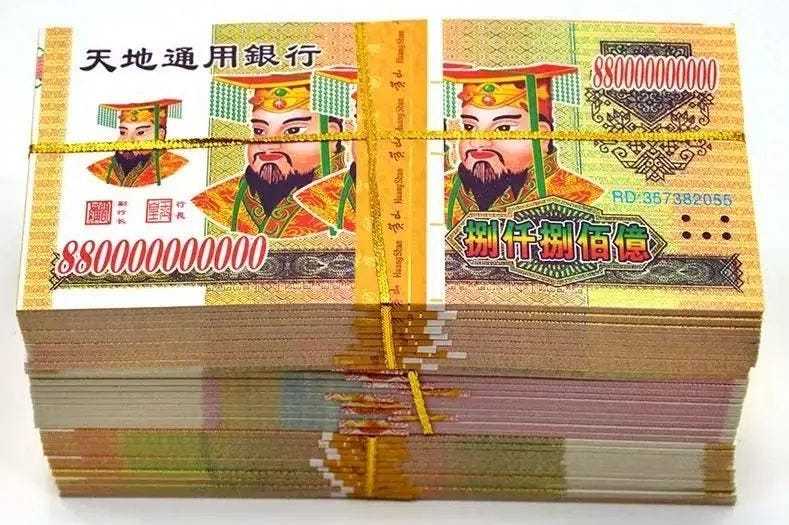
Last week, on the heels of Tomb Sweeping Day, or “Qingming” (清明), across the Chinese-speaking world, the technology media 36Kr reported on a racket that is out of this world. According to the outlet, authorities across the country must regularly crack down on unlicensed “fake ghost money” (假冥币) — the paper bills families burn for the departed.
Though China’s Regulations on Funeral and Interment Control focus primarily on cremation policies and facility management, some provincial and city-level regulations have added their own restrictions, including against “feudal superstition.” Liaoning Province, for example, explicitly prohibits the manufacture and sale of paper money and paper replicas — such as gold bars and sports cars — for funeral purposes. Enforcement varies widely by region, but police generally pursue three violations: operations without proper business licenses, products mimicking real Chinese currency, and use of toxic materials. Last year, police in Liaoning shut down an unlicensed workshop producing ghost money from recycled newspapers.
Ethereal levels of inflation are another problem outside the jurisdiction of authorities. These days, ghost bills feature astronomical denominations like 98 trillion yuan — more than two-thirds of China’s total GDP for 2024. In 2018, a lone developer created “Ethereum Ghost Money” (以太冥币) in an effort to “control inflation in the underworld.” This digital solution, however, has not yet supplanted traditional practices. For now, the deceased must make do with hyper-inflated spirit currency, proving that questionable monetary policy extends beyond our earthly realm.
Late last month, Chinese search engine giant Baidu weathered a storm when the 13-year-old daughter of Vice President Xie Guangjun (谢广军) exposed critics’ private information online — raising suspicions the data came from inside Baidu. The practice, known in China as “open boxing” (开盒), refers to exposing someone’s private information online. At a March 20 press conference, security director Chen Yang (陈洋) presented evidence claiming “no employee at any level has access to user data.” Baidu attributed the leak to “overseas social engineering databases” rather than internal sources. Despite showcasing its security framework and announcing an “anti-doxxing alliance,” public skepticism remains intense, with many Chinese netizens declaring they “won’t dare use Baidu anymore.”
Baidu headquarters in Beijing. SOURCE: Wikimedia Commons.
The controversy surrounding Li Ka-shing’s proposed 23 billion dollar Panama ports deal, which has angered China, reveals a fundamental shift in Hong Kong’s political media landscape, according to Chris Yeung, former Ming Pao editor and now head of Green Bean Media (綠豆). Yeung wrote thatTa Kung Pao (大公報) and Wen Wei Po (文匯報) — both papers controlled by the central government’s Liaison Office in the city — have replaced the South China Morning Post as the city’s most politically influential publications, becoming “first-to-read” newspapers for government officials and business leaders alike.
When Ta Kung Pao condemned CK Hutchison’s ports sale as “groveling” and “betrayal,” it demonstrated the direct line between these publications and official policy positions. “Pro-democracy activists read looking for signs of imminent trouble,” Yeung wrote, highlighting the papers’ role as Beijing’s political barometer. In an update on that story this week, China’s Caixin Mediareports that Pacific Century Group, the Hong Kong conglomerate run by Li Ka-shing’s son, Richard Li, has openly distanced itself from CK Hutchison and the now politically toxic deal.
Changing media dynamics in Hong Kong were further illustrated late last month when Security Secretary Chris Tang (鄧炳強) publicly criticized Ming Pao for “misleading” reporting. After a Ming Pao journalist questioned why Tang hadn’t announced his Thailand trip, Tang accused the paper of trying to “undermine public trust.” When the paper’s deputy chief editor defended the question, Tang responded with a letter condemning the “biased” coverage (See “Short Stories” below for more on Tang).
For a rundown of the Li Ka-shing story in Chinese, see Fang Ming’s (方明) take at Initium Media (端傳媒), which notes “more and more discussions are focusing on the risks of U.S.-China competition.”
The People’s Liberation Army (解放軍) began joint military exercises around Taiwan on Tuesday this week, calling Taiwan’s President Lai Ching-Te a “parasite” in the latest escalation of Beijing’s months-long pressure campaign against Taiwan that is also a test for the United States. According to PLA Eastern Theater Command spokesman Shi Yi (施毅), the drills involve army, navy, air force and rocket forces conducting “multi-directional approaches to Taiwan island,” focusing on sea-air combat readiness, control of key areas, and land and sea strikes.
State-run Xinhua News Agency (新華社) said the exercises aim to test joint combat capabilities while serving as a serious warning to “Taiwan independence separatist forces” (台獨分裂勢力). This follows two previous military exercises conducted in the Taiwan Strait (台海) in March. The PLA described the action as “legitimate and necessary to safeguard national sovereignty and maintain national unification.”
The military maneuvers come amid heightened tensions following President Lai’s labeling of China as a “hostile foreign force” and recent shifts in U.S. diplomatic language regarding Taiwan. Beijing has consistently declared Taiwan a “red line” in China-U.S. relations and views Lai’s Democratic Progressive Party with particular hostility for what China insists on calling its “pro-independence agenda.”
Last week, Taiwan’s Commonwealth Magazine (天下) launched a free interactive data tool that maps PLA activities around Taiwan. The “Map Explorer” (地圖探索) function displays real-time trajectories of Chinese military aircraft and vessels, revealing PLA hotspots. Users can filter dates, play/pause movement tracking, and click on red dots to examine detailed maps.
Once known for quality print journalism, Italy’s media industry has suffered several financial strain in recent decades that has in many ways weakened professional values. Traditional reporting has increasingly given way to “infotainment” — a trend pioneered since the 1990s by former prime minister Silvio Berlusconi’s Mediaset empire, the country’s largest broadcaster, which prioritizes entertainment over substantive news. Cash-strapped outlets struggle to maintain journalistic standards, resulting in declining salaries for reporters and cautious approaches to digital innovation and AI integration. Against this backdrop of economic vulnerability, China has been strategically expanding its influence throughout Italy’s weakened media landscape.
Despite having nearly 285,000 Chinese residents, Italy has few Chinese-language media outlets. Meanwhile, collaborations between Chinese state media and Italian news agencies have facilitated the spread of Beijing’s narratives into mainstream discourse. To better understand the complex interplay between Italian media and Chinese state narratives and media engagement, we spoke to Italian journalist Giulia Pompili. As one of the few journalists who has critically covered the on-and-off saga of Italy’s involvement in Xi Jinping’s signature Belt and Road Initiative, Pompili offers a unique perspective on Beijing’s information strategy and its ongoing impact on the Italian media landscape.
Dalia Parete: When we look at media landscapes globally, each country has its unique characteristics and challenges. What are the most important things to understand about how media works in Italy today?
Giulia Pompili: The main challenge for Italian media is financial. Print media do not have the income or budgets they once had when they had large paid-for circulations. Television is still a strong presence in the media landscape. But over the past 40 years, it has increasingly shifted toward “infotainment” — a blend of information and entertainment. This means fewer programs are focused on delivering substantive information, and more segments are designed primarily to entertain viewers rather than inform them.
Regarding the “infotainment” trend in Italian media, [former Prime Minister] Berlusconi pioneered this transformation. He fundamentally changed how Italians consumed information with his three television channels under Mediaset Italia S.P.A. He was also the first in Italy to envision using media manipulation to cultivate public support.
After Berlusconi, all Italian channels, including the national public broadcasting company Rai, considered the “Italian BBC,” transformed the way they presented information to follow the Mediaset path. So, there is now more “infotainment” and less information across the board.
A young Silvio Berlusconi at the Mediaset headquarters. SOURCE: RAI.
Newspapers lost many readers in the early 2000s, and printed information experienced a major crisis at that time. In the past decade, Italy has attempted to expand into digital media through websites and social media. But it has lagged behind countries like the United States. We’ve also seen the rise of influencers and information websites that often translate foreign articles. More recently, informational podcasts have gained some traction, but the business model remains unclear. No one has figured out how to monetize these platforms effectively. Nevertheless, this shift has once again changed the media landscape.
DP: What significant challenges and transformations do you see on the horizon for Italian media? For instance, how are developments like AI or changing consumption patterns affecting the industry?
GP: One of the biggest challenges is declining compensation for journalists. For example, if you are a freelancer, you cannot afford to pay rent for an apartment. And if you are a staff writer or a TV producer, you likely have a very low monthly income.
Italy remains quite conservative in the media sector. AI hasn’t been widely implemented in newsrooms, and significant fear surrounds it. Whenever I discuss this with colleagues, especially those from older generations, they express the concern that AI will take their jobs.
From the consumption side, Italy has a significant information literacy gap because there is no education on media literacy. Most of the population is illiterate when it comes to media. They struggle to distinguish between information from influencers, reporters, staff writers, investigative journalists, and activists. This is especially problematic among younger generations, who often can’t differentiate between a TikTok influencer discussing Uyghurs in China’s Xinjiang region, for example, and a professional journalist who has thoroughly investigated the topic. Ideological perspectives create substantial barriers between activists, influencers, and traditional journalists — representing one of our biggest challenges.
Younger generations often can’t differentiate between a TikTok influencer discussing Uyghurs in China’s Xinjiang region and a professional journalist who has thoroughly investigated the topic.
DP: Despite Italy hosting nearly 285,000 Chinese nationals, few Chinese-language media outlets exist. What factors, in your view, have contributed to this limited media presence, and how does this affect information flow within the Chinese community?
GP: In Italy, it often seems that the large Chinese diaspora is already closely aligned with the Chinese Communist Party — though there is no specific research or data about this. They may not demand dedicatedmediabecause the Party already maintains a strong influence over diaspora groups, and pro-China content is known to dominate the media that are present. The main Chinese-language radio station, China FM Italia focuses primarily on entertainment rather than news. Another outlet, Cina in Italia (世界中国) began as a book publisher. They tried to publish educational books in Italian and Chinese. It was originally a cultural company, but it has now changed its business model, working directly with the official China News Service [under the United Front Work Department of the CCP].
Another unique character of the Chinese community in Italy is that you rarely hear any form of dissenting opinion. As the white-paper protests that began in Shanghai spread internationally in late 2022, there were attempts to organize demonstrations in major squares in Bologna and Rome — but these barely made an impact. Compared to similar protests in Germany, France, and the UK, which were much larger and more visible, the level of dissent in Italy was negligible. In Italy, such activities are notably absent.
DP: So, how would you characterize China’s approach to media or media engagement in Italy?
GP: The media engagement approach has been simple. Embassy personnel have built relationships with Italian editors, editors-in-chief, press agencies, and individual journalists.
Before 2019, Chinese media had numerous bilateral contracts and cooperation programs between Chinese and Italian media. We engaged significantly with the official China Media Group [under the CCP’s Central Propaganda Department], which maintains the most prominent presence everywhere. In reality, they were paying for advertising in Italian newspapers. They would pitch original Chinese-language articles translated into Italian. Like everywhere in Europe, they tried to coordinate with Italian media outlets to publish Chinese dossiers written by the embassy or agencies working with the embassy. Generally, they attempted to use Italian media as a powerful tool to share their narratives.
In 2019, something changed. Xi Jinping came to Italy for an official state visit. During that visit, Italy officially joined the Belt and Road Initiative, establishing numerous institutional cooperation agreements. One of the most notorious agreements for the media was between Agenzia Nazionale Stampa Associata (ANSA), our country’s leading news agency, and the Chinese government’s Xinhua News Agency. ANSA is a primary news source for Italian journalists, so this partnership allowed Chinese state narratives to directly enter Italy’s mainstream news ecosystem.
ANSA’s CEO, Stefano De Alessandri, and former Xinhua’s President, Cai Ming Zhao (蔡名照), signing a cooperation agreement between the two agencies. SOURCE: ANSA.
DP: How did the COVID-19 pandemic affect China’s information strategy in Italy?
GP The COVID-19 pandemic was a turning point for Italy, revealing China’s information manipulation tactics more sharply. A key example was when the Chinese Red Cross sent masks to Italy. Our former Foreign Affairs Minister Luigi Di Maio, who had signed the Belt and Road MOU the previous year, was entirely absorbed by Chinese propaganda and disinformation to rehabilitate China’s image as the country where the virus originated.
We engaged significantly with the official China Media Group, which maintains the most significant presence everywhere.
By late March 2020, China was building its image as Europe’s savior. This tactic worked quite well in Italy. They manipulated the situation by sending masks and supplies to the Italian Red Cross, creating a major political event. However, these weren’t donations but rather purchases made by Italy. We still have numerous legal proceedings regarding emergency funds spent on Chinese supplies. The critical point is that during this emergency, China used Italy as an experiment to see how effectively they could manipulate information to craft their image as a savior amid the pandemic.
An article in Italy’s Il Foglio, published during a visit to the country by Xi Jinping, bears the headline: “We are not in Beijing,” after Chinese diplomats demanded positive coverage.
DP:How did Chinese officials typically engage with foreign journalists, like yourself, who were critical of their policies?
GP: At the time, I was one of the journalists who extensively covered Chinese-Italian bilateral relations. I was also among the few who criticized Italy’s joining the Belt and Road Initiative. At the time, the appointed spokesperson of the Chinese embassy confronted me at the Quirinale Palace during Xi’s visit. He aggressively told me, “You must stop saying bad things about China.” The next day, we published the news headline, “We are not in Beijing.” In the article that chronicled this confrontation, we included the spokesperson’s full name, which made him very angry.
This incident also marked the first time that the Italian political establishment realized that the silencing of journalists was something that could not go unanswered.
He aggressively told me, “You must stop saying bad things about China.”
DP: Despite claims of a tougher stance toward China since Italy’s exit from the Belt and Road Initiative, how would you assess the reality of Italian-Chinese relations, notably regarding media partnerships and Meloni’s broader political agenda?
A page at Italy’s Agenzia Nova dedicated to coverage by China’s official Xinhua News Agency.
GP: We are saying that we are restricting Chinese influence, right? Italian printed media generally reduced Chinese content partnerships, but some outlets still publish Chinese state-sponsored content for financial compensation. While the “Chinese dossiers” appear less frequently, Italy remains an outlier in Europe by continuing to monetize the publication of Chinese government messaging in its media landscape.
The Chinese government’s official Xinhua News Agency changed cooperation partners from ANSA to Agenzia Nova, a popular online news source. So, it is still doing what it was doing with new partners.
From a political perspective, Meloni’s core focus as Italian president is immigration — she doesn’t think about much of anything else. She knows that China is the only country that can help her in Africa because China currently has the most significant political influence there.
She understands that she cannot effectively deal with Libya, Algeria, or Egypt without support from Chinese officials and institutions. For Meloni, the only priority is this very concrete issue, and she is ready to do whatever it takes to achieve her singular foreign policy goal: managing immigration. She knows that she needs China to stabilize the relationship with Africa.